Variable 2D offsets
A constant offset grows every part of an outline by the same distance. A variable offset lets the distance change around the boundary — a clearance that opens toward one end, a draft that eases off, a wall thicker where it carries load.
Sketch.Offset(law) takes the distance as a function of position, and the sign carries
the direction exactly as the constant overload’s does: all positive grows, all negative
shrinks.
A clearance that opens along the part
// 1 mm of clearance at the left end, opening to 6 mm at the right.var plate = Sketch.RoundedRectangle(60, 30, 5);var clearance = plate.Offset(p => 3.5 + p.X / 12.0)[0];
var (outer, holes) = Profile.FromRegion(clearance, SketchPlane.XY.Frame);var scene = new Scene();scene.Add(new Part("clearance", Shape.Extrude(outer, Vector3d.UnitZ * 3, holes), Palette.Steel));scene.Add(new Part("plate", Shape.Extrude(plate, 9), Palette.Coral));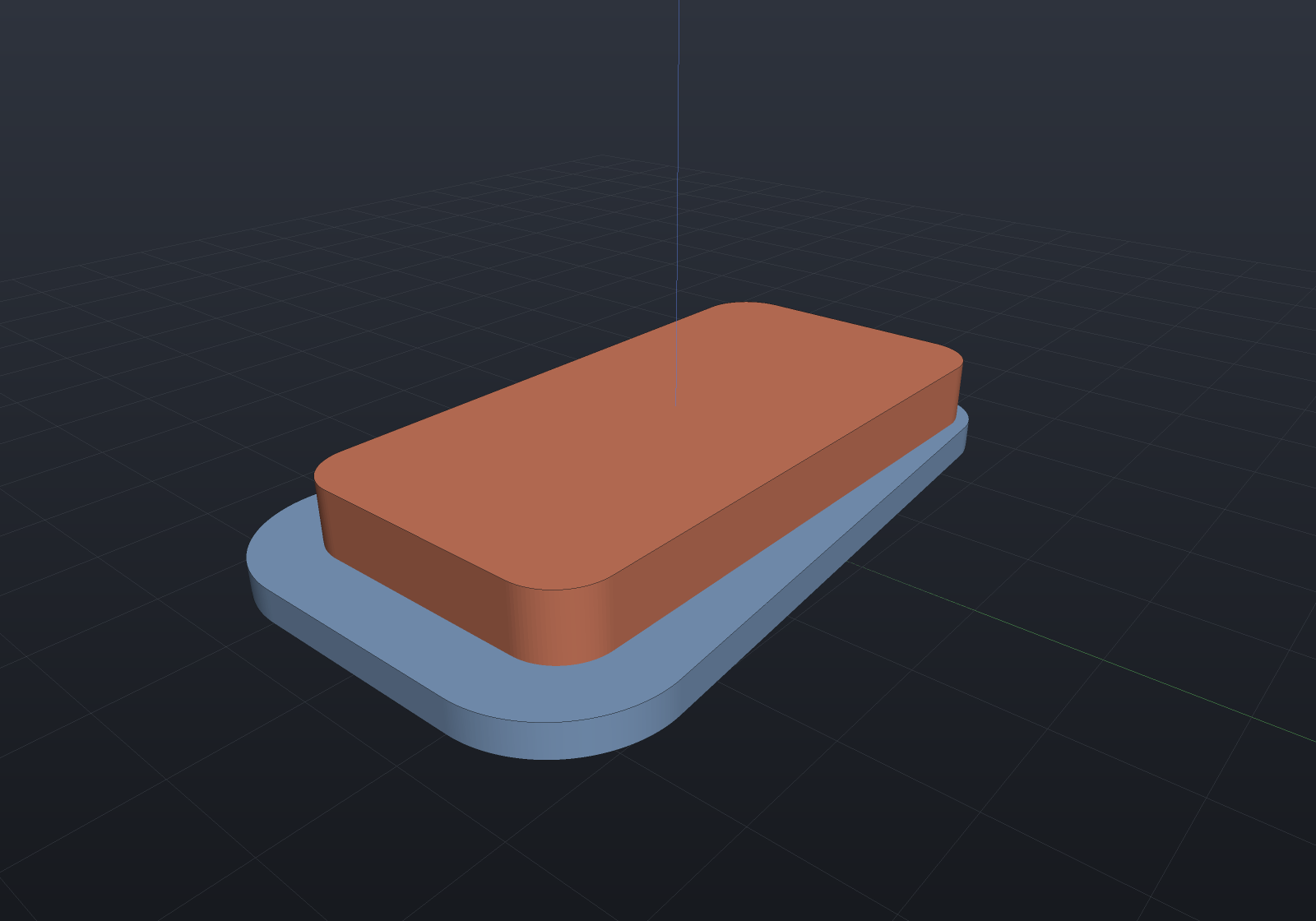
The boundary of a varying offset is not the perpendicular one. Sweeping a disc whose
radius changes along an edge leaves a region bounded by the external tangent line of
the two end circles, tilted off the normal by sin φ = Δr / L — not by the line through
the two offset endpoints, which under-covers near the smaller end by exactly the tangency
wedge. Each vertex then takes a round join of its own radius between the two adjacent
tangency feet.
Eroding by a varying distance
A negative law erodes. There is no frame and no complement: the classical erosion
B \ dilate(B \ R, d) has a frame whose distances a variable law would have to define, and
that frame cancels — the answer is the region minus the inward collar, built from the
same tangent slabs with the normal flipped.
// A wall that thins toward the right: 0.5 mm taken off the left end, 3.5 mm off the right.var plate = Sketch.RoundedRectangle(60, 30, 5);var eroded = plate.Offset(p => -(2.0 + p.X / 20.0))[0];
var (outer, holes) = Profile.FromRegion(eroded, SketchPlane.XY.Frame);var scene = new Scene();scene.Add(new Part("plate", Shape.Extrude(plate, 3), Palette.Steel));scene.Add(new Part("eroded", Shape.Extrude(outer, Vector3d.UnitZ * 9, holes), Palette.Coral));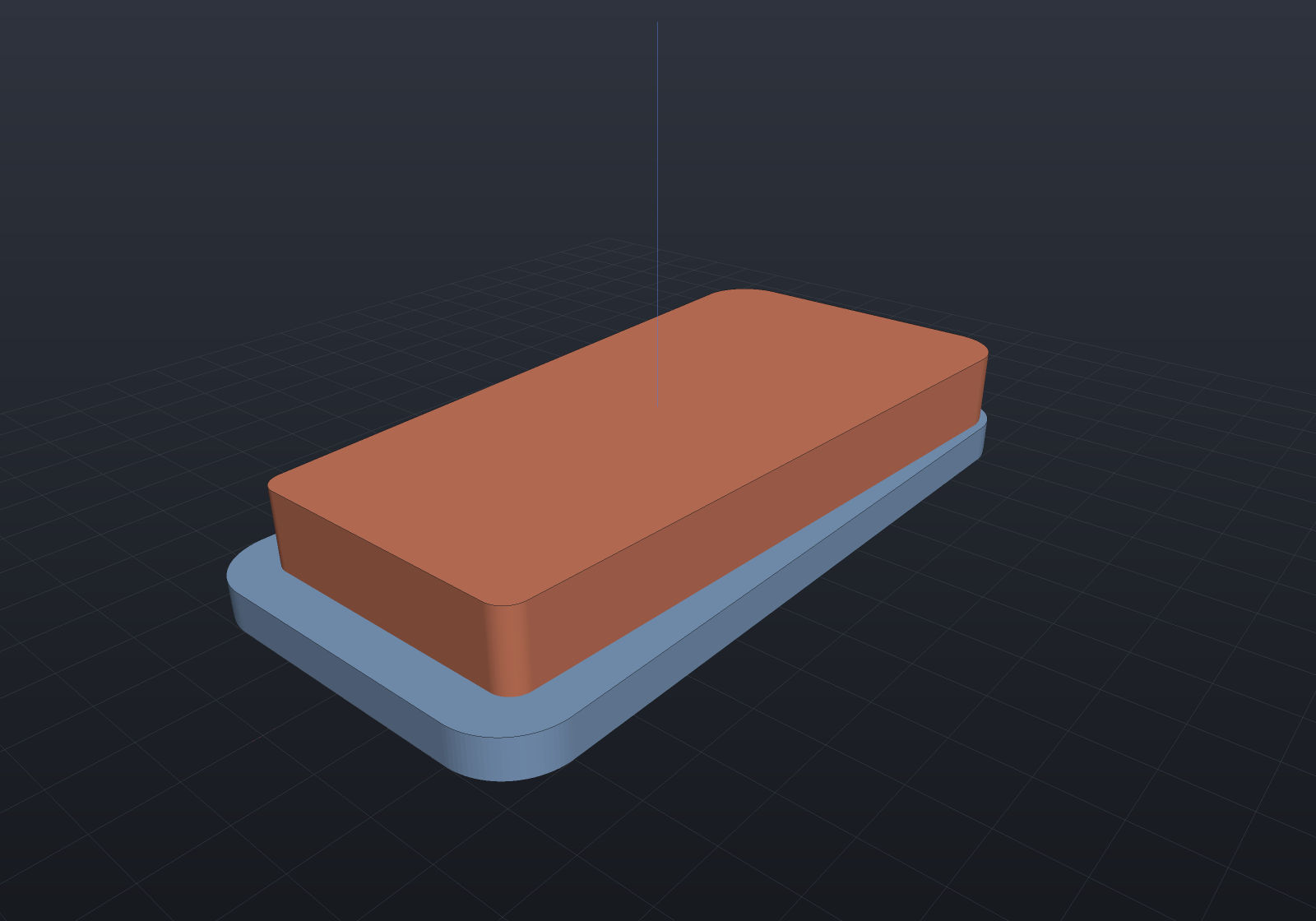
Which corners need filling swaps with the direction, and it is a derivation rather than a
sign flip: a point just outside a reflex corner has no nearest boundary point at the
vertex, which is why the outward pass fills convex corners only — and inside, a point near a
convex corner projects onto one of its two edges while a reflex corner opens a wedge of
exactly α − 180°. Since Cross(−a, −b) equals Cross(a, b) exactly, negating both
normals does not swap which corners are filled; reversing their order does.
Holes go the same way
A distance is how far the material advances into the void, on the outline and on every hole alike. So one positive law grows the outline and shrinks each bore, with no separate rule and no sign to remember:
var plate = Sketch.Rectangle(60, 40).WithHole(Sketch.Circle((0, 0), 10));
// One law. The plate grows outward and the bore closes in.var grown = plate.Offset(p => 2.0 + p.Y / 25.0)[0];
if (grown.Holes.Count != 1)    throw new Exception("expected the bore to survive as one hole");
var (outer, holes) = Profile.FromRegion(grown, SketchPlane.XY.Frame);var scene = new Scene();scene.Add(new Part("grown", Shape.Extrude(outer, Vector3d.UnitZ * 6, holes)));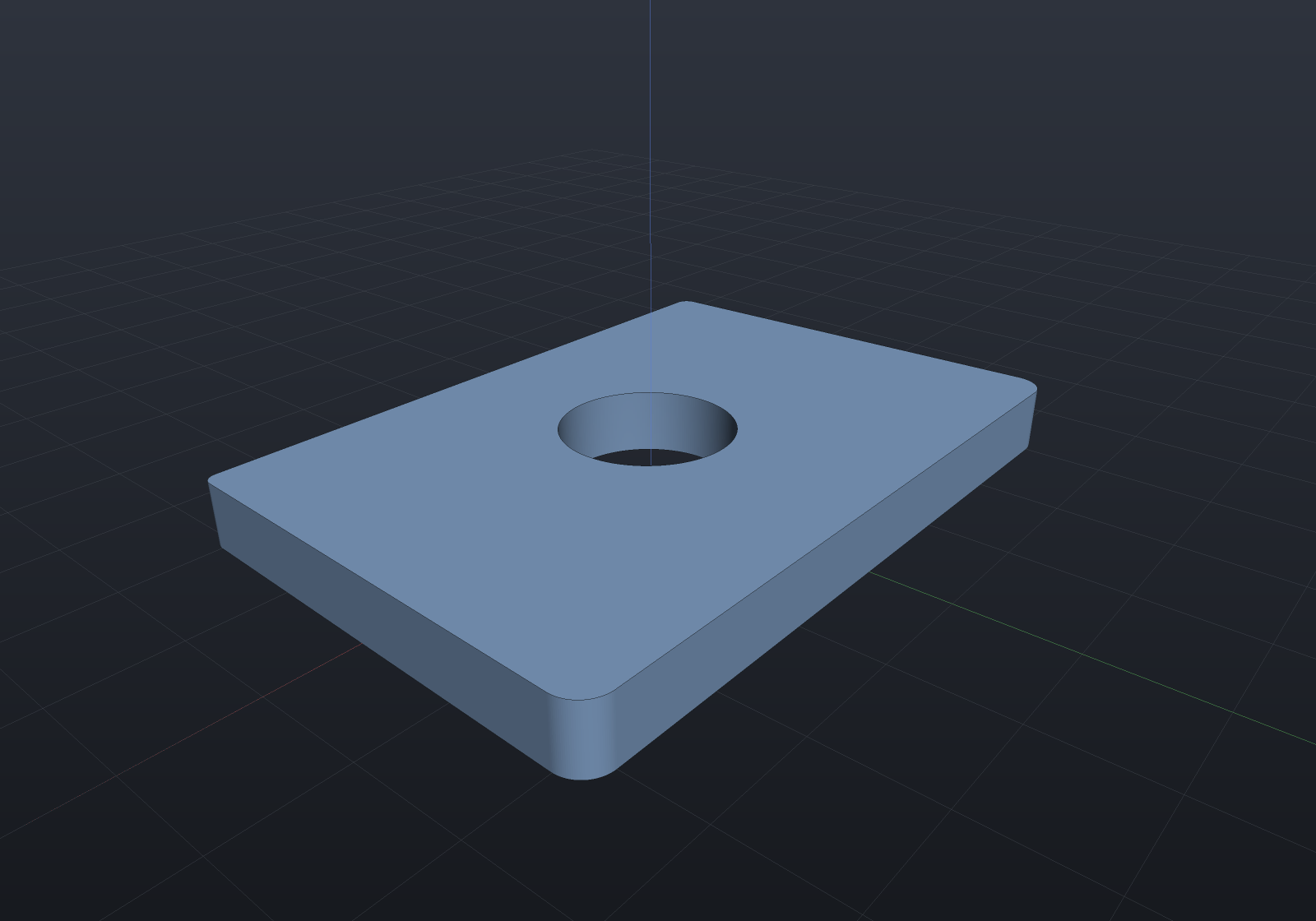
Keeping the arcs — and reporting what is fitted
OffsetExact(law) runs the same construction on the exact curved tier. Straight edges keep
exact tangent slabs and vertex joins become true circular sectors, so a polygonal outline
comes back exact — better than the flattened route, whose round joins are inscribed
chords.
An arc is the one primitive that cannot stay exact. Substituting an arc into the tangency condition gives
q(u) = C + (R + σ·r(u)·cos φ)·û(u) − sign(sweep)·r(u)·sin φ·t̂(u)which is a spiral, not an arc of any radius — so it is fitted, and the departure is reported rather than hidden:
var slot = Sketch.Slot(40, 16);
// The law varies across the caps, so their swept boundary is a spiral and is fitted.var grown = slot.OffsetExact(p => 3.0 + p.Y / 8.0, fitTolerance: 1e-4);
if (!(grown.MaxDeviation > 0 && grown.MaxDeviation <= 1e-4))    throw new Exception($"unexpected fit deviation {grown.MaxDeviation}");
var scene = new Scene();scene.Add(new Part("slot", Shape.Extrude(slot, 10), Palette.Coral));scene.Add(new Part("grown", Shape.Extrude(Sketch.FromCurvedRegion(grown.Regions[0]), 4), Palette.Steel));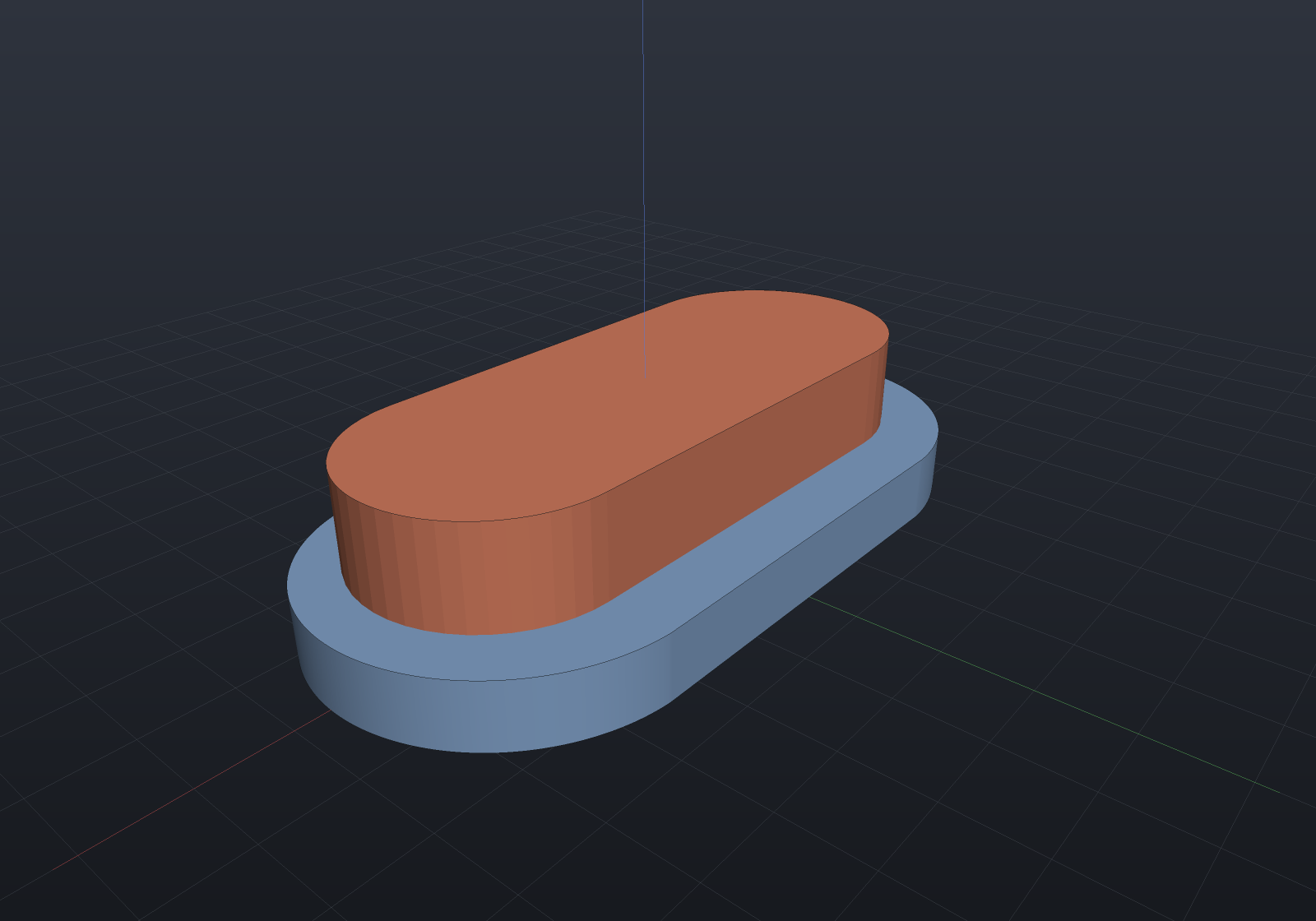
An edge whose law is locally constant takes an exact concentric branch, so a bore under
one stated distance stays exact and MaxDeviation reads exactly zero:
// Each of a slot's caps has BOTH its ends at one x, so an x-ramp gives that arc// equal distances at both ends - a locally constant law, and the exact branch.var exact = Sketch.Slot(24, 10).OffsetExact(p => 1.5 + p.X / 20.0);if (exact.MaxDeviation != 0) throw new Exception($"expected an exact answer, got {exact.MaxDeviation}");What the law is sampled at, and what that costs
The law is evaluated at the boundary’s own vertices and interpolated linearly in arc length between them. So a law that is affine in position is reproduced exactly along every straight edge — refining the sampling does not move the answer — while a curved law carries the flattening’s own sampling. The chord tolerance is the knob for both.
Refused by name
var plate = Sketch.Rectangle(30, 20);
// A law that grows in places and shrinks in others would pass through a zero-radius// disc, where the swept set is not defined.try{    plate.Offset(p => p.X);    throw new Exception("expected a refusal");}catch (ArgumentException e) when (e.Message.Contains("SIGN")){}
// An edge whose distance changes by more than its own LENGTH: the larger end's disc// swallows the whole sweep and no external tangent exists.try{    Region2dOffset.Offset(plate.ToRegions()[0], [1.0, 40.0, 1.0, 1.0]);    throw new Exception("expected a refusal");}catch (ArgumentException e) when (e.Message.Contains("swallows")){}
An arc offset inward past its own centre is refused too: the swept boundary has a cusp there rather than a spiral, and the constant offset’s pie-slice degeneration has no varying-radius counterpart.
Related
- 2D sketch booleans — the constant offset and the exact curved tier
- 2D views — sections and silhouettes, which feed the same region model
- Toolpath infill — a consumer of the stroked/offset footprint