Parametric features
A feature is a class with [Param] properties and a pure Apply body; a model is an
ordered FeatureHistory that regenerates on change — FeatureScript, but plain C#.
sealed class BasePlate : Feature{    [Param(Min = 20, Units = "mm")] public double Width { get; init; } = 48;    [Param(Min = 20, Units = "mm")] public double Depth { get; init; } = 48;    [Param(Min = 4, Units = "mm")] public double Thickness { get; init; } = 8;
    public override Shape Apply(FeatureContext c) =>        Shape.Extrude(Sketch.RoundedRectangle(Width, Depth, 6), Thickness);}
sealed class BoltCircle : Feature{    [Param(Min = 2, Max = 24)] public int Count { get; init; } = 6;    [Param(Min = 5, Units = "mm")] public double Radius { get; init; } = 16;
    public override Shape Apply(FeatureContext c)    {        var points = Enumerable.Range(0, Count)            .Select(i => 2 * Math.PI * i / Count)            .Select(a => new Vector2d(Radius * Math.Cos(a), Radius * Math.Sin(a)))            .ToList();        return c.Body!.Drill(StandardHoles.Counterbored(4), points, depth: 12, c.TopPlane);    }}
var history = new FeatureHistory();history.Add(new BasePlate());history.Add(new BoltCircle { Count = 8 });
var scene = new Scene();scene.Add(history.ToPart("bracket", Palette.Steel));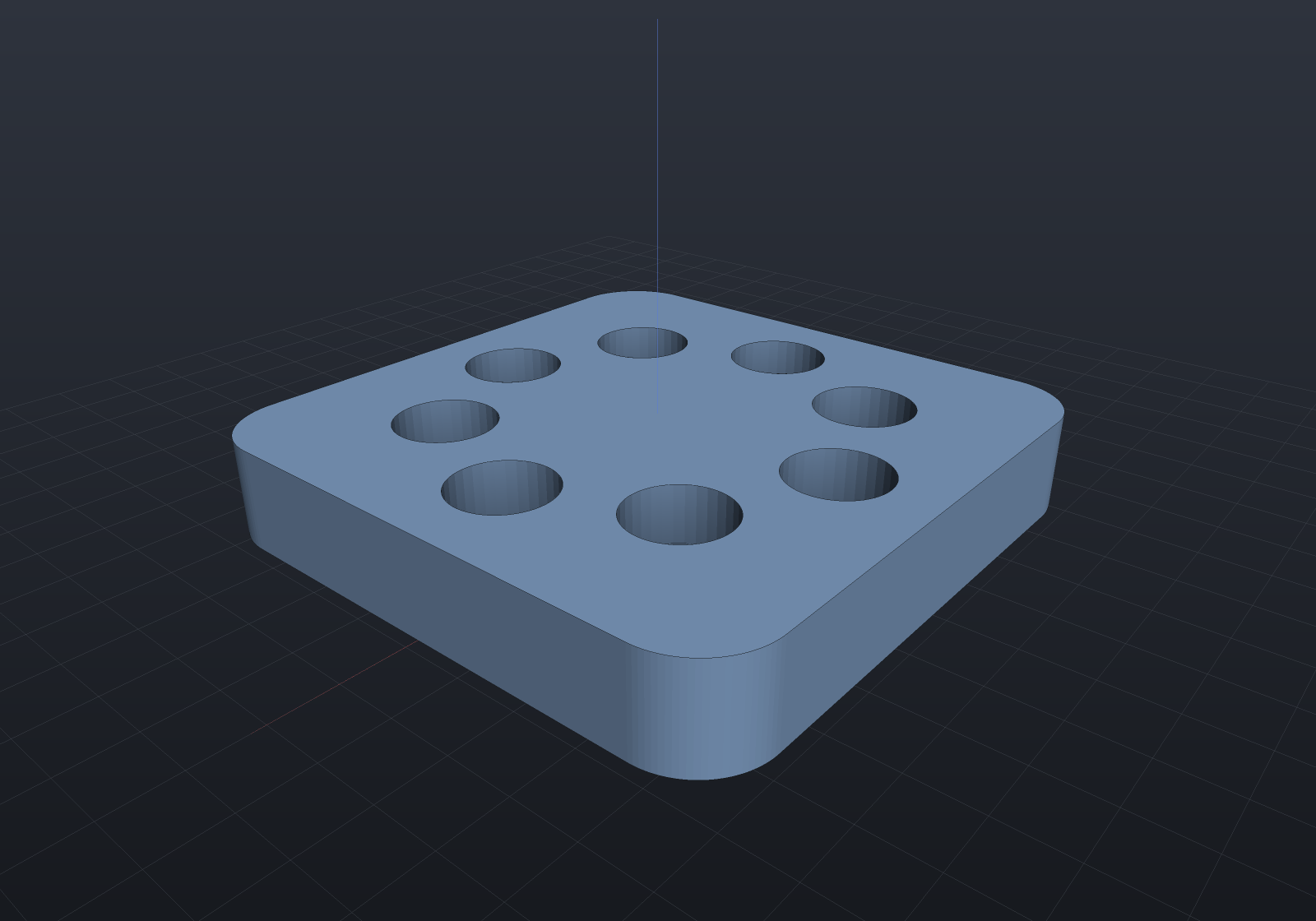
FeatureContext gives Apply the running body (c.Body), a lazily lowered B-Rep
for selector queries (c.Lowered), and the current top plane
(c.TopPlane). Features can also declare the geometry they need — a plane, a face,
an axis — as typed properties that validate up front and re-resolve every
regeneration: see geometry inputs.
Regeneration
FeatureHistory.Regenerate replays the list with prefix caching — editing
feature 5 re-runs only 5..n, keyed by instance identity + a [Param] snapshot (a
fresh instance always re-runs, which safely covers non-param inputs like sketches and
selectors). Validation runs first (Min/Max ranges); the first failure keeps the
last good prefix and skips the rest, and per-feature statuses report what happened.
Features can be suppressed (Suppressed = true), and Feature.FromFunc handles
one-off steps without a class.
Keep Apply a pure function of its parameters and context — the cache assumes it.
JSON parameters
SaveParameters / LoadParameters round-trip every [Param] value, so a design is
re-tunable without recompiling:
sealed class Plate : Feature{    [Param(Min = 10, Max = 100, Units = "mm")] public double Width { get; init; } = 40;
    public override Shape Apply(FeatureContext c) =>        Shape.Extrude(Sketch.Rectangle(Width, 20), 5);}
var history = new FeatureHistory();history.Add(new Plate());var result = history.Regenerate();if (!result.Succeeded) throw new Exception(result.ToString());
var json = history.SaveParameters();          // {"Plate":{"Width":40}} (shape may evolve)Console.WriteLine(json);
var warnings = history.LoadParameters(json);  // re-applies values; reports unknown keysif (warnings.Count != 0) throw new Exception(string.Join("; ", warnings));if (!history.Regenerate().Succeeded) throw new Exception("regeneration after load failed");
Standard features (ExtrudeSketchFeature, RevolveSketchFeature, HoleFeature,
FilletRimFeature, ChamferRimFeature, BooleanFeature, linear/circular pattern
features) cover simple histories out of the box. Their geometry inputs — the drilling
plane, the rim faces, the pattern axis — are typed
references that round-trip through the same JSON.
Optional parameters
A parameter that means “not stated — inherit it from somewhere else” is spelt with the
nullable type. null is a value JSON already has, so it round-trips; the regeneration
cache key renders it "null", so clearing one re-runs the feature; and a
[Param(Min=, Max=)] range does not fire on it, because a value that is not there
cannot be out of range.
sealed class Spacer : Feature{    [Param(Min = 1, Units = "mm")] public double Height { get; init; } = 10;
    // null = "take the standard bore", not a magic 0.    [Param(Min = 0.1, Units = "mm", Description = "Bore radius override; empty inherits")]    public double? BoreRadius { get; init; }
    public override Shape Apply(FeatureContext c) =>        Shape.Cylinder(8, Height)        - Shape.Cylinder(BoreRadius ?? 3, Height * 2).Translate(0, 0, -Height / 2);}
var history = new FeatureHistory();history.Add(new Spacer { BoreRadius = 2.5 });if (!history.Regenerate().Succeeded) throw new Exception("regeneration failed");
string saved = history.SaveParameters();                   // {"Spacer":{...,"BoreRadius":2.5}}history.LoadParameters("""{ "Spacer": { "BoreRadius": null } }""");if (((Spacer)history.Features[0]).BoreRadius is not null) throw new Exception("not cleared");if (!history.Regenerate().Succeeded) throw new Exception("null failed the Min = 0.1 range");
history.LoadParameters(saved);                             // and back againif (((Spacer)history.Features[0]).BoreRadius != 2.5) throw new Exception("value lost");
Which spelling to reach for is decided by the editor, not by taste. The properties
panel offers a slider exactly when [Param(Min=, Max=)] is finite at both ends, and a
slider is a total function onto its range with no way to say “unset” — so a parameter
behind one can be moved off “inherit” and never back. The rule: a parameter whose editor
can express absence (a text box: empty shows it, null sets it) takes the nullable type;
one whose editor cannot keeps a sentinel outside its own legal range.
EdgeFlangeFeature applies both halves — Width and BendRadius are double?, while
KFactor keeps a sentinel 0 (which a K-factor may never be) because its range is
finite and its slider’s minimum is 0.
The feature registry and whole-history JSON
SaveParameters re-tunes an existing history; SaveHistory / LoadHistory rebuild
the history itself — ordered records of type, name, suppression, constructor inputs
and [Param] values. The construction side is FeatureRegistry: it lists every known
feature type with its parameter metadata (the UI-insertion catalogue) and says honestly
which are data-constructible — [Param]-only features (fillets, chamfers,
patterns) construct directly, and holes and sketch extrude/revolves reconstruct from
their saved inputs (sketches serialize through the exact public Curve2d vocabulary,
so lines, circular and elliptical arcs and Béziers round-trip with nothing flattened —
a coverage the test suite enumerates from the segment types, because the writer’s
default case throws and Document.Save does not catch it).
var plate = Sketch.RoundedRectangle(40, 30, 5);var history = new FeatureHistory();history.Add(new ExtrudeSketchFeature(plate) { Height = 8, Name = "Plate" });history.Add(new HoleFeature(StandardHoles.Counterbored(5), [new(-12, 0), new(12, 0)])    { Depth = 9, Name = "Bolt holes" });history.Add(new ChamferRimFeature { Setback = 0.5 });
string json = history.SaveHistory();var loaded = FeatureHistory.LoadHistory(json);      // FeatureRegistry.Defaultif (!loaded.Complete) throw new Exception(string.Join("; ", loaded.Warnings));
// The loaded model IS the model — same regeneration, same geometry...double a = history.Regenerate().Body!.ToMesh().Volume();double b = loaded.History.Regenerate().Body!.ToMesh().Volume();if (a != b) throw new Exception("round-trip changed the geometry");// ...and the file is a fixed point: save -> load -> save is byte-identical.if (loaded.History.SaveHistory() != json) throw new Exception("unstable serialized form");
A placed standard component is data too: ComponentFeature writes its
catalogue item as a kind plus the factory arguments that built it, never as its
Designation — “ISO 4762 M6×20” says nothing about the clearance fit, the seating or
whether the socket is modelled, and a lossy key is how a reload comes back as a
plausible different screw. So a host prepared by placed fasteners reopens parametric
and its bores move when the plate does.
Your own [Param]-only feature classes join with
registry.Register<MyFeature>() (or Register(type, factory) plus a
Feature.SaveInputs override for constructor inputs). What cannot round-trip, and
why: BooleanFeature (an arbitrary Shape graph has no serialized form),
VariableChamferRimFeature (its setback law is code), a ComponentFeature holding a
component outside the built-in catalogue (your own HardwareComponent subclass — it is
refused at save time rather than written as something a load rebuilds wrong), and
Feature.FromFunc lambdas. SaveHistory
still writes them — type, name, parameters — and LoadHistory either skips them
with a warning naming each, or hands the record to your resolveOpaque hook to supply
the instance. One place that still bites: ComponentAssembly(name, shape) seeds its
history with a lambda over an arbitrary Shape, so a host built that way keeps one
opaque record — the BooleanFeature limitation showing through, not a component one.