Extrude, revolve, sweep
The three sketch-consuming operations turn 2D profiles into solids. All are native in every representation (see the support matrix).
Extrude
Shape.Extrude(sketch, height, plane?) extrudes along the plane normal (default:
world XY, so height is +Z):
var bracket = Sketch.Start(0, 0)    .LineTo(40, 0).LineTo(40, 12).LineTo(12, 12).LineTo(12, 36).LineTo(0, 36)    .Close();
var scene = new Scene();scene.Add(new Part("L-bracket", Shape.Extrude(bracket, 16), Palette.Copper));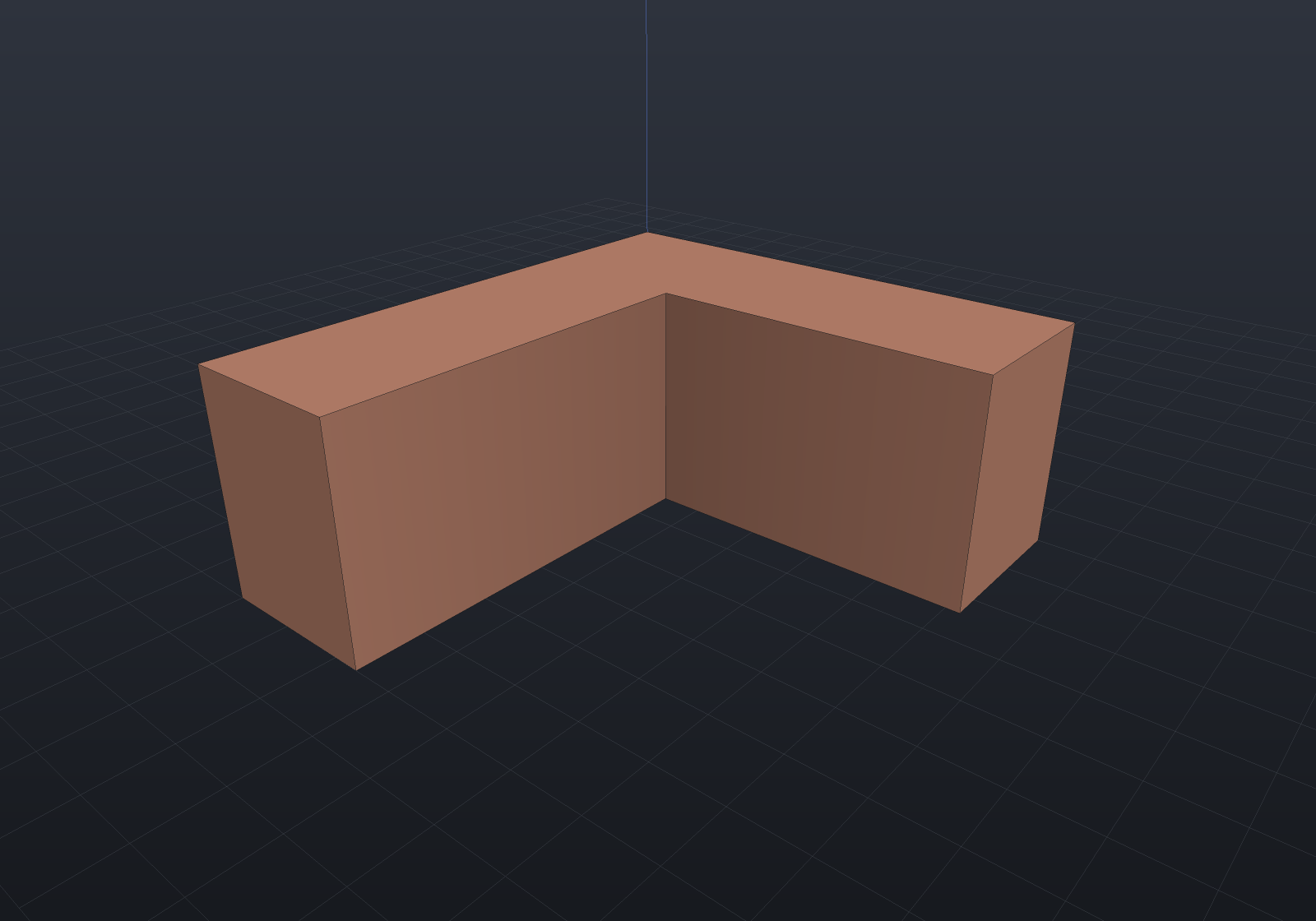
Twist and taper
Shape.Extrude(sketch, height, twist, scale, plane?, slices?) is OpenSCAD’s
linear_extrude(twist, scale, slices): the cross-section at height fraction t is
the sketch scaled by lerp(1, scale, t) (per axis, about the plane origin) and
rotated by twist·t about the plane normal — radians, counter-clockwise (OpenSCAD’s
twist is the opposite sign). A call with zero twist and unit scale is exactly the
plain extrusion:
var star = Sketch.Polygon(Enumerable.Range(0, 10)    .Select(i =>    {        double a = Math.PI / 2 + i * Math.PI / 5;        double r = i % 2 == 0 ? 14.0 : 6.5;        return new Vector2d(r * Math.Cos(a), r * Math.Sin(a));    }).ToList());
var scene = new Scene();scene.Add(new Part("twisted star", Shape.Extrude(star, 40, twist: Math.PI / 2), Palette.Brass));scene.Add(new Part("tapered boss",    Shape.Extrude(Sketch.Rectangle(24, 24), 30, twist: 0, scale: 0.4).Translate(40, 0, 0),    Palette.Steel));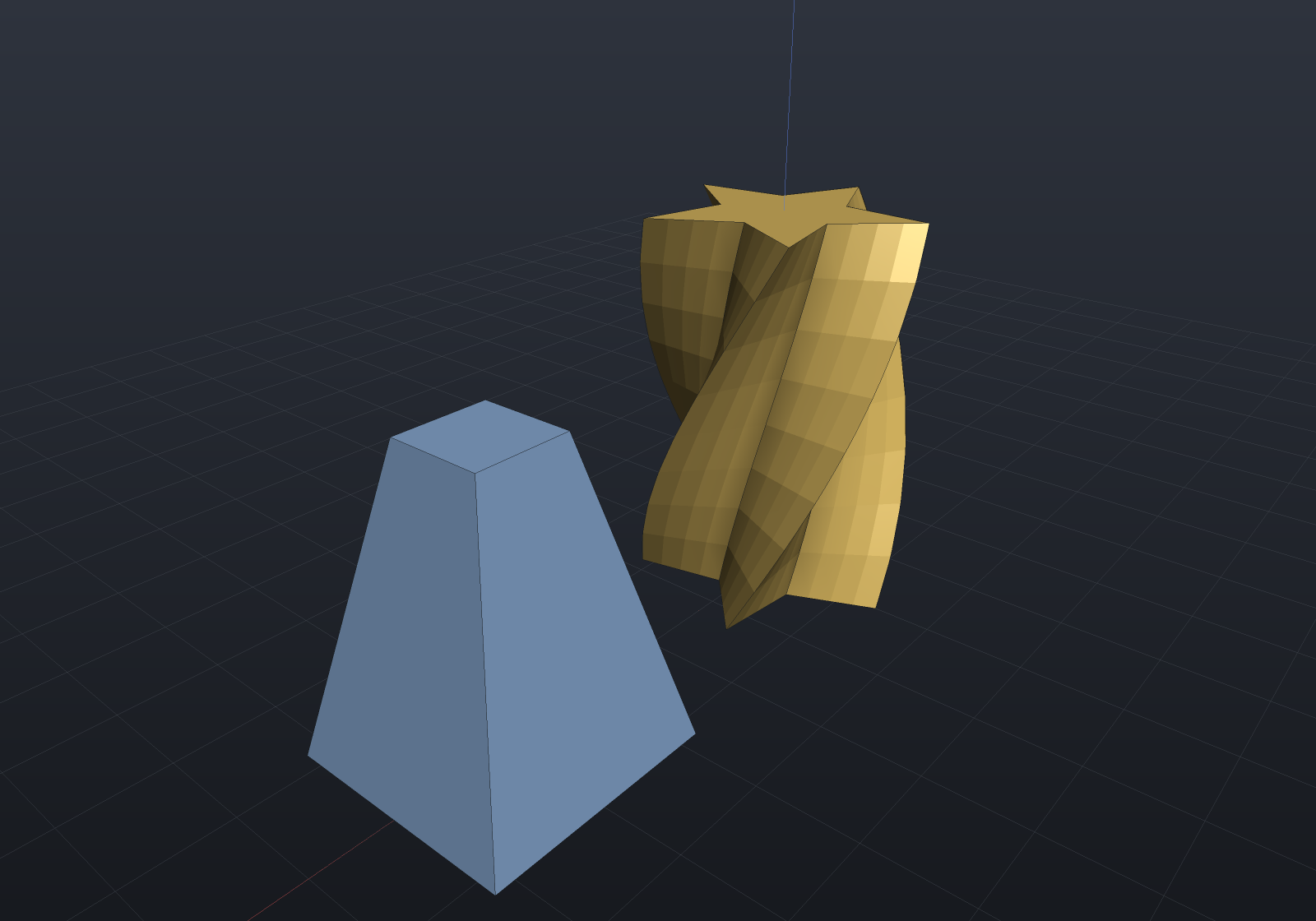
Both cases are B-Rep-Native, and each for its own reason:
- A pure taper (
twist: 0) is a ruled loft — every straight side sweeps an exact plane through the scaling centre, so the solid is the skin between the base section and the scaled top, holes included. - A twist has an exact analytic side surface too.
TwistedSurfaceisP(u, v) = R_z(theta*v) . diag(lerp(1, sx, v), lerp(1, sy, v)) . C(u) + h*v*zhat: one surface per profile segment, with both partials in closed form, so the twisted body carries the same guarantees every other exact solid does —Validate()passes, it survives booleans, it archives losslessly, and its volume converges quadratically.
slices sizes the direct section sweep, which is now reached only where the B-Rep
cannot lower — ToMesh takes the highest-fidelity route available, so a twisted body
tessellates its exact solid and a 2-slice call and a 64-slice one produce the same
mesh. Explain(target) reports each case.
The volume is the identity that says the surface is right. Every section of a twisted
prism is the base section rotated, and a rotation preserves area — so a pure twist
encloses exactly the untwisted volume A*h, whatever the twist angle. A linear
taper multiplies it by the prismatoid factor (1 + s + s^2)/3, and a per-axis taper by
(2 + sx + sy + 2*sx*sy)/6, which reduces to the frustum factor at sx == sy. Measured
on a 20x20 square twisted a quarter turn over 40 (win-x64, 128 segments per circle):
16000.000584 against 16000 for the pure twist, and 3.8e-8 to 5.4e-8 relative for the
tapered cases — the grade of reading a volume off the tessellation, not of the geometry.
A twisted profile with holes
A hole twists about the same axis as the outline, so its inner skin is one more twisted surface per hole segment and nothing about the construction changes:
var plate = Sketch.Rectangle(30, 30)    .WithHole(Sketch.Circle(new Vector2d(8, 8), 6))    .WithHole(Sketch.Circle(new Vector2d(-8, -8), 6));
var scene = new Scene();scene.Add(new Part("twisted plate", Shape.Extrude(plate, 45, twist: Math.PI / 3), Palette.Brass));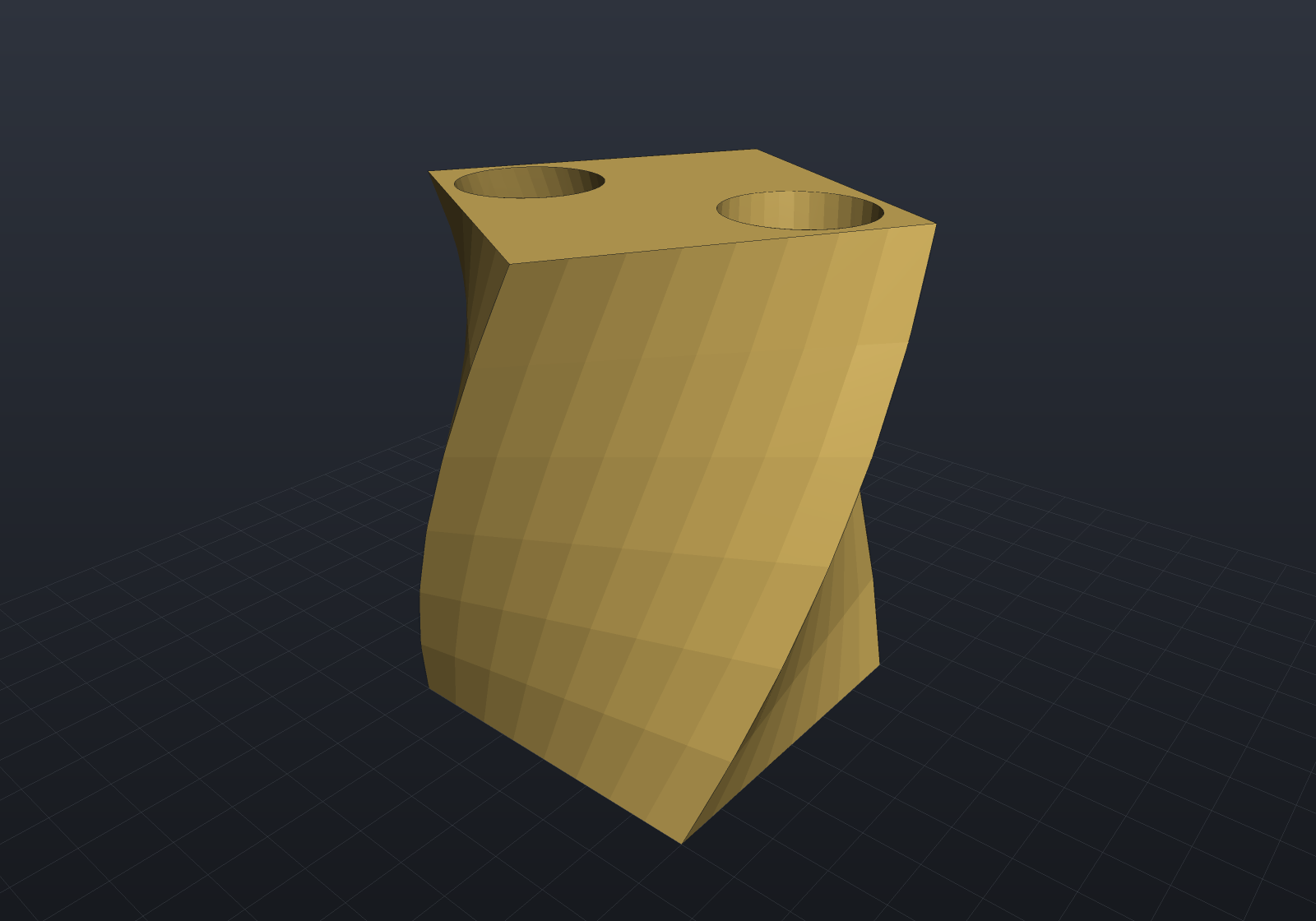
Twist and taper together
The two compose — the section at height fraction t is scaled per axis and rotated,
so an anisotropic taper is an ordinary case rather than a third parameter:
var scene = new Scene();scene.Add(new Part("square to slot", Shape.Extrude(Sketch.Rectangle(26, 26), 50, twist: Math.PI / 2, scale: (0.4, 1.1)), Palette.Steel));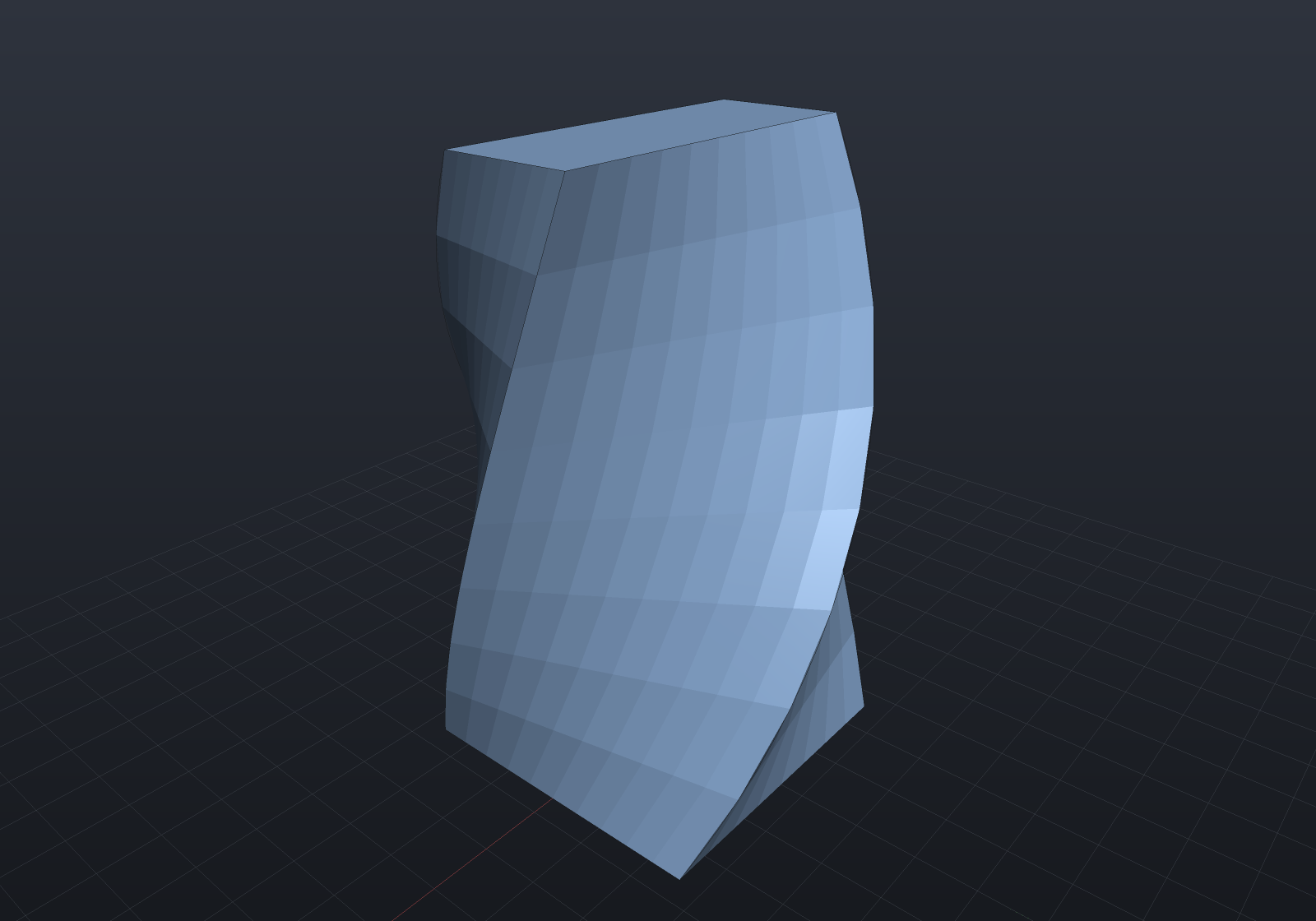
What being exact buys: booleans on a twisted body
This is the figure the mesh route could not produce. A cross-hole through a twisted,
tapered column is an ordinary exact B-Rep boolean — the tool’s cylinder meets each
twisted band transversally, the bore rim is a real edge, and the result passes
Validate():
var column = Shape.Extrude(Sketch.Rectangle(24, 24), 60, twist: Math.PI / 2, scale: 0.7);var bore = Shape.Cylinder(5, 60).Rotate(Vector3d.UnitX, 90).Translate(0, 0, 30);
var scene = new Scene();scene.Add(new Part("bored column", column - bore, Palette.Copper));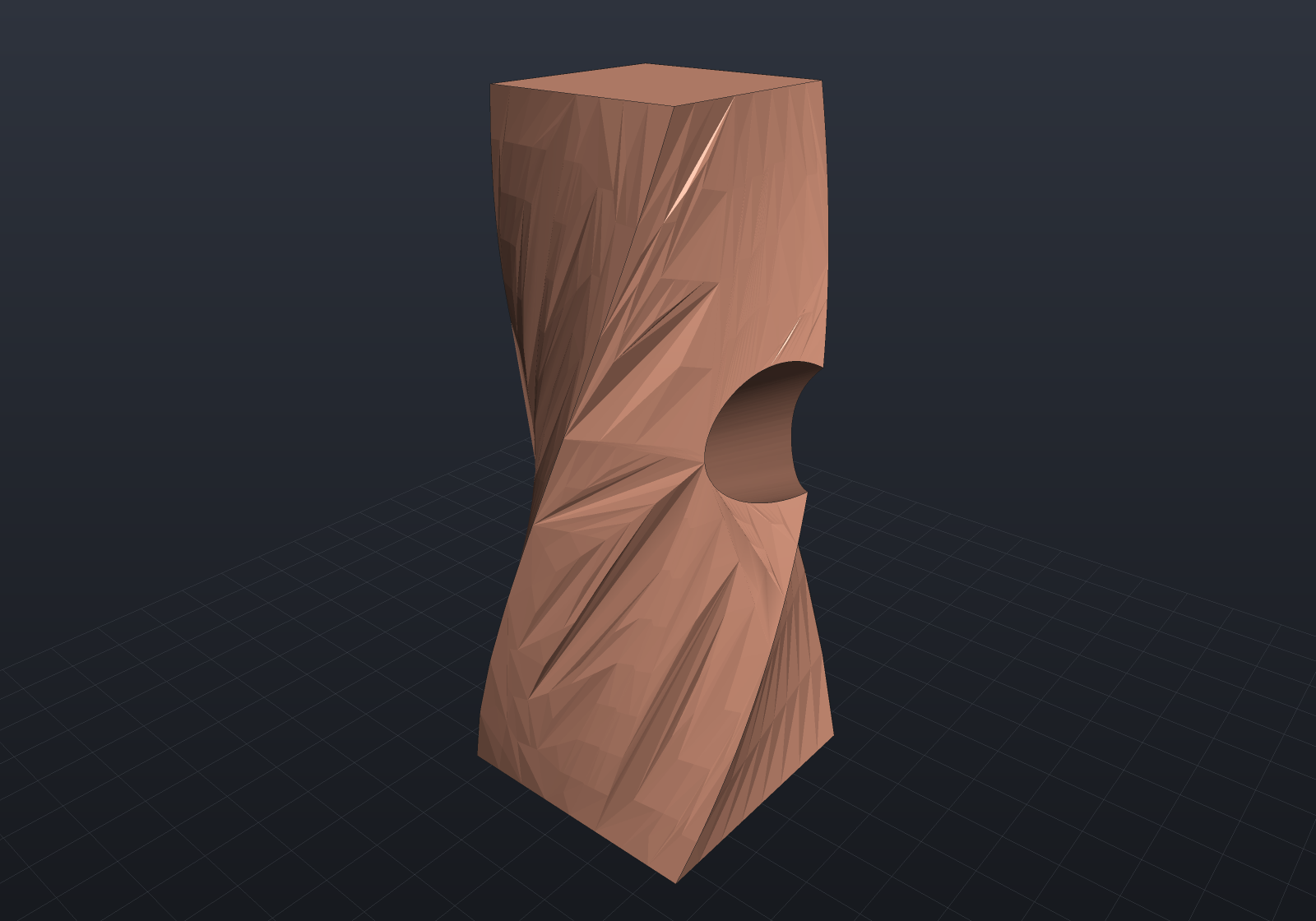
Refused by name rather than approximated: a STEP export of a twisted body (the
format has no entity for the surface — the swept bucket, alongside helical threads and
lofts; BrepArchive round-trips it losslessly instead), and a sheared or
non-uniformly scaled placement (it would change the section family, so it is not a
re-placement at all). Rim features refuse on a twisted side face for the reason they
always do — a straight rim edge needs planar neighbours.
Extrude and cut until a face
ExtrudeUntil (boss) and CutUntil (pocket) stop against the body instead of at a
typed depth — build123d/CadQuery’s until=NEXT/LAST. Until.Next stops at the first
surface met (a boss lands on the body; a cut punches through the first wall and stops
in the void behind it); Until.Last continues to the far boundary (flush boss;
through-all cut with the standard overshoot). Both extrude from the sketch plane
along −normal, the Drill convention:
// A base plate with a shelf floating above it (one body, a void between).var body = Shape.Extrude(Sketch.Rectangle(60, 40), 6)         | (Shape.Extrude(Sketch.Rectangle(60, 40), 4).Translate(0, 0, 18)            | Shape.Box(4, 32, 16).Translate(-24, 0, 12));
var above = SketchPlane.At((0, 0, 30), Vector3d.UnitX, Vector3d.UnitY);
// A post that grows DOWN from z=30 until it lands on the shelf (Until.Next)...var withPost = body.ExtrudeUntil(Sketch.Circle(new Vector2d(18, 0), 4), above, Until.Next);// ...and a slot cut down through the shelf that stops in the void (Until.Next),// leaving the base plate untouched.var slotPlane = SketchPlane.At((-10, 0, 30), Vector3d.UnitX, Vector3d.UnitY);var finished = withPost.CutUntil(Sketch.Slot(16, 6), slotPlane, Until.Next);
var scene = new Scene();scene.Add(new Part("until-features", finished, Palette.Steel));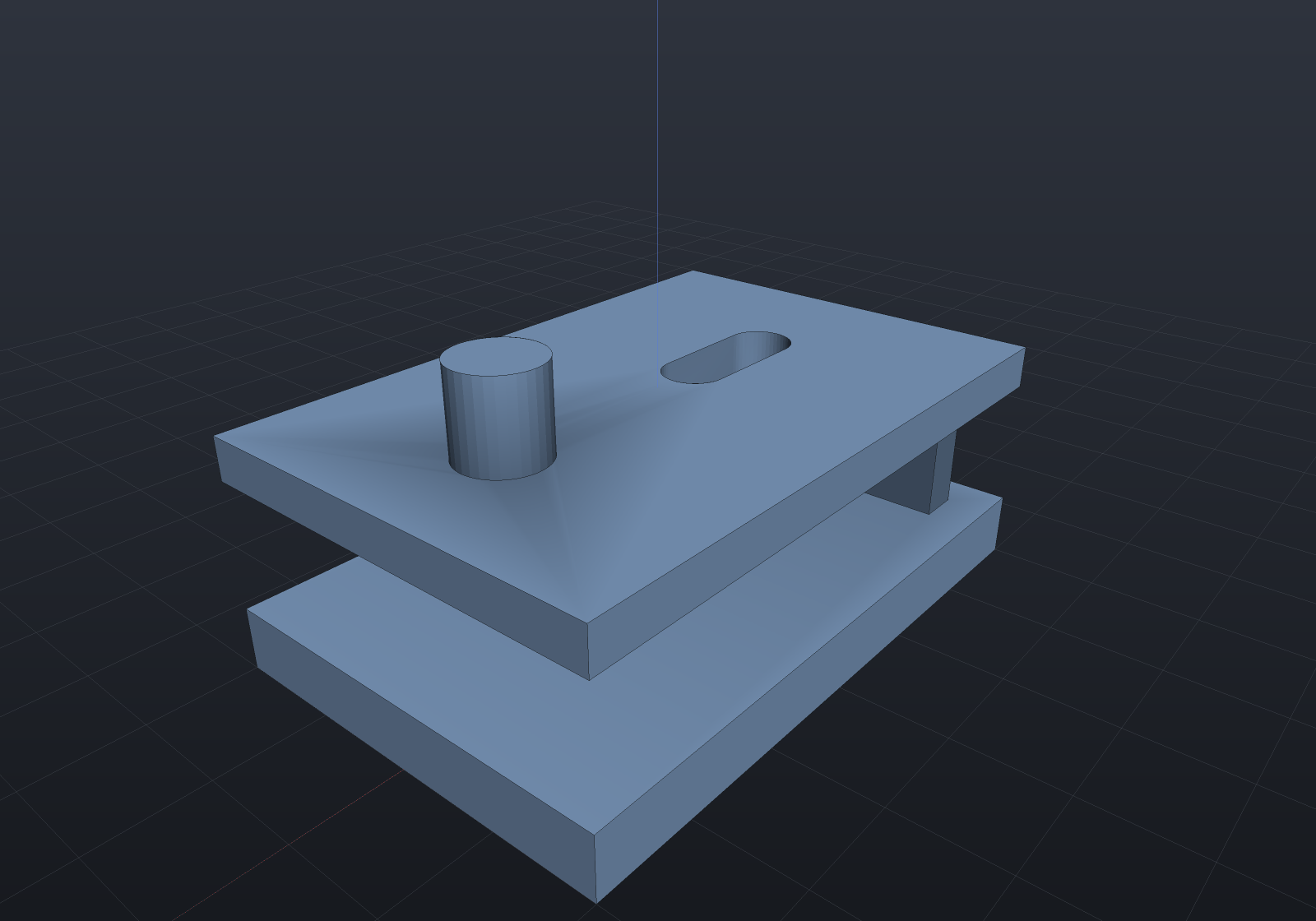
The stop is found by probe rays from the profile’s interior against the body’s mesh,
and it must be one plane perpendicular to the extrusion — a flat extrusion cannot
honestly conform to a curved or slanted stop, so anything ambiguous refuses loudly
naming the candidates: hit-distance clusters with their ray counts for a curved stop,
the number of rays that missed for an overhanging profile, the probe point that saw a
tangent graze. Resolution is eager (measured at the call, like Resized) — wrap
the call in a Feature to re-measure per regeneration. Overshoots follow the Drill
lessons so booleans never see coplanar faces: a Next boss reaches slightly into
the body, a Next cut slightly into the void behind the wall, a Last cut through
the far face; only a Last boss ends exactly flush (its union is a coplanar boolean
where material adjoins — the B-Rep lowering may refuse it, mesh/implicit handle it).
Revolve
Shape.Revolve(sketch, angle?, plane?) spins the sketch about its plane’s y axis;
sketch x is the radial direction (must be ≥ 0). The default plane (XZ) puts the axis
on world Z. Sketches may touch the axis on full turns — on-axis stretches revolve
to nothing and their endpoints become poles, which is how vases, domes, and spheres
close up in all three representations:
var vaseProfile = Sketch.Start(0, 0)    .LineTo(10, 0)                                    // base disc (touches the axis)    .BezierTo(new(17, 9), new(3.5, 17), new(9, 26))   // curved wall    .LineTo(0, 26)                                    // rim back to the axis    .Close();
var scene = new Scene();scene.Add(new Part("vase", Shape.Revolve(vaseProfile), Palette.Teal));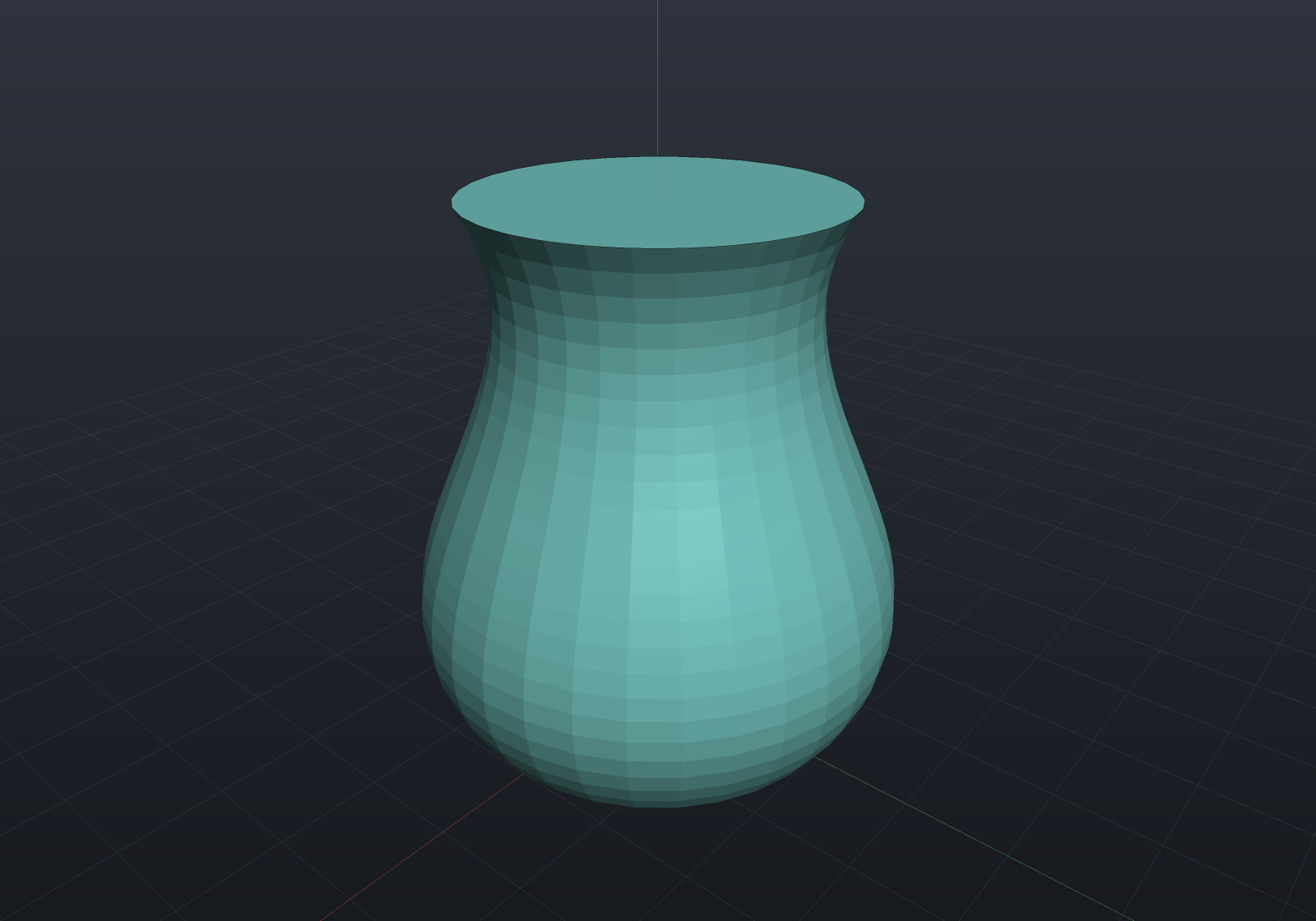
Partial revolves (angle < 2π) need axis clearance and are rejected at construction
when the sketch touches the axis:
var section = Sketch.Start(8, 0)    .LineTo(20, 0).LineTo(20, 6).LineTo(14, 9).LineTo(14, 14).LineTo(20, 17)    .LineTo(20, 23).LineTo(8, 23)    .Close();
var scene = new Scene();scene.Add(new Part("pulley section", Shape.Revolve(section, angle: 1.5 * Math.PI),    Palette.Steel));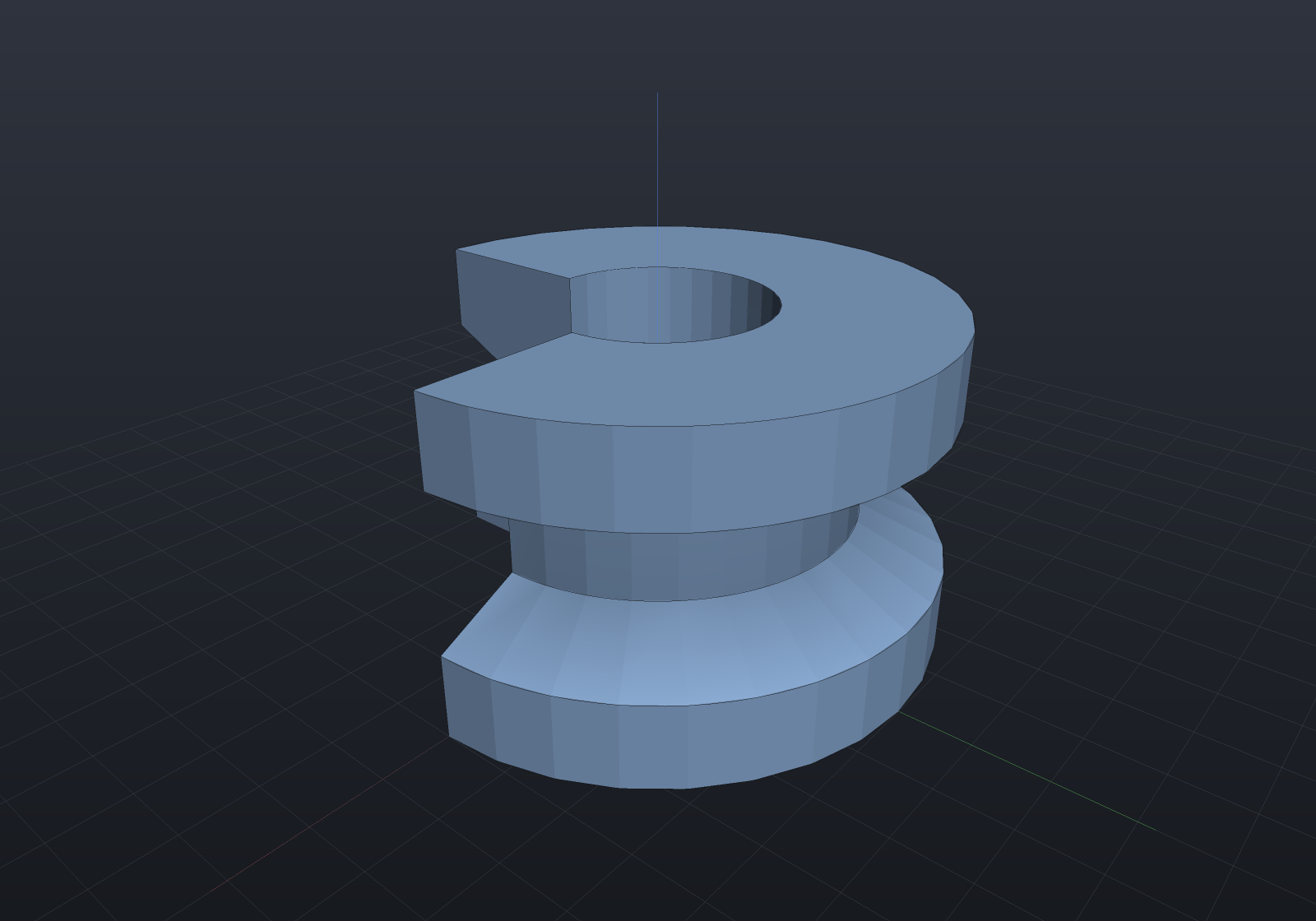
Sweep
Shape.Sweep(sketch, path, plane?) sweeps the profile along a 3D curve using
rotation-minimizing frames. The sketch plane must sit at the path start,
perpendicular to its tangent:
// A quadratic NURBS path rising along +Z then bending toward +Y;// it starts at the origin with tangent +Z, matching the default XY sketch plane.var path = new NurbsCurve(2,    [(0, 0, 0), (0, 0, 26), (0, 22, 44)], null,    [0, 0, 0, 1, 1, 1]);
var scene = new Scene();scene.Add(new Part("swept tube", Shape.Sweep(Sketch.Circle(5), path), Palette.Sage));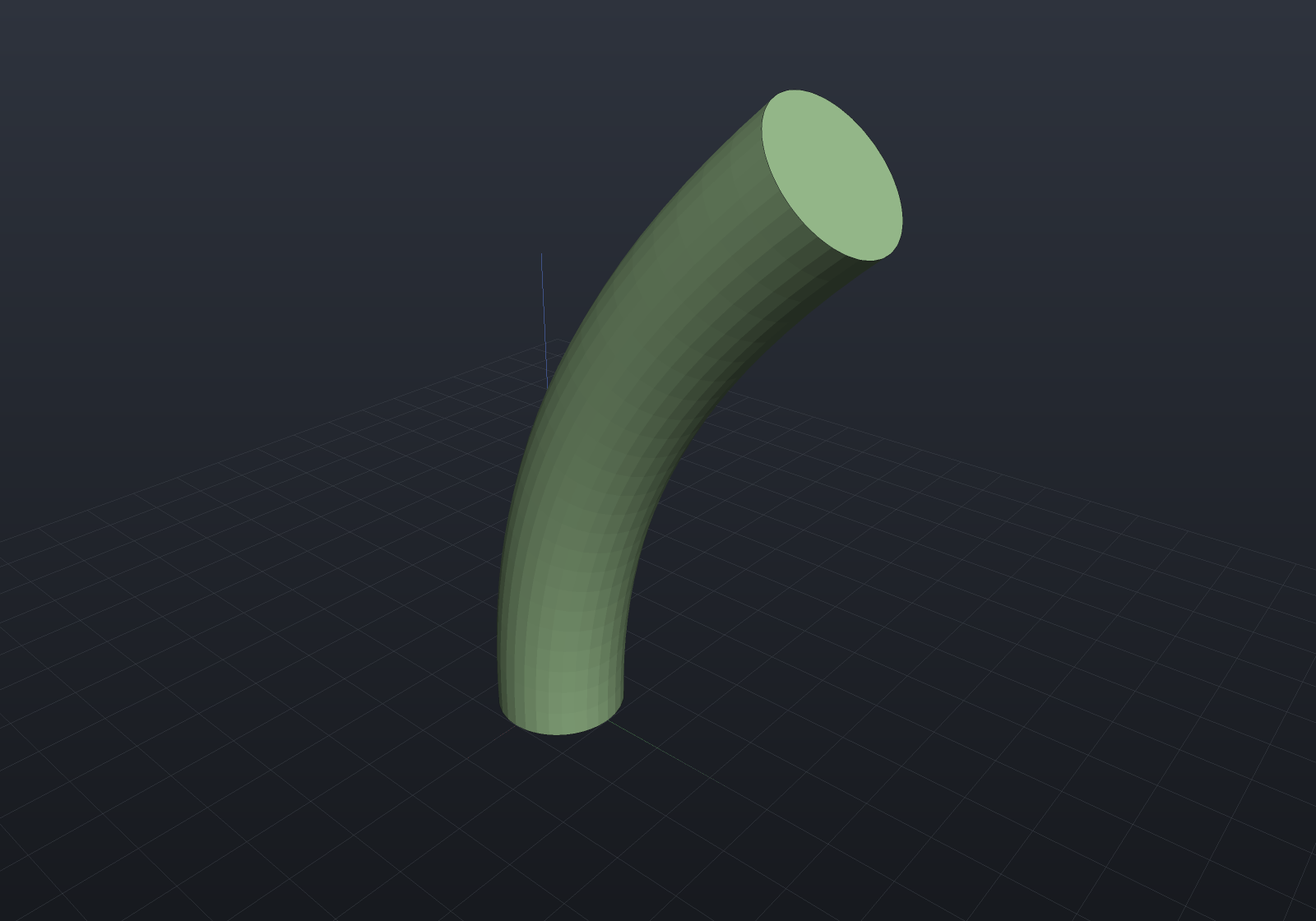
Profile-based overloads (Shape.Extrude(Profile, direction, holes?),
Shape.Revolve(Profile, axisOrigin, axisDirection, angle?, holes?),
Shape.Sweep(Profile, path, holes?)) expose the lower-level B-Rep factory directly —
including sheared extrusions and pipe elbows from closed profiles.