Roofs (straight skeleton)
Shape.Roof raises a polygonal footprint into a solid by sweeping every base edge
inward at one pitch — OpenSCAD’s roof(). The surface it produces is the
straight skeleton: the trace of the footprint’s own corners as the wavefront
shrinks, which is what a hip roof’s ridges and valleys are.
It is an exact operation rather than a polygonal approximation. Every face is a
single inclined plane, every ridge and valley is a straight line, and every apex is a
plane intersection — the same closed-form arithmetic Draft and Shell already do —
so a roof is B-Rep-Native, its mesh comes from that exact B-Rep, and its implicit
form is bridged through it.
A hip roof
The textbook case: a rectangle. Two triangular ends and two trapezoids meeting at a
ridge, and every number in it is a closed form — the ridge is exactly
length − width long and sits at width/2 · tan(pitch).
var footprint = Sketch.Rectangle(60, 24);var roof = Shape.Roof(footprint, pitchDegrees: 35);
var facts = Shape.RoofFacts(footprint, RoofPitch.FromAngle(35));if (Math.Abs(facts.Height - 12 * Math.Tan(35 * Math.PI / 180)) > 1e-9)    throw new Exception("a hip roof's apex is half the width risen at the pitch");
var scene = new Scene();scene.Add(new Part("roof", roof) { Color = new PartColor(0.70f, 0.36f, 0.26f) });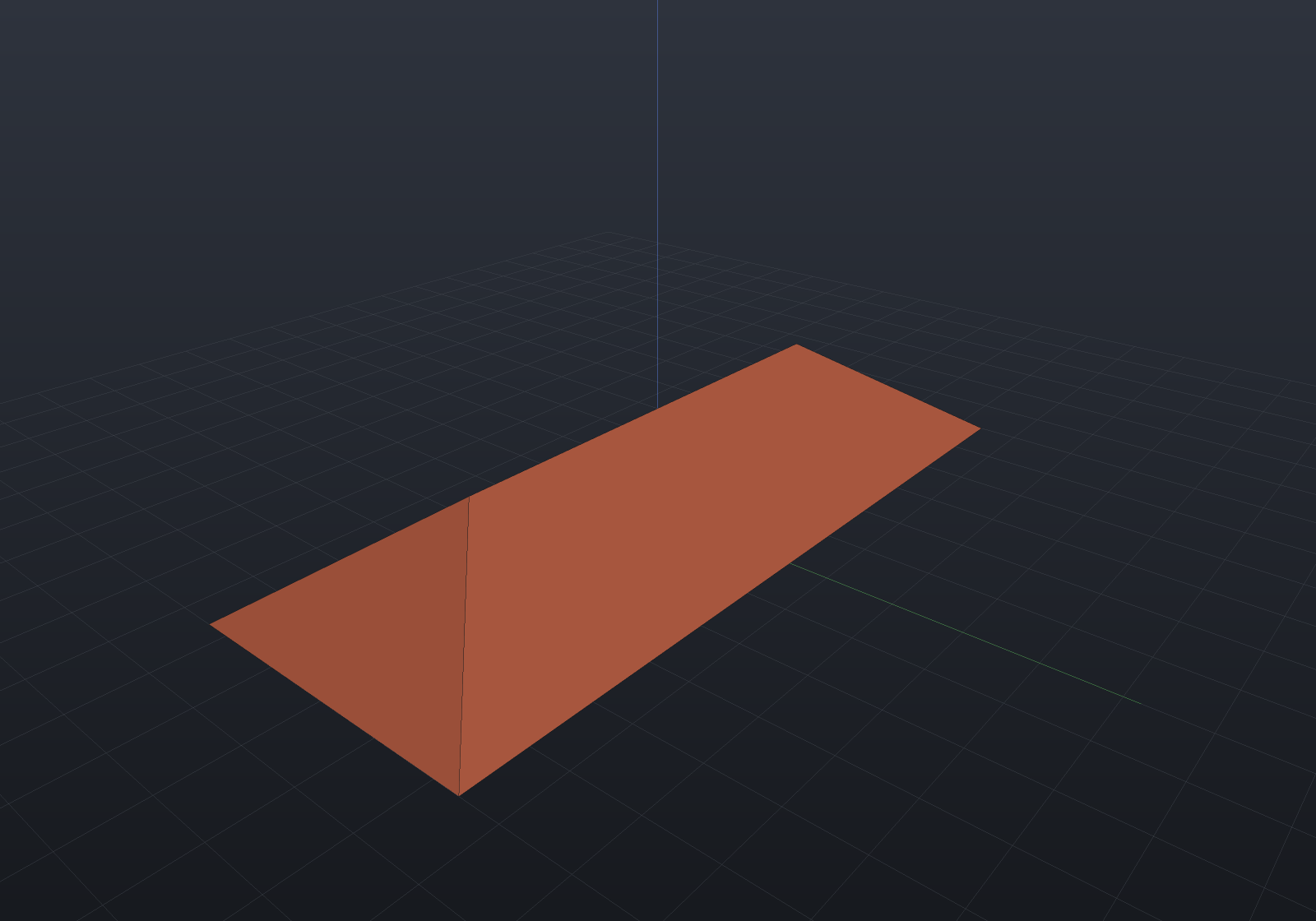
The volume has a closed form too, tan(pitch) · (L·W²/4 − W³/12), which is what the
tests assert rather than a picture. A square collapses that ridge to a point and
the roof is a pyramid of exactly area · height / 3.
Pitch or height — one number, two spellings
RoofPitch states the steepness either way. The two are related by the footprint’s
own skeleton (height = tan(pitch) · maxOffset), so the type stores the one you gave
and derives the other; they cannot contradict each other.
var footprint = Sketch.Polygon([    new Vector2d(0, 0), new Vector2d(40, 0), new Vector2d(40, 26),    new Vector2d(0, 26),]);
var scene = new Scene();double x = 0;foreach (var pitch in new[] { RoofPitch.FromAngle(20), RoofPitch.FromAngle(45), RoofPitch.FromHeight(20) }){    var facts = Shape.RoofFacts(footprint, pitch);    scene.Add(new Part($"{facts.PitchDegrees:F0} deg", Shape.Roof(footprint, pitch).Translate(x, 0, 0)));    x += 50;}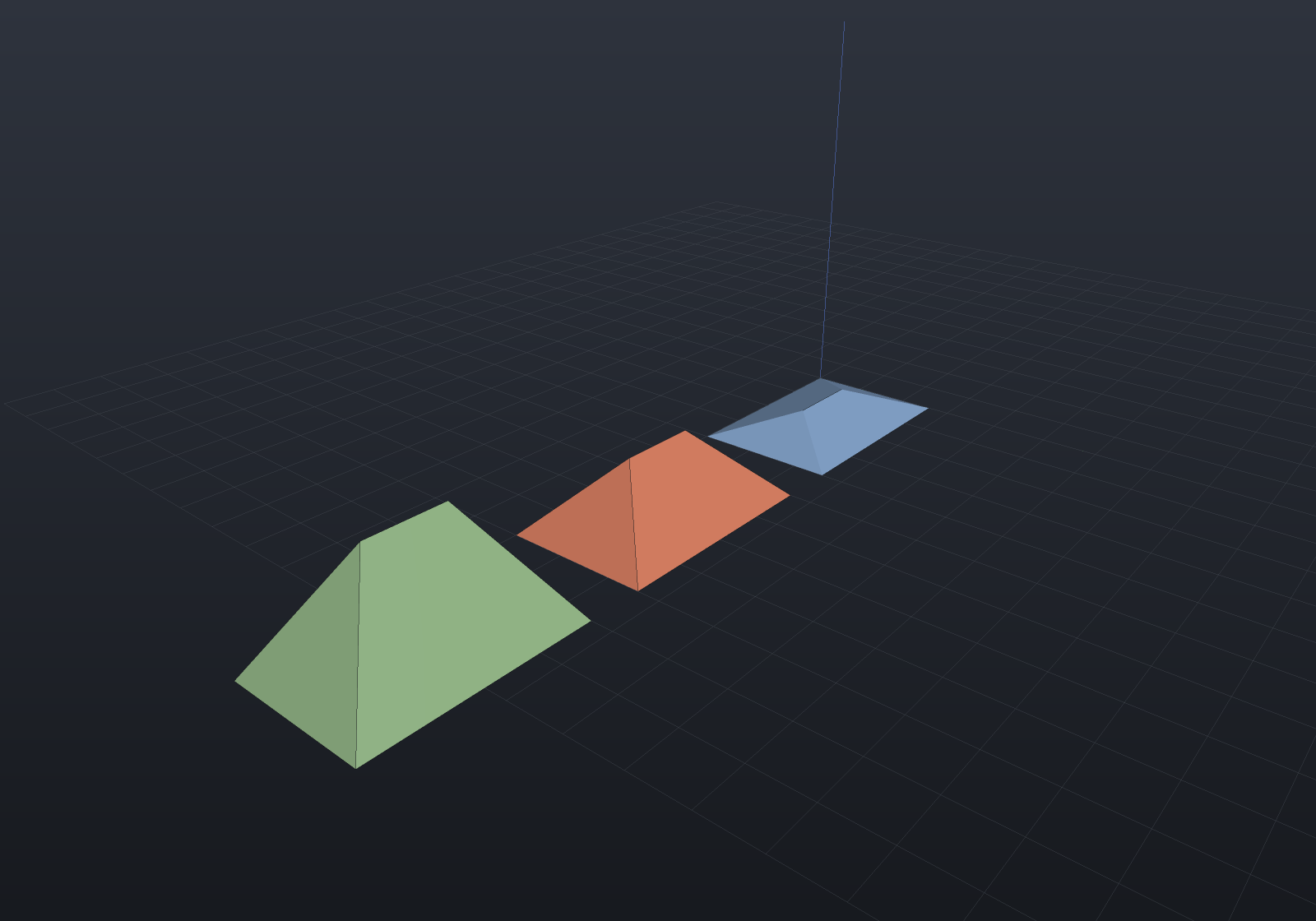
An L-shape, and the split event
A convex footprint only ever collapses edges. A non-convex one also splits: a reflex corner runs across the body and reaches an opposing edge, dividing the wavefront in two. That is what puts the valley in an L-shaped roof, and an implementation that stops at edge events is a well-verified subset that returns nonsense for the first L it meets.
var footprint = Sketch.Polygon([    new Vector2d(0, 0), new Vector2d(30, 0), new Vector2d(30, 20),    new Vector2d(18, 20), new Vector2d(18, 6), new Vector2d(0, 6),]);
var facts = Shape.RoofFacts(footprint, RoofPitch.FromAngle(45));if (facts.Skeleton.SplitEvents < 1)    throw new Exception("an L-shape's reflex corner must reach the opposite edge");
var scene = new Scene();scene.Add(new Part("L roof", Shape.Roof(footprint, 45)) { Color = new PartColor(0.59f, 0.47f, 0.38f) });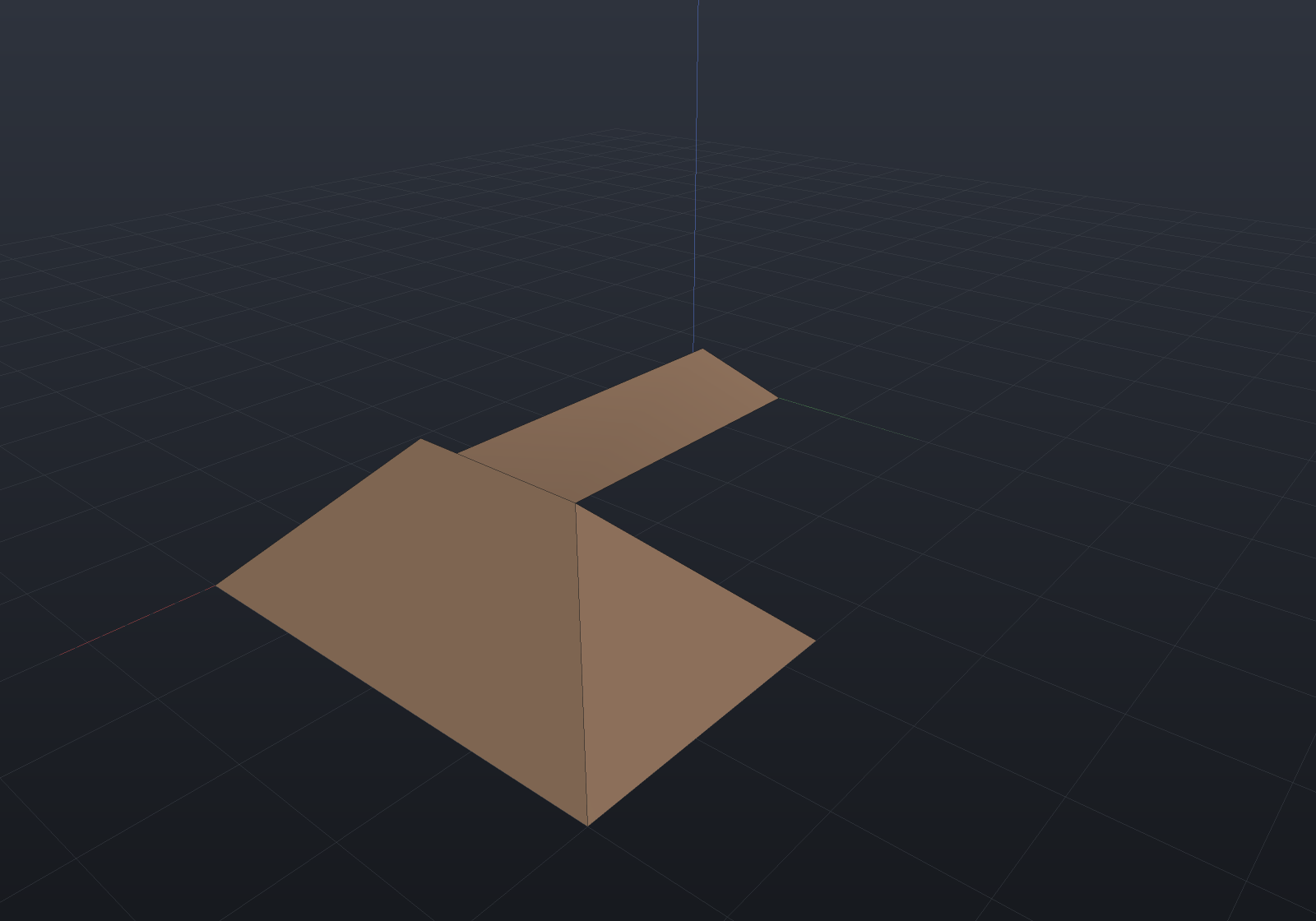
This footprint’s skeleton was derived by hand and is what the test suite asserts:
four interior nodes at (3,3), (21,3), (24,6) and (24,14), six faces whose
areas sum to the footprint’s own 348, and — at 45° — an enclosed volume of exactly
738. Skipping split events cannot close it at all, which is the mutation that
proves they earn their place.
A slot splits one edge twice
Cut a slot into a plate and both of its reflex corners reach the bottom edge at the same instant, so the wavefront becomes three loops.
var slot = Sketch.Polygon([    new Vector2d(0, 0), new Vector2d(60, 0), new Vector2d(60, 40), new Vector2d(40, 40),    new Vector2d(40, 10), new Vector2d(20, 10), new Vector2d(20, 40), new Vector2d(0, 40),]);
var scene = new Scene();scene.Add(new Part("slotted roof", Shape.Roof(slot, 38)) { Color = new PartColor(0.47f, 0.52f, 0.59f) });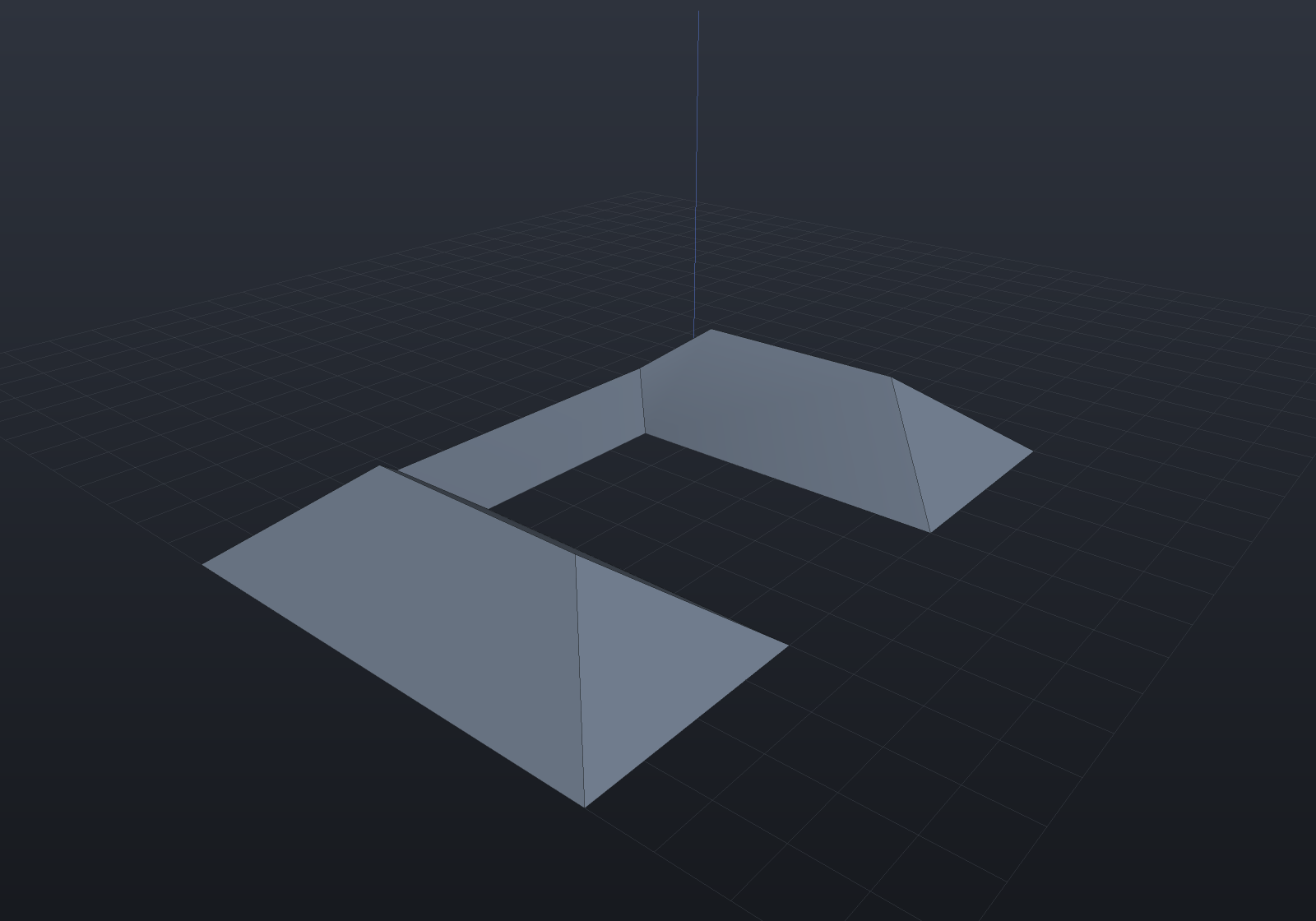
A star is not a split-event shape
Worth stating, because it is the obvious guess and it is wrong: a regular star’s reflex corners all point at the centre (the notch between two points is outside the polygon), so they arrive together and the whole wavefront resolves by edge events — measured at zero splits and one interior node for every regular star tried. Break the symmetry and the splits appear.
var corners = new List<Vector2d>();for (int i = 0; i < 10; i++){    double r = i % 2 == 0 ? 24 : 9;    double t = Math.PI * i / 5;    corners.Add(new Vector2d(r * Math.Cos(t), r * Math.Sin(t)));}
var scene = new Scene();scene.Add(new Part("star roof", Shape.Roof(Sketch.Polygon(corners), 42)) { Color = new PartColor(0.77f, 0.59f, 0.28f) });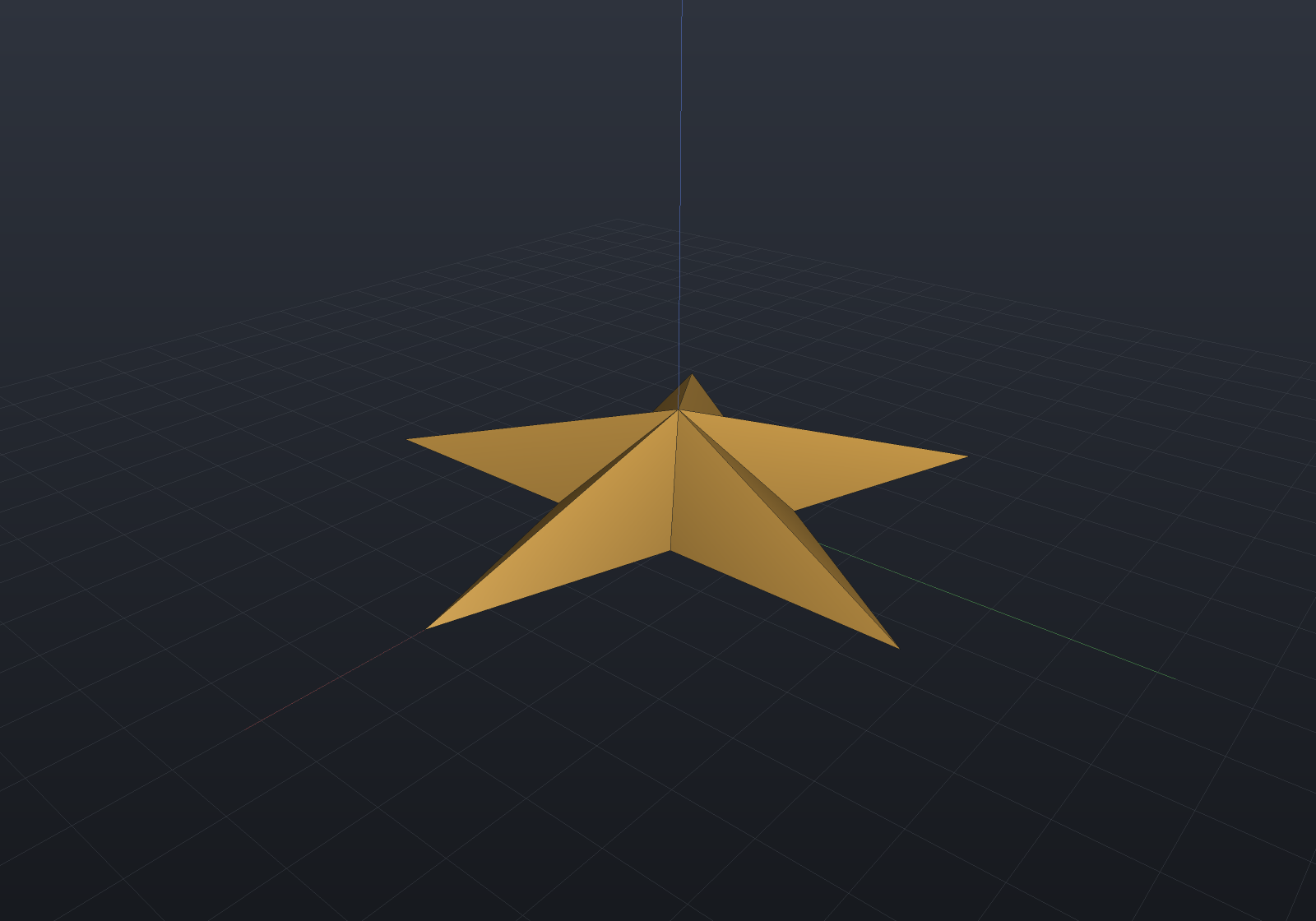
What it refuses, and why
| Refused | Reason |
|---|---|
| A footprint with holes | A hole’s wavefront grows into the outer one, so the two meet in a merge event whose first contact is — for every rectilinear footprint — an edge against an edge rather than a vertex against an edge, which the vertex-event simulation has no event for. Roof the outline and subtract the hole’s own solid. |
| Arcs or Béziers in the footprint | A curved edge sweeps a curved surface; the straight skeleton is defined for straight edges. Approximate the curve with line segments first. |
| A pitch of 0° or 90° | A flat slab and a vertical wall are not roofs. |
| A sheared or non-uniformly scaled placement | It would change the pitch, which is the one thing the roof states. A uniform scale is fine — it scales the skeleton and the height together. |
The simulation also refuses by name rather than returning a plausible skeleton when it meets a degeneracy it cannot decide: what is checked before anything is returned is that the skeleton faces are simple, positively wound, and that their areas sum to the footprint’s own.