Loft, draft & shell
Four operations from the mould-making and industrial-design toolbox, all exact B-Rep
constructions under the hood: loft skins a solid through cross-sections, draft
adds the mould-release taper, shell hollows a solid to constant walls, and
round edges fillets every convex edge of a solid in one boolean-free operation.
Each is B-Rep-Native under rigid placements and uniform scaling, bridges implicit and
mesh through the exact B-Rep, and refuses what it cannot do exactly by name —
shape.Explain(target) tells the story per node.
Loft: skin through sections
Shape.Loft takes two or more sketches, each placed by its own SketchPlane, and
skins a closed solid through them. Sections correspond by segment index: matching
counts loft directly, and an integer-ratio count splits the coarser section’s
segments automatically (equal-parameter pieces, no geometry moved — a square lofting
to an octagon splits each side once), while a non-integer ratio fails at the call.
A circular closed section lofting to a NURBS one is re-expressed as its exact rational
NURBS full circle automatically, so the two tessellate at one density and the skin
welds. Winding and starting segment are aligned automatically to the least-twist match,
and the ends are capped. Here a rectangle (four lines) becomes a slot (two lines, two
arcs):
var transition = Shape.Loft([    (Sketch.Rectangle(24, 10), SketchPlane.XY),    (Sketch.Slot(16, 7), SketchPlane.At((0, 0, 14), Vector3d.UnitX, Vector3d.UnitY)),]);
var scene = new Scene();scene.Add(new Part("transition", transition));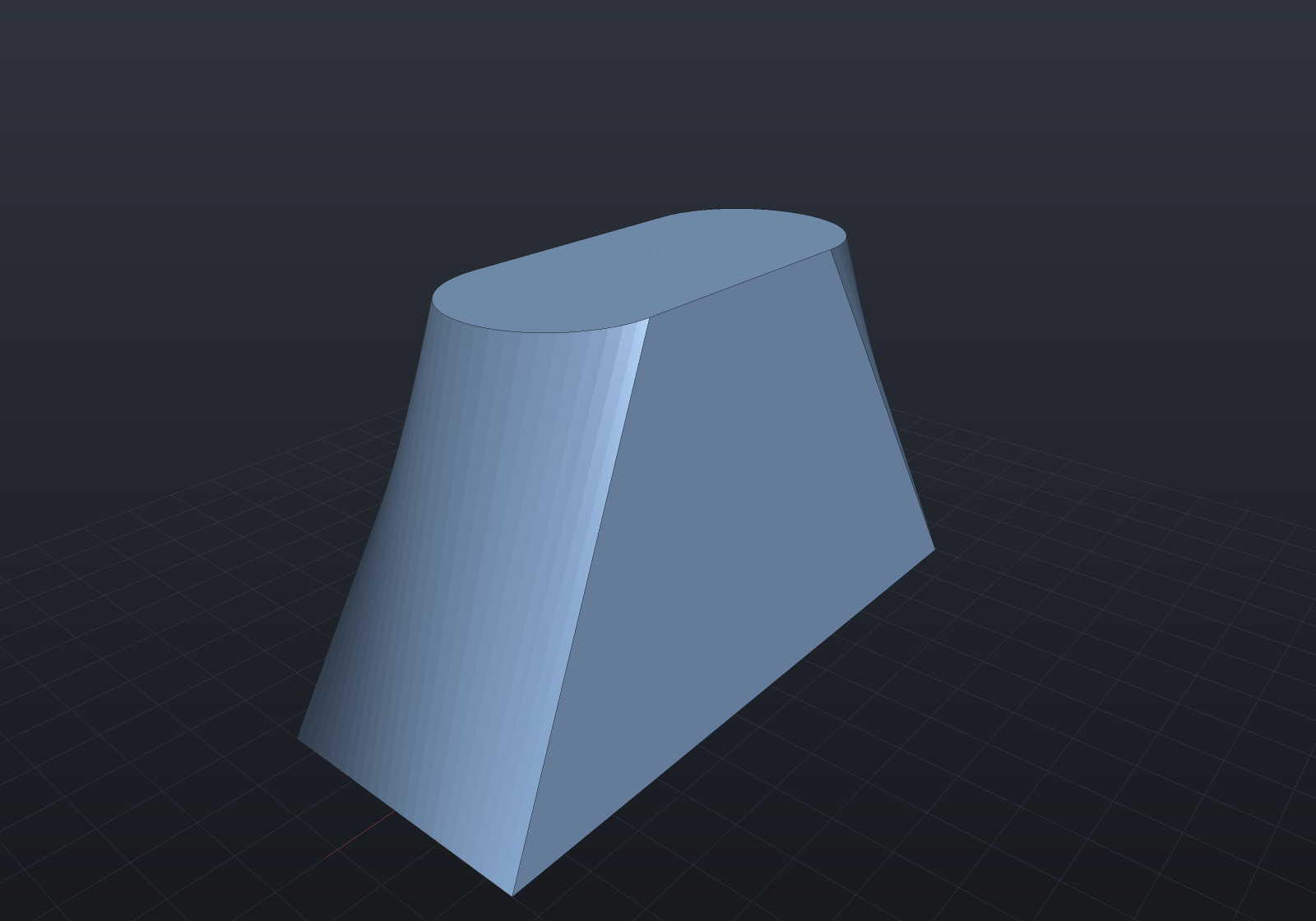
LoftStyle.Smooth (the default) interpolates all sections with one skin, so
intermediate sections leave no edge; LoftStyle.Ruled runs straight strips between
consecutive sections and keeps each junction as a real edge:
var funnel = Shape.Loft([    (Sketch.Rectangle(20, 20), SketchPlane.XY),    (Sketch.Rectangle(16, 16), SketchPlane.At((0, 0, 6), Vector3d.UnitX, Vector3d.UnitY)),    (Sketch.Rectangle(6, 6), SketchPlane.At((0, 0, 16), Vector3d.UnitX, Vector3d.UnitY)),], LoftStyle.Ruled);
var scene = new Scene();scene.Add(new Part("funnel", funnel));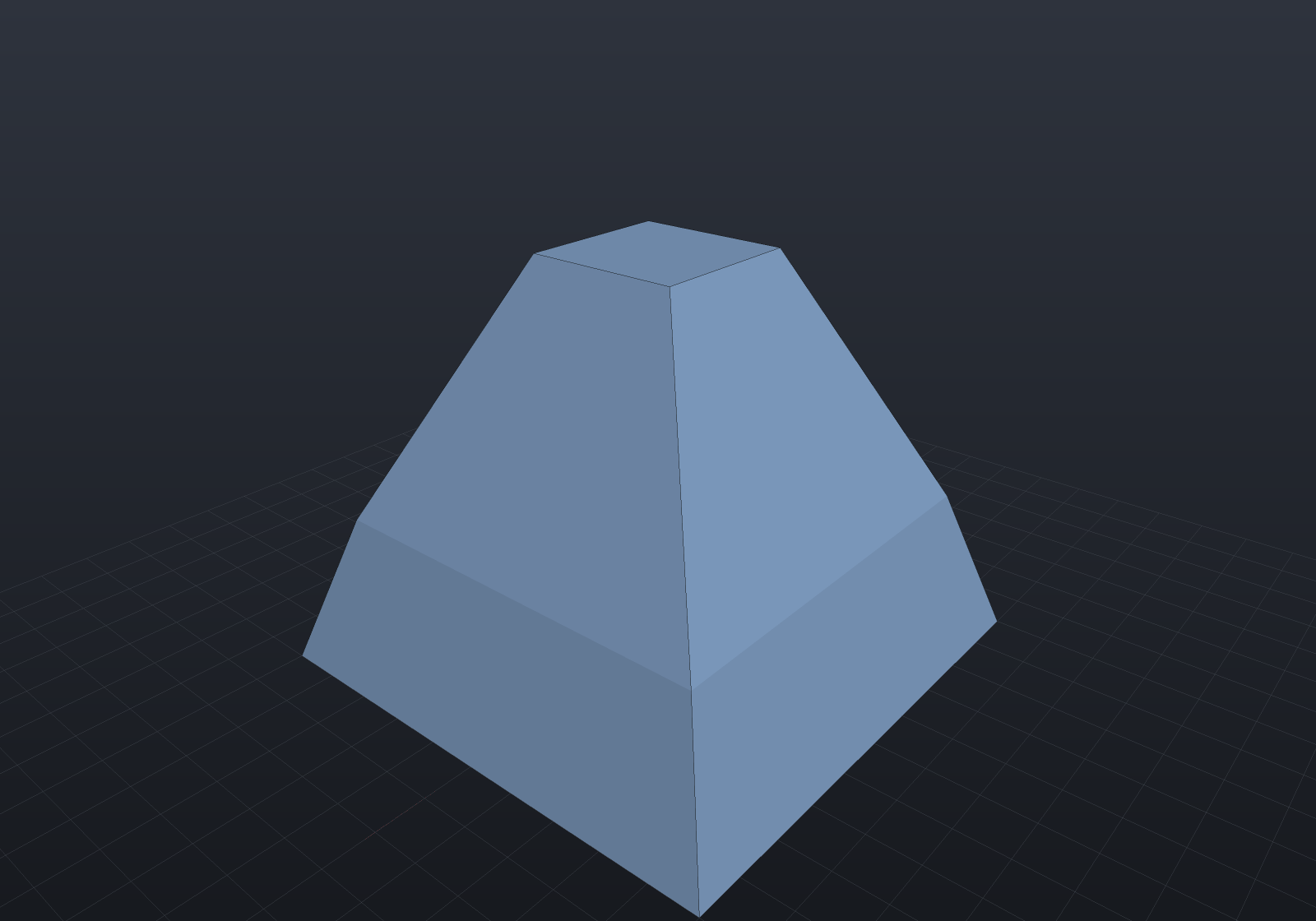
Ruled lofts of polygonal sections are exact prismatoids — the two-rectangle loft above
has the closed-form volume h·(A₀/3 + Aₘᵢₓ/6·2 + A₁/3), and the tests hold the
tessellated solid to it at nine digits.
The split is what lets a four-sided rectangle loft straight into an eight-segment rounded rectangle:
var transition = Shape.Loft([    (Sketch.Rectangle(26, 16), SketchPlane.XY),    (Sketch.RoundedRectangle(20, 12, 4),        SketchPlane.At((0, 0, 12), Vector3d.UnitX, Vector3d.UnitY)),]);
var scene = new Scene();scene.Add(new Part("transition", transition, Palette.Brass));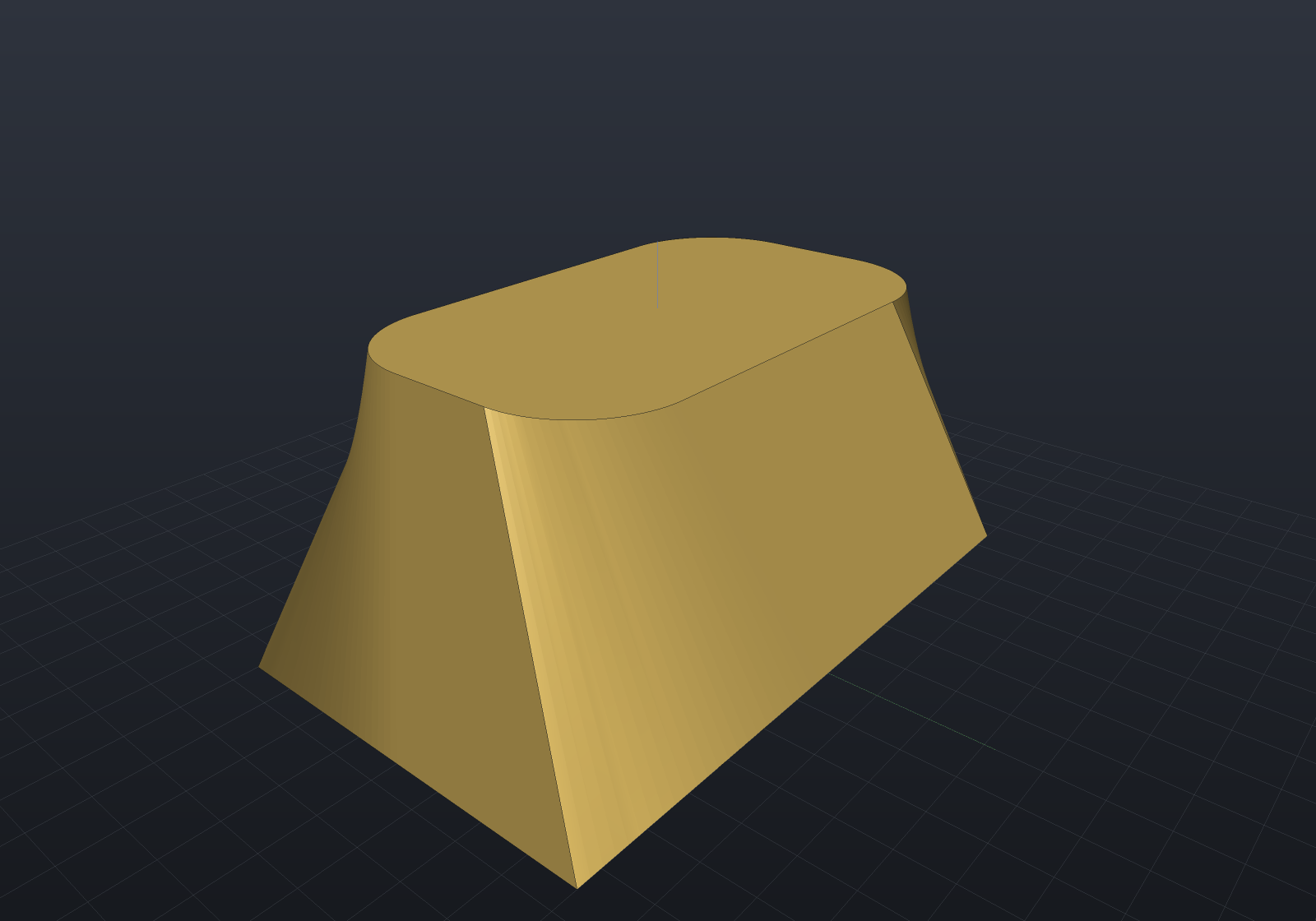
Sections with holes
A section sketch may carry holes: hole j of every section lofts into its own inner
skin (holes correspond by their WithHole declaration order, so every section must
declare the same number), and the caps become faces with hole loops. A hole family may
even be a different curve kind than the outer — here a square outer tapers around a
circular bore, the drilled-adapter archetype:
var sectionPlanes = new[] { SectionPlane.On(SectionAxis.Y, 0) };
var adapter = Shape.Loft([    (Sketch.Rectangle(30, 30).WithHole(Sketch.Circle(6)), SketchPlane.XY),    (Sketch.Rectangle(18, 18).WithHole(Sketch.Circle(7.5)),        SketchPlane.At((0, 0, 20), Vector3d.UnitX, Vector3d.UnitY)),], LoftStyle.Ruled);
var scene = new Scene();scene.Add(new Part("adapter", adapter, Palette.Steel));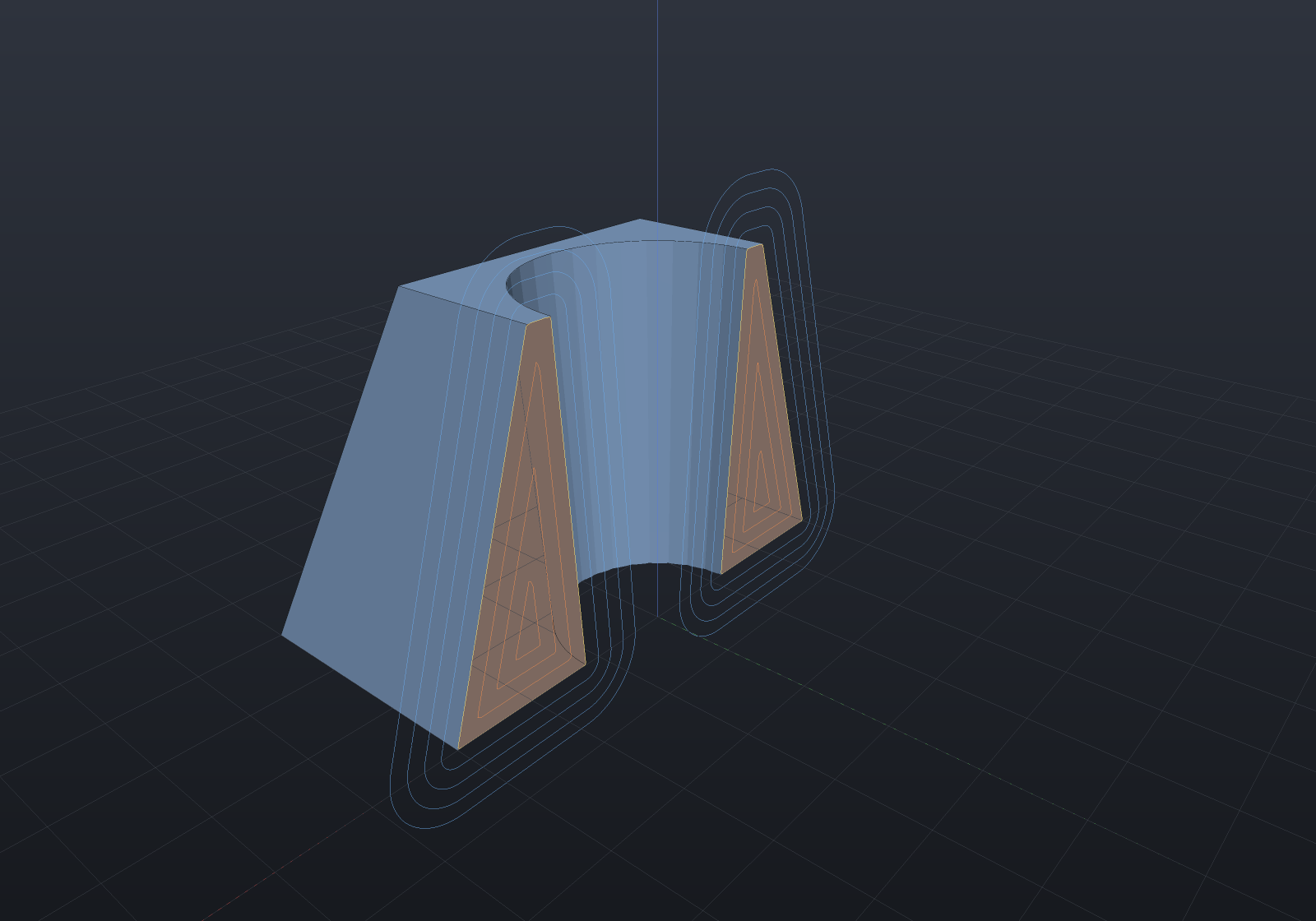
The same machinery reaches the pure taper — Shape.Extrude(sketch, height, twist: 0, scale: …) of a holed sketch is B-Rep-Native now, the hole tapering with the outer
about the same scaling centre — and LoftAlong, whose stations place the holes
through the same frames as the outer. With a rectangular hole every wall of both skins
is a planar trapezoid, so the hollow prismatoid volume is an exact identity of the
tessellation, held at nine digits in the tests.
Evolution laws: LoftAlong
Shape.LoftAlong generates the sections itself: one sketch carried along a spine in
rotation-minimizing frames (the same frames Sweep uses), scaled and twisted by laws
evaluated along the way — OCCT’s pipe shell with an evolution law. The generated
sections feed Loft unchanged:
// A tapered, twisted column: square section, linear 1 → 0.45 scale, 60° of twist.var spine = new Line3d(new Vector3d(0, 0, 0), new Vector3d(0, 0, 30));var column = Shape.LoftAlong(    Sketch.Rectangle(12, 12), spine, sectionCount: 12,    scale: s => 1 - 0.55 * s,    twist: s => s * Math.PI / 3);
var scene = new Scene();scene.Add(new Part("column", column));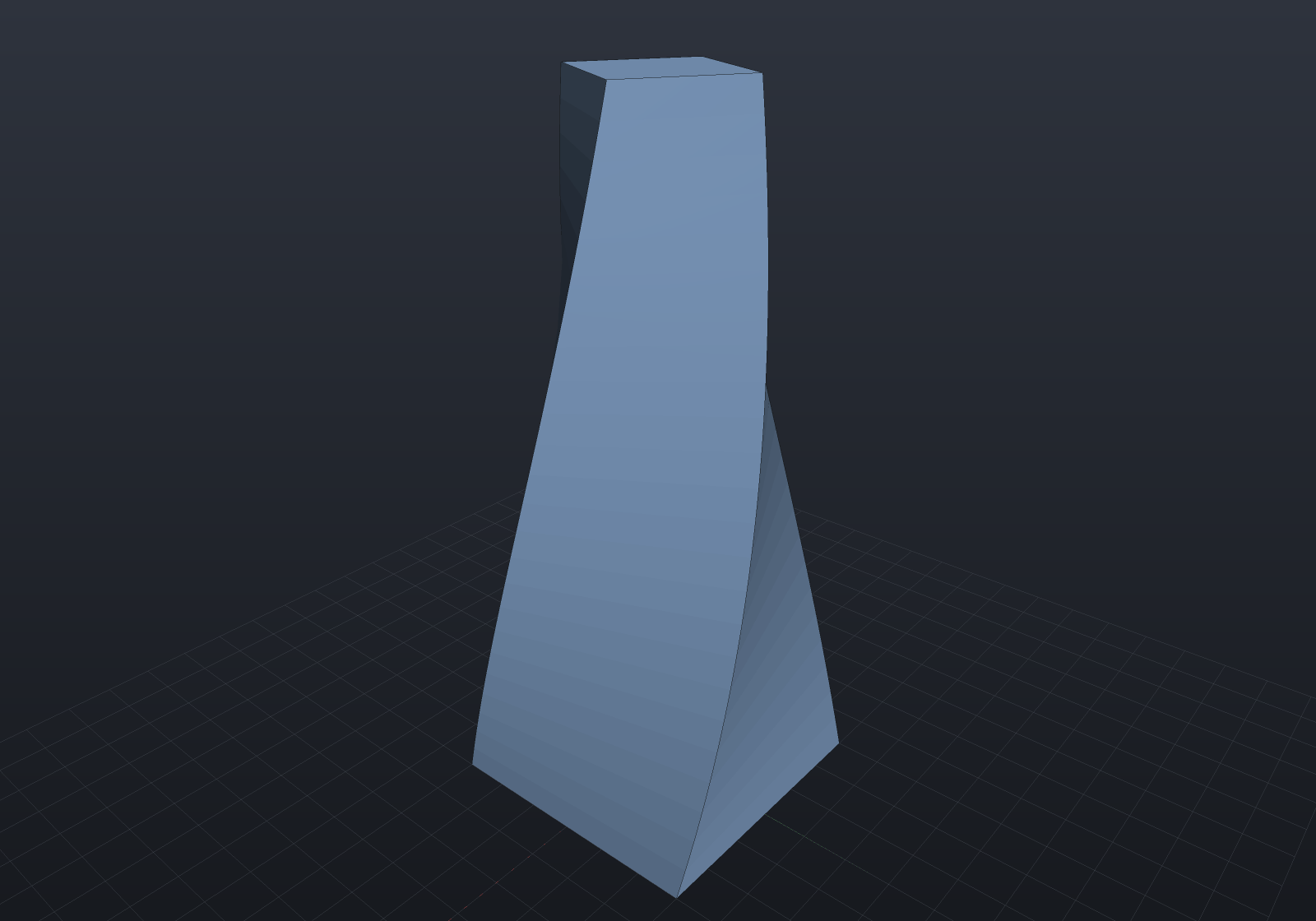
Without laws, prefer Shape.Sweep — its swept surface is exact along the whole path,
where a loft interpolates a finite number of stations. The law is what LoftAlong
exists for.
Draft: the mould-release taper
shape.Draft(angleDegrees, neutralOrigin, pullDirection, faces?) tapers side faces
about the neutral plane (through neutralOrigin, perpendicular to the pull
direction) so the part releases from its mould. Geometry on the neutral plane does not
move — it is the parting line. The operation is exact: each face’s plane is rotated
about its neutral line, and every corner is re-solved as the intersection of three
planes, so a drafted box is exactly a frustum:
var outline = Sketch.Polygon([    new(-15, -10), new(15, -10), new(15, 10), new(-15, 10),]);
// 8 degrees is far more than a real mould needs - it makes the taper visible.var boss = Shape.Extrude(outline, 18)    .Draft(8, neutralOrigin: (0, 0, 0), pullDirection: Vector3d.UnitZ);
var scene = new Scene();scene.Add(new Part("boss", boss));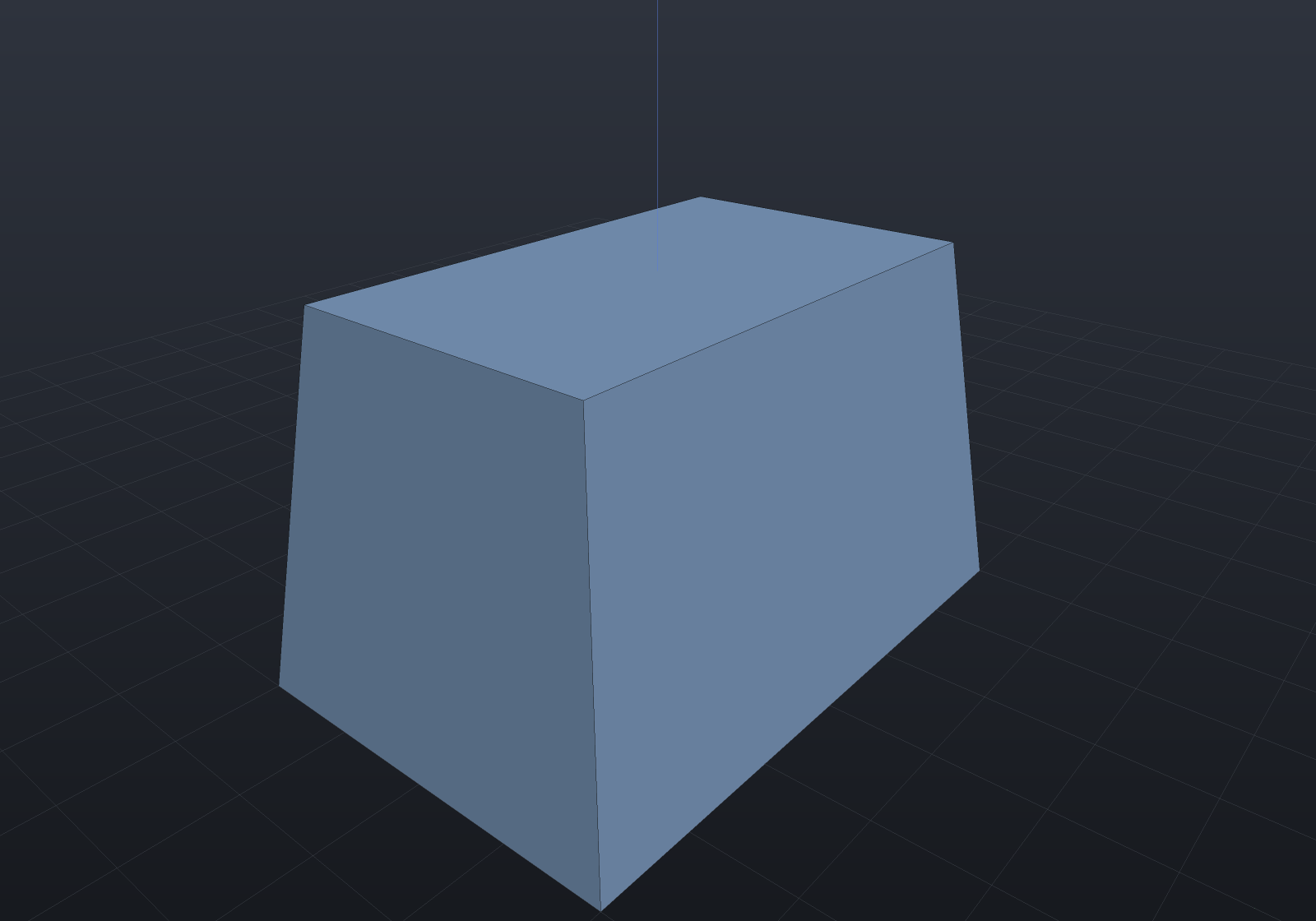
A face selector (the same query vocabulary as chamfer/fillet) drafts a subset; chaining
calls gives per-face angles, exactly — the operation is closed-form and composable
(Draft.Apply also takes a per-face angle selector directly at the kernel level):
var block = Shape.Box(30, 20, 12)    .Draft(4, (0, 0, -6), Vector3d.UnitZ,        s => s.PlanarFacesWithNormal(Vector3d.UnitX)              .Concat(s.PlanarFacesWithNormal(-Vector3d.UnitX)))    .Draft(12, (0, 0, -6), Vector3d.UnitZ,        s => s.PlanarFacesWithNormal(Vector3d.UnitY)              .Concat(s.PlanarFacesWithNormal(-Vector3d.UnitY)));
var scene = new Scene();scene.Add(new Part("block", block));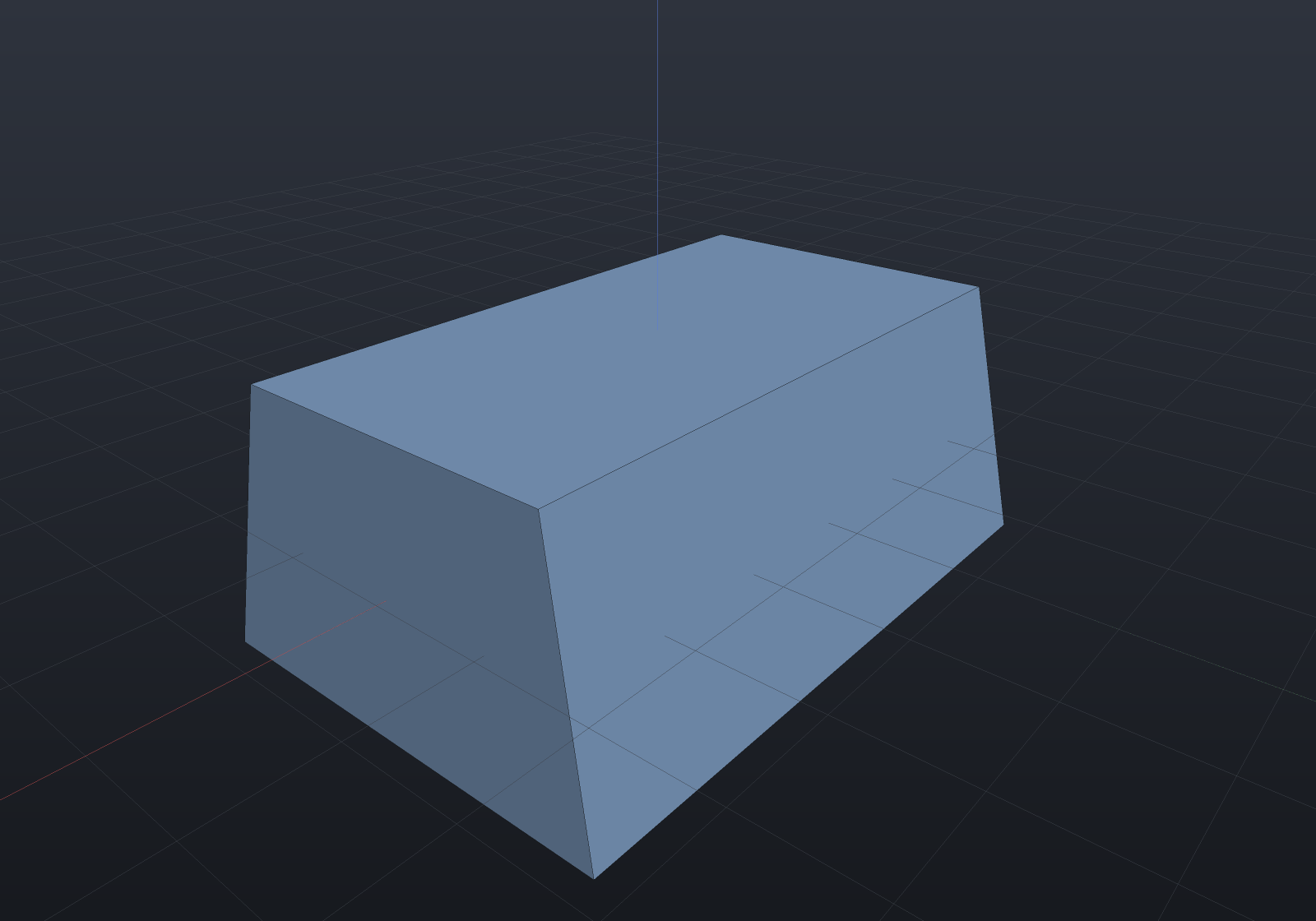
Curved faces taper too, and exactly. A face of revolution about the pull direction drafts by rotating its generator in its own axial half-plane about the point where that generator crosses the neutral plane — the same rule, one dimension down. So a drafted cylinder is exactly a cone, not a cone to some tolerance:
var boss = Shape.Cylinder(10, 20).Draft(6, (0, 0, -10), Vector3d.UnitZ);
var scene = new Scene();scene.Add(new Part("tapered boss", boss, Palette.Brass));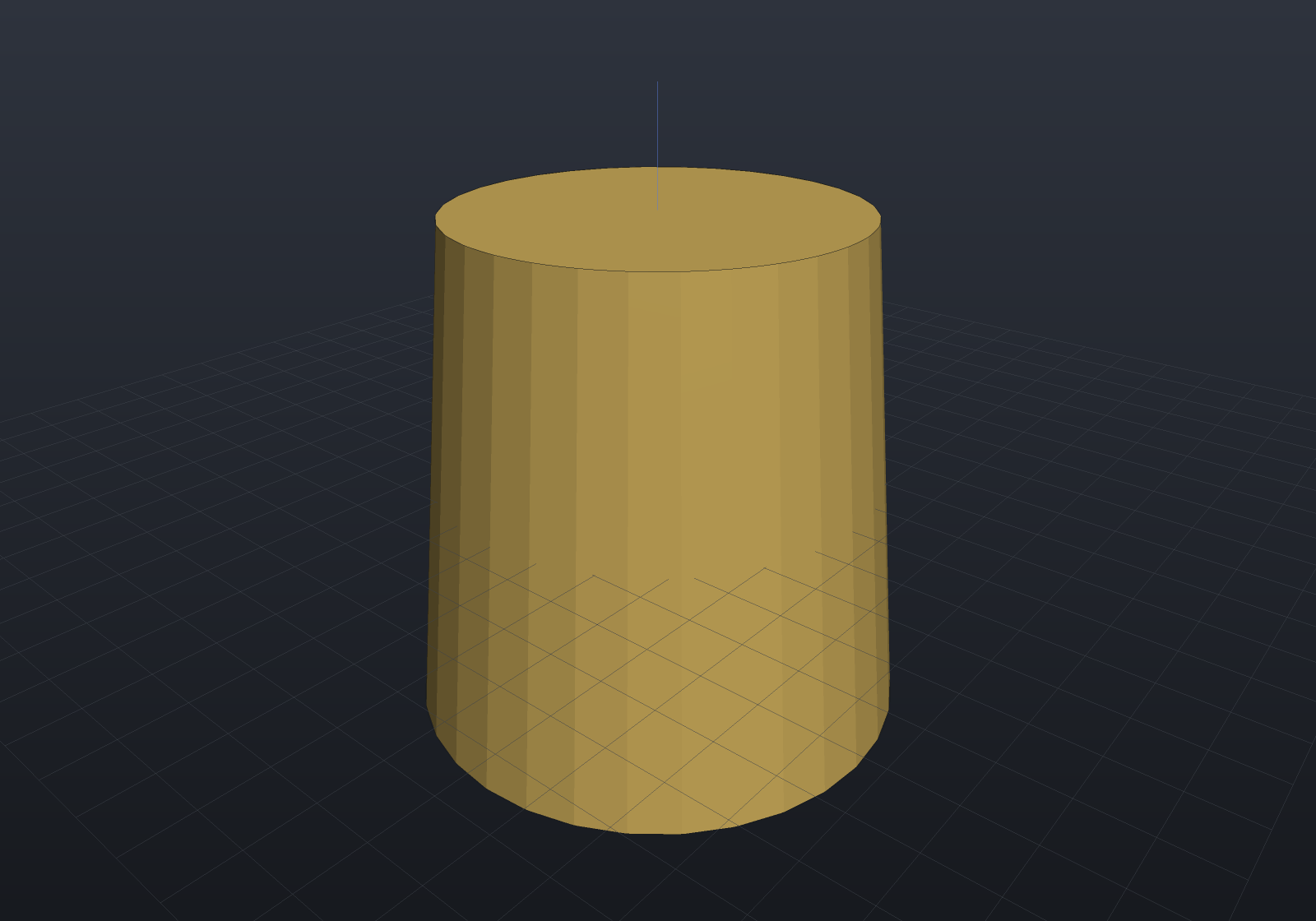
Caps carry holes, and the hole drafts the other way. A hole’s walls are an ordinary closed ring of side faces whose outward normals point into the hole, so the same rotate-about-the-neutral-line rule applies to them verbatim — and the consequence is the one a mould needs: the outside closes going along the pull while the hole opens, so the core pin releases. Both rings are exact planes, so the volume is a closed form whose second-order terms cancel between them:
var plate = Sketch.Rectangle(40, 40).WithHole(Sketch.Rectangle(16, 16));
// 10 degrees, again far more than a real tool needs, so the lean reads at this size.var cored = Shape.Extrude(plate, 12)    .Draft(10, neutralOrigin: (0, 0, 0), pullDirection: Vector3d.UnitZ);
var scene = new Scene();scene.Add(new Part("cored plate", cored, Palette.Steel));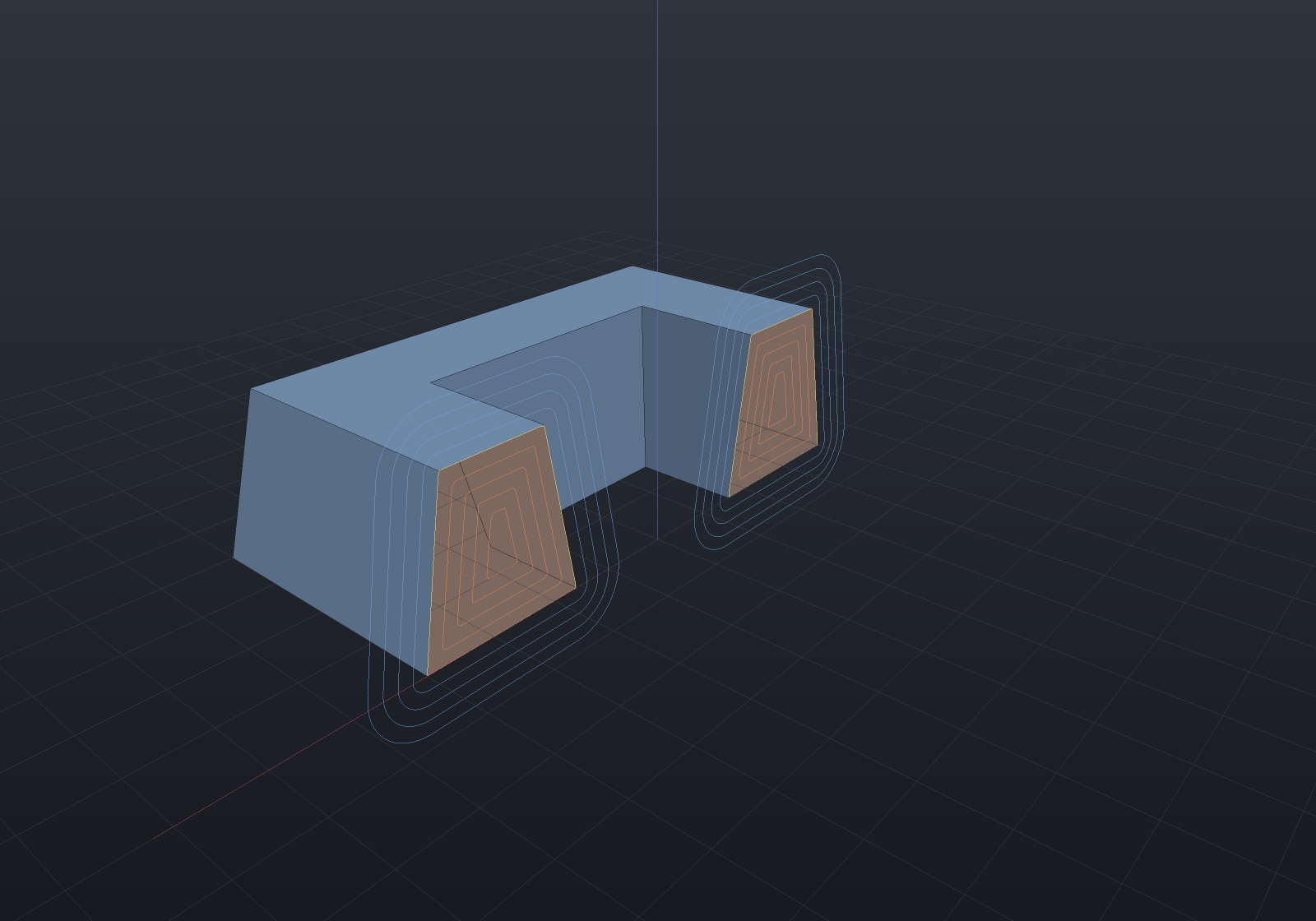
The same holds for a bore a boolean cut, which is the closest thing the kernel builds to an imported body: a difference marks the subtracted tool’s walls reversed, and the taper reads its lean off the outward normal — the negation of that face’s surface normal — so the bore drafts open rather than plausibly shut:
var housing = Shape.Cylinder(18, 26) - Shape.Cylinder(8, 40);var drafted = housing.Draft(7, neutralOrigin: (0, 0, -13), pullDirection: Vector3d.UnitZ);
var scene = new Scene();scene.Add(new Part("cored housing", drafted, Palette.Brass));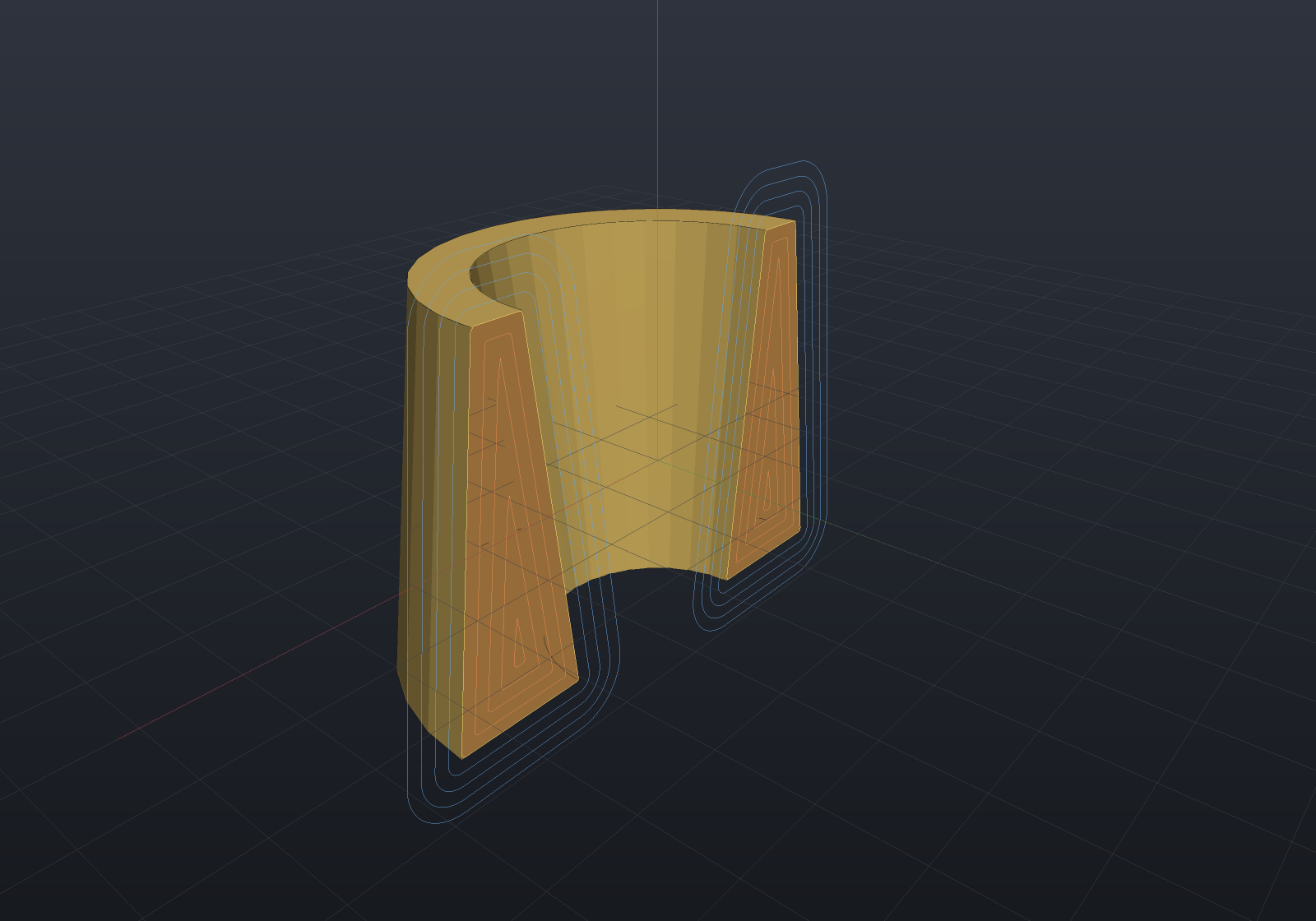
Profile-folding tapers, curved faces on any other axis (their drafted carrier is not a surface of any family this kernel builds) and a non-planar neutral surface (which would give every drafted face a curved hinge, and so a general ruled carrier) are refused with a message naming the problem.
Shell: hollow to constant walls
shape.Shell(thickness, openings) hollows a solid inward to walls of the given
thickness, keeping the outer surface exactly. Faces named by the openings selector
are removed, opening the cavity through them — the classic tray; a null selector
seals the cavity as an internal void. Exact for polyhedral solids: an offset plane is a
plane, and every inner corner is the intersection of its three offset planes.
var tray = Shape.Box(50, 34, 16)    .Shell(2.5, s => s.PlanarFacesWithNormal(Vector3d.UnitZ));
var scene = new Scene();scene.Add(new Part("tray", tray));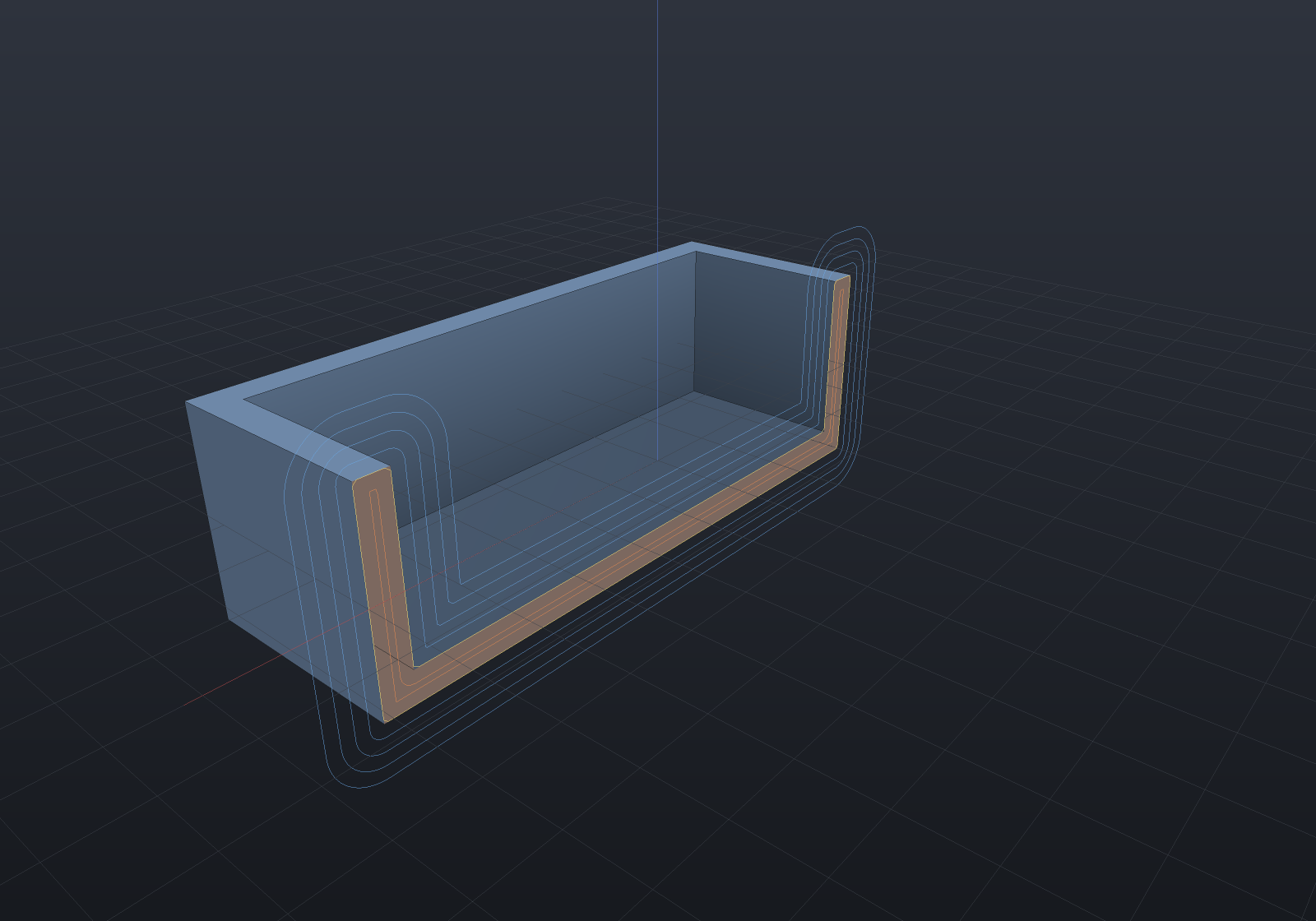
[!NOTE] This is a different operation from
shape.Shell(thickness)without a selector — the SDF onion|d| − t/2, which skins the surface symmetrically (half the wall outside the original surface) and is implicit-Native. The two are different geometry, so they are different calls: which walls a design gets is its explicit choice, never a representation’s.Explainon the SDF shell names this overload as the exact route.
Curved faces shell exactly too. A cylinder offsets to a cylinder, a cone to a cone and a torus to a torus, so a cylinder hollows to a cup and a pipe elbow opened at both ends to a genus-1 tube whose volume matches Pappus:
var cup = Shape.Cylinder(14, 24).Shell(2, s => s.PlanarFacesWithNormal(Vector3d.UnitZ));var cone = Shape.Cone(16, 8, 22).Shell(2, s => s.PlanarFacesWithNormal(Vector3d.UnitZ));
var scene = new Scene();scene.Add(new Part("cup", cup, Palette.Steel,    Matrix4d.CreateTranslation((-18, 0, 0))));scene.Add(new Part("conical cup", cone, Palette.Brass,    Matrix4d.CreateTranslation((18, 0, 0))));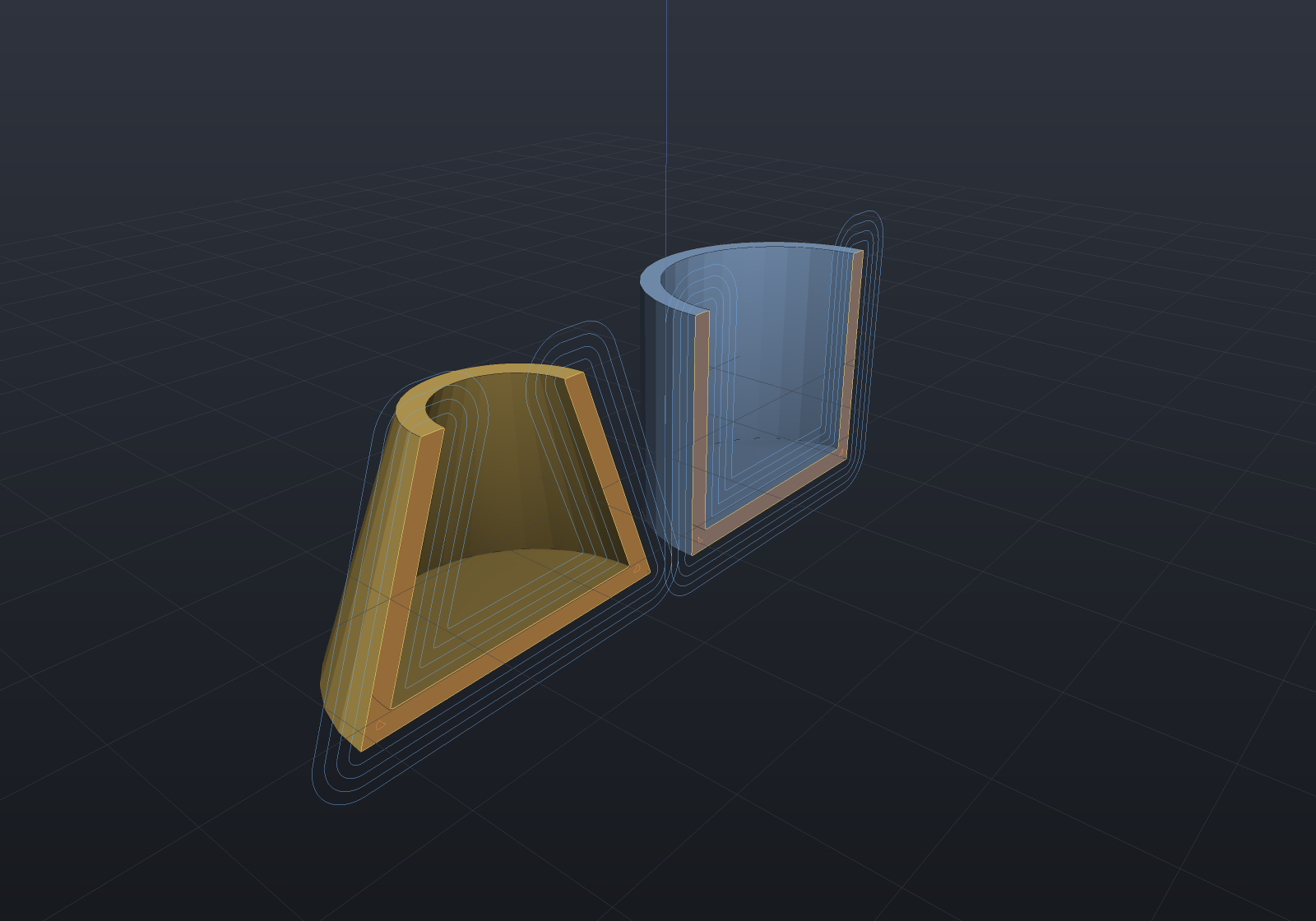
Openings may be adjacent. Where two opened faces share an edge the strip between their two rims has zero width, so the annulus is cut open and the outer and inner boundaries become one loop — the shared edge cut back to the two end pieces both rims use, and the stretch between the inner corners simply not built. The result is one simply-connected rim face per opening rather than an annulus:
var tray = Shape.Box(46, 34, 20).Shell(2.5,    s => s.PlanarFacesWithNormal(Vector3d.UnitZ)          .Concat(s.PlanarFacesWithNormal(Vector3d.UnitX)));
var scene = new Scene();scene.Add(new Part("open corner", tray, Palette.Steel));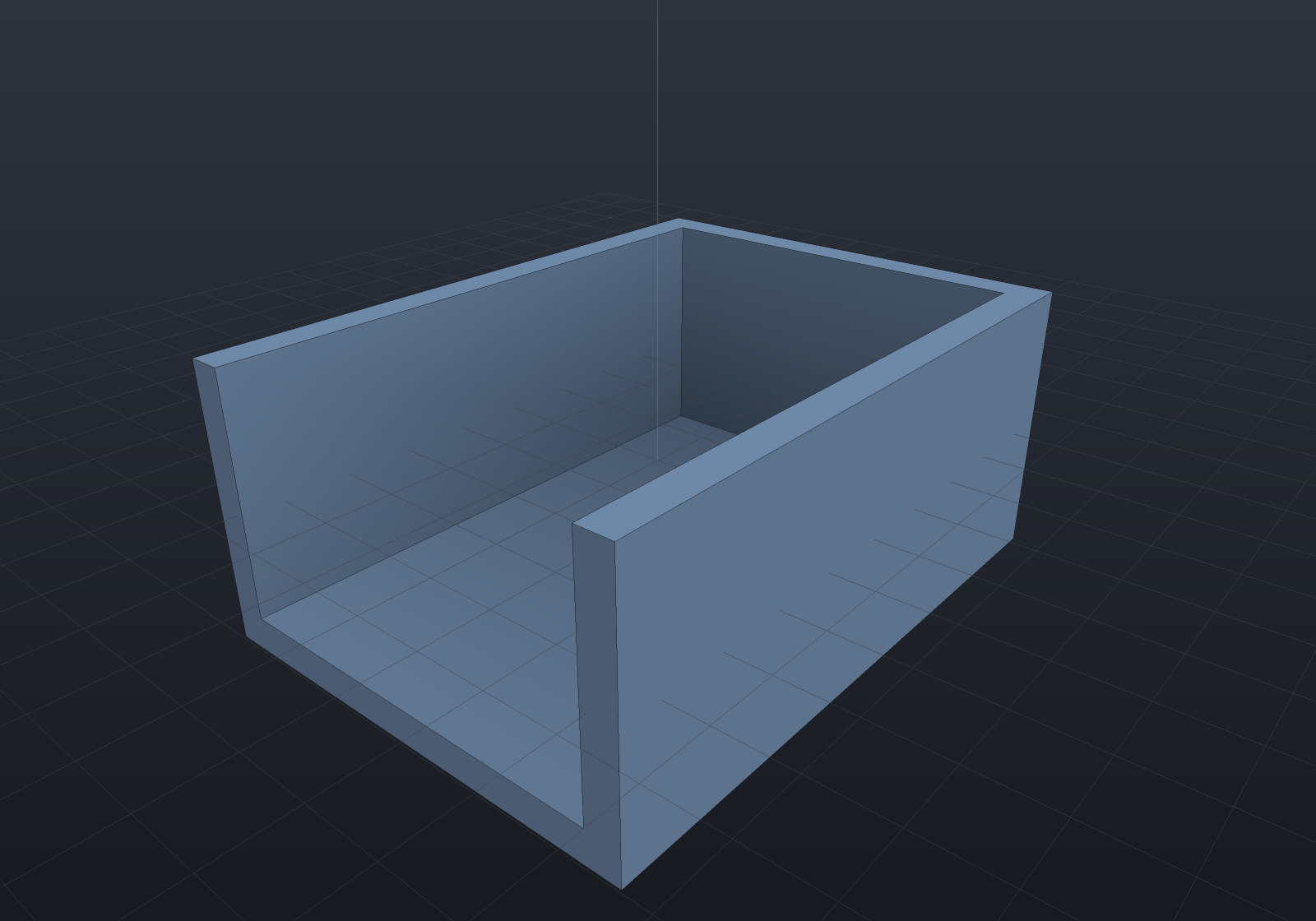
Sectioned, the wall is the same thickness everywhere and the cavity reaches both opening planes exactly — which is what makes the volume a difference of two boxes:
var tray = Shape.Box(46, 34, 20).Shell(2.5,    s => s.PlanarFacesWithNormal(Vector3d.UnitZ)          .Concat(s.PlanarFacesWithNormal(Vector3d.UnitX)));
var scene = new Scene();scene.Add(new Part("open corner", tray, Palette.Steel));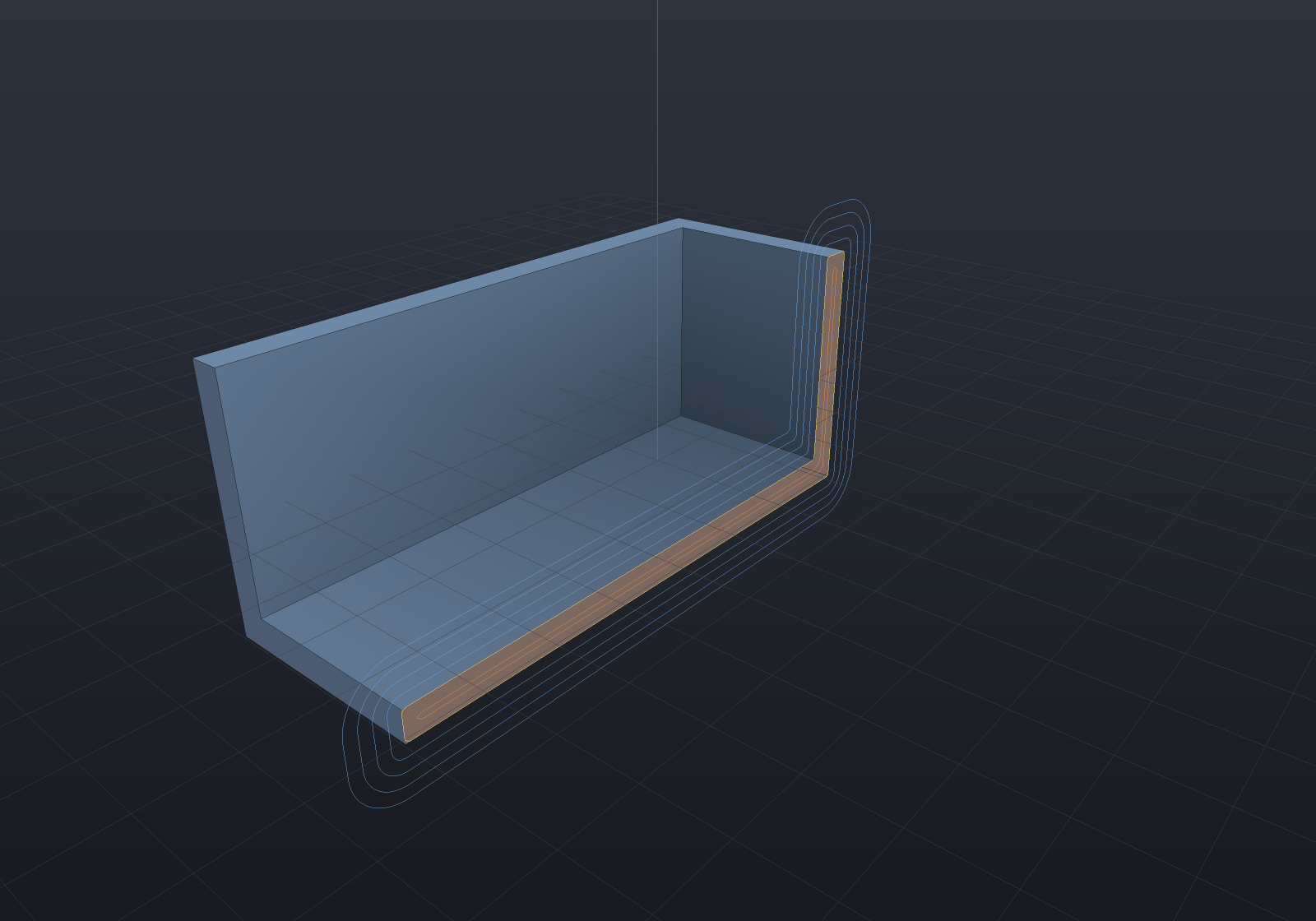
Merging the two openings into ONE face would have been the wrong shape of fix — they lie on different planes, so that face does not exist. Three openings meeting at one vertex are refused by name: the rim closes to a point there, which no thickness can rescue.
A bore a boolean cut shells too. Its wall is reversed, so the cavity twin must face
exactly opposite the parent’s own outward normal — !parentReversed rather than a
hard-coded flip — and a reversed planar parent’s twin is the plane verbatim, since the
reversal it already carries is the flip.
What is refused, by name: a carrier with no exact offset of its own family (swept and NURBS surfaces), adjacent openings on a curved body (the shared edge’s rim pieces would be sub-curves, each needing its own parameter solved on the shared carrier, and a closed shared rim has no two corners to cut back to), and a rim the construction cannot reproduce as a concentric circle — which is what catches a sealed elbow, whose moved cap planes cut the offset torus in a quartic rather than a circle. Open that face instead.
The kernel API also supports a per-face wall thickness — a thick base under thin walls:
Shelling.Shell(solid, face => IsBase(face) ? 4.0 : 1.5, openings).
Round edges: whole-solid rounding
shape.RoundEdges(radius) rounds every convex edge and corner with one radius —
the exact morphological opening (K ⊖ B_r) ⊕ B_r, built directly rather than through
booleans: each face keeps its own plane with a shrunk boundary, each edge becomes an
exact cylindrical band, each corner an exact spherical patch. A box becomes 26 faces:
var block = Shape.Box(30, 20, 12).RoundEdges(2.5);
var scene = new Scene();scene.Add(new Part("block", block));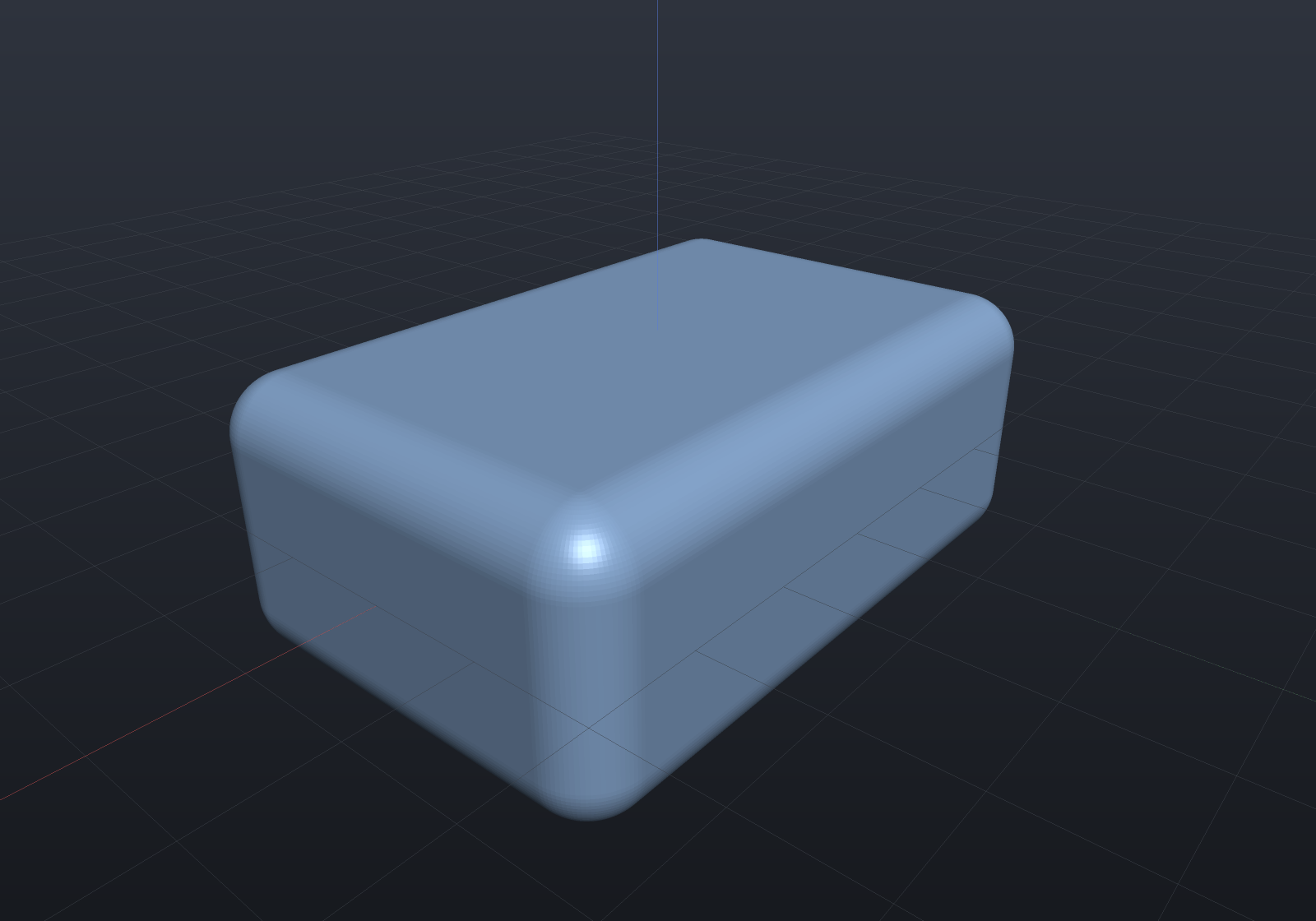
The tessellated volume converges quadratically onto Steiner’s formula
V₀ + A₀r + (r²/2)Σℓθ + (4π/3)r³ for the eroded solid. Convex prisms and sheared
boxes keep exact lune corner patches, and general trihedral corners (a
tetrahedron’s, a drafted block’s) build trimmed spherical-triangle patches — see
chamfer & fillet. Concave edges and
higher-valence vertices are refused by name. For organic rounding of arbitrary shapes,
the implicit route (Offset(-r) then Offset(+r) on the field) remains available.