Transforms & patterns
Transforms
Translate, RotateX/Y/Z, Rotate(axis, angle), Scale, and the general
Transform(Matrix4d) are ordinary graph nodes. Lowerings bake accumulated
transforms into construction inputs — a rotated-then-drilled B-Rep stays exact
because the transform moves the profiles and axes, never finished geometry:
var blank = Shape.Box(26, 12, 6);
var scene = new Scene();scene.Add(new Part("original", blank, Palette.Steel,    Matrix4d.CreateTranslation((-36, 0, 8))));scene.Add(new Part("rotated", blank.RotateZ(Math.PI / 6).RotateY(Math.PI / 8),    Palette.Brass, Matrix4d.CreateTranslation((0, 0, 8))));scene.Add(new Part("scaled x1.4", blank.Scale(1.4), Palette.Coral,    Matrix4d.CreateTranslation((38, 0, 8))));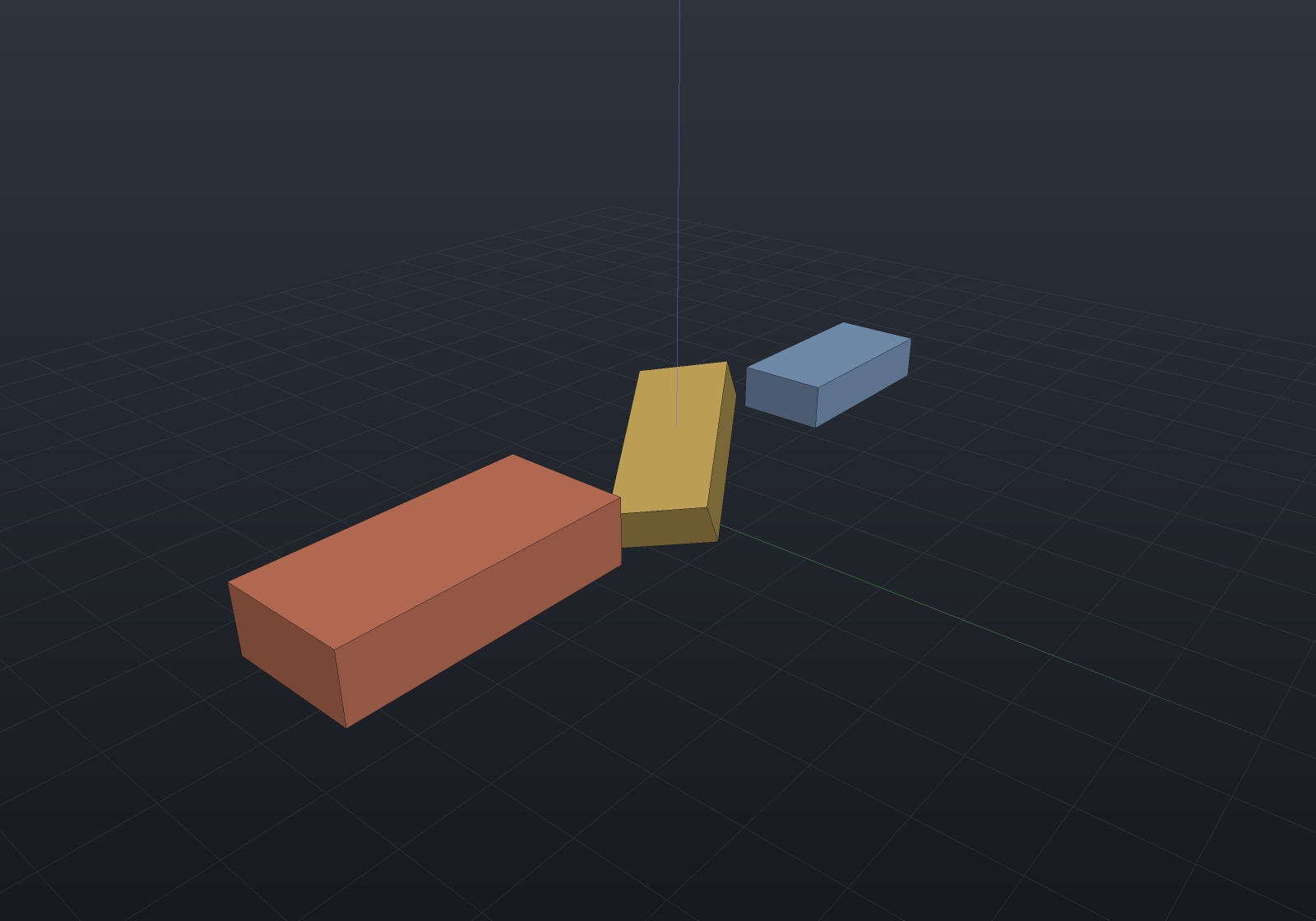
Uniform scaling keeps everything exact (feature sizes scale with it); shear and
non-uniform scale — Scale(x, y, z), OpenSCAD’s scale([x,y,z]) — are exact for
boxes, cylinders, and extrusions, and bridge or reject elsewhere — Explain names
the offending node (details).
Resize
Resized(newSize, auto?) is OpenSCAD’s resize(): measure the shape’s bounds (on
its mesh lowering — Shape.Bounds(quality)), then scale per axis about the origin so
they hit the target. A zero component keeps its axis; with the matching auto flag it
follows the first sized axis’s factor instead, which is the proportional resize:
var gear = Shape.Cylinder(12, 4) - Shape.Cylinder(4, 5);
var scene = new Scene();scene.Add(new Part("original", gear, Palette.Steel));// Proportional: x to 16, y and z follow (factor 2/3).scene.Add(new Part("resized", gear.Resized((16, 0, 0), auto: true).Translate(24, 0, 0),    Palette.Brass));// Per-axis: an elliptical squash - B-Rep keeps it exact (cylinders become ellipses,// and those rims tessellate at segmentsPerCircle like any other angular curve).scene.Add(new Part("squashed", gear.Resized((24, 12, 4)).Translate(-26, 0, 0),    Palette.Coral));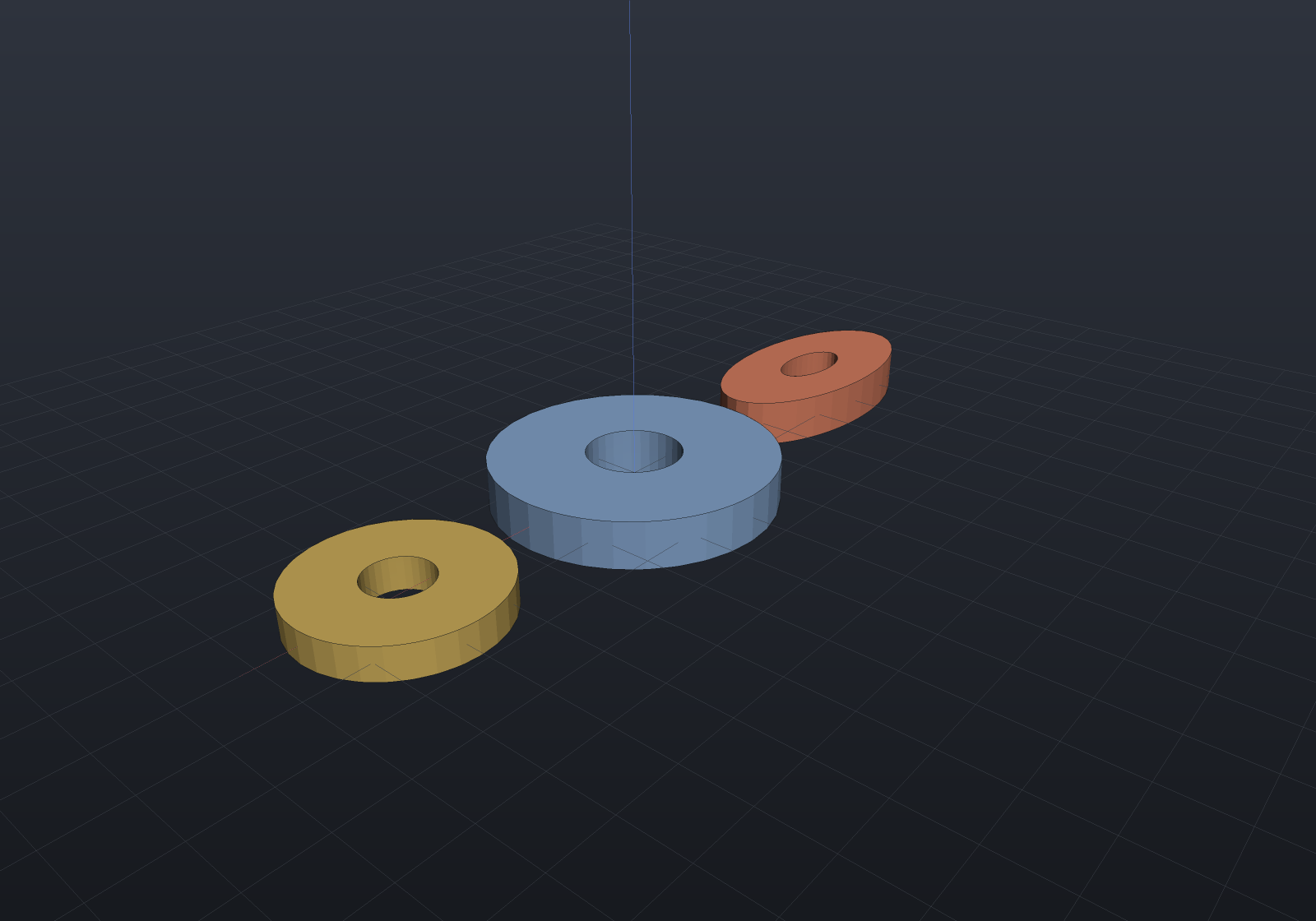
Because Resized is just a scale about the origin, representation support is the
non-uniform-scale story above: equal factors change nothing, unequal factors keep
boxes/cylinders/extrusions B-Rep-exact and make a sphere B-Rep-Impossible (the
message names the ellipsoid it would need) while mesh and implicit routes stay
available. The bounds are measured, eagerly, at the call — a tessellation inscribes
curved surfaces, so extremes read a chord’s sagitta small at coarse quality.
Mirror
Mirror(point, normal) reflects across the plane through point with normal
(OpenSCAD’s mirror()); Mirror(normal) mirrors through the origin. It is the way
to get left/right-hand pairs of a chiral part from one model:
// An L-bracket with an off-center boss (a genuinely chiral part) and its mirror// image across the YZ plane — the classic handed pair.var lSection = Sketch.Start(0, 0).LineTo(26, 0).LineTo(26, 4).LineTo(4, 4)    .LineTo(4, 20).LineTo(0, 20).Close();
var bracket = Shape.Extrude(lSection, 14,        SketchPlane.At((2, 7, 0), Vector3d.UnitX, Vector3d.UnitZ))    | Shape.Cylinder(2.2, 4).Translate(20, 3.5, 4);
var scene = new Scene();scene.Add(new Part("right-hand", bracket, Palette.Steel));scene.Add(new Part("left-hand", bracket.Mirror(Vector3d.UnitX), Palette.Copper));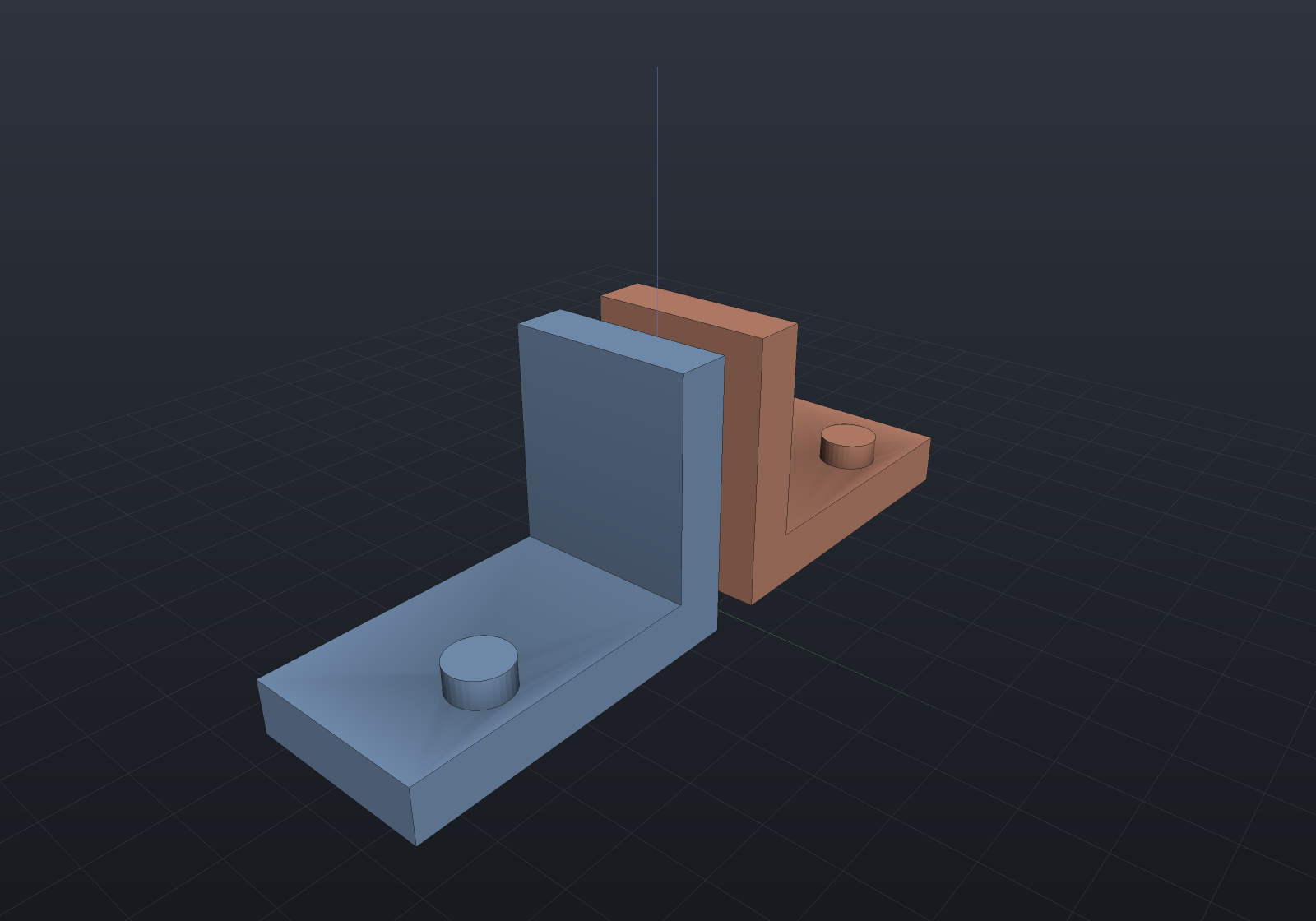
Mirroring is a single exact reflection matrix, correct in every representation: meshes transform positions and reverse triangle winding (staying outward-oriented), and the implicit lowering reflects the query point, which is exact for any SDF. B-Rep support follows the node under the mirror, and every modeling node now has a mirrored lowering: boxes, cylinders, and sketch extrusions handle any affine map (this bracket stays fully B-Rep-native); spheres, tori, and cones re-place natively under mirrored similarities; revolves sweep about the negated transformed axis (a reflection conjugates the rotation — the same identity that makes a mirrored thread the left-hand thread); sweeps need no fix at all (rotation-minimizing frames are intrinsic); and chamfers, fillets, and drilled holes follow because their geometry commutes with isometries (support matrix).
Linear patterns
PatternLinear(count, step) unions transformed copies (as a balanced tree, in every
representation). Disjoint copies become a valid multi-shell solid:
var post = Shape.Cylinder(3, 20).Translate(0, 0, 10)    .SmoothUnion(Shape.Sphere(4.5).Translate(0, 0, 22), 2);
var scene = new Scene();scene.Add(new Part("fence", post.PatternLinear(6, step: (14, 0, 0)), Palette.Teal));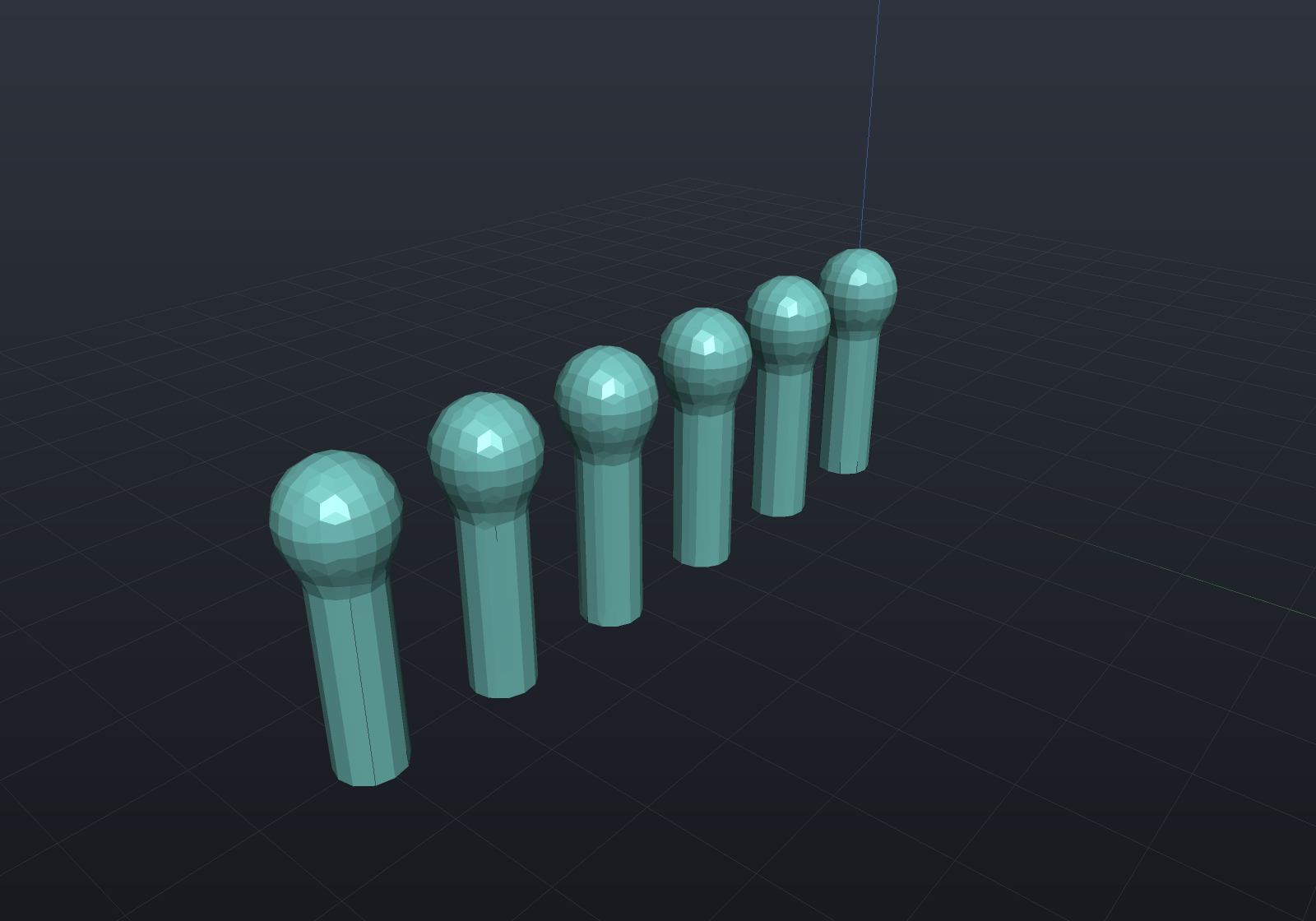
Circular patterns
PatternCircular(count, axisOrigin, axisDirection, angleStep?) revolves copies about
an axis — the classic bolt-circle / carousel layout:
var carousel = Shape.Cylinder(20, 4)    | Shape.Cylinder(3, 14).Translate(15, 0, 8)   // posts overlap the disc (tangent        .PatternCircular(8, Vector3d.Zero, Vector3d.UnitZ);  // contact is not supported)
var scene = new Scene();scene.Add(new Part("carousel", carousel, Palette.Brass,    Matrix4d.CreateTranslation((0, 0, 2))));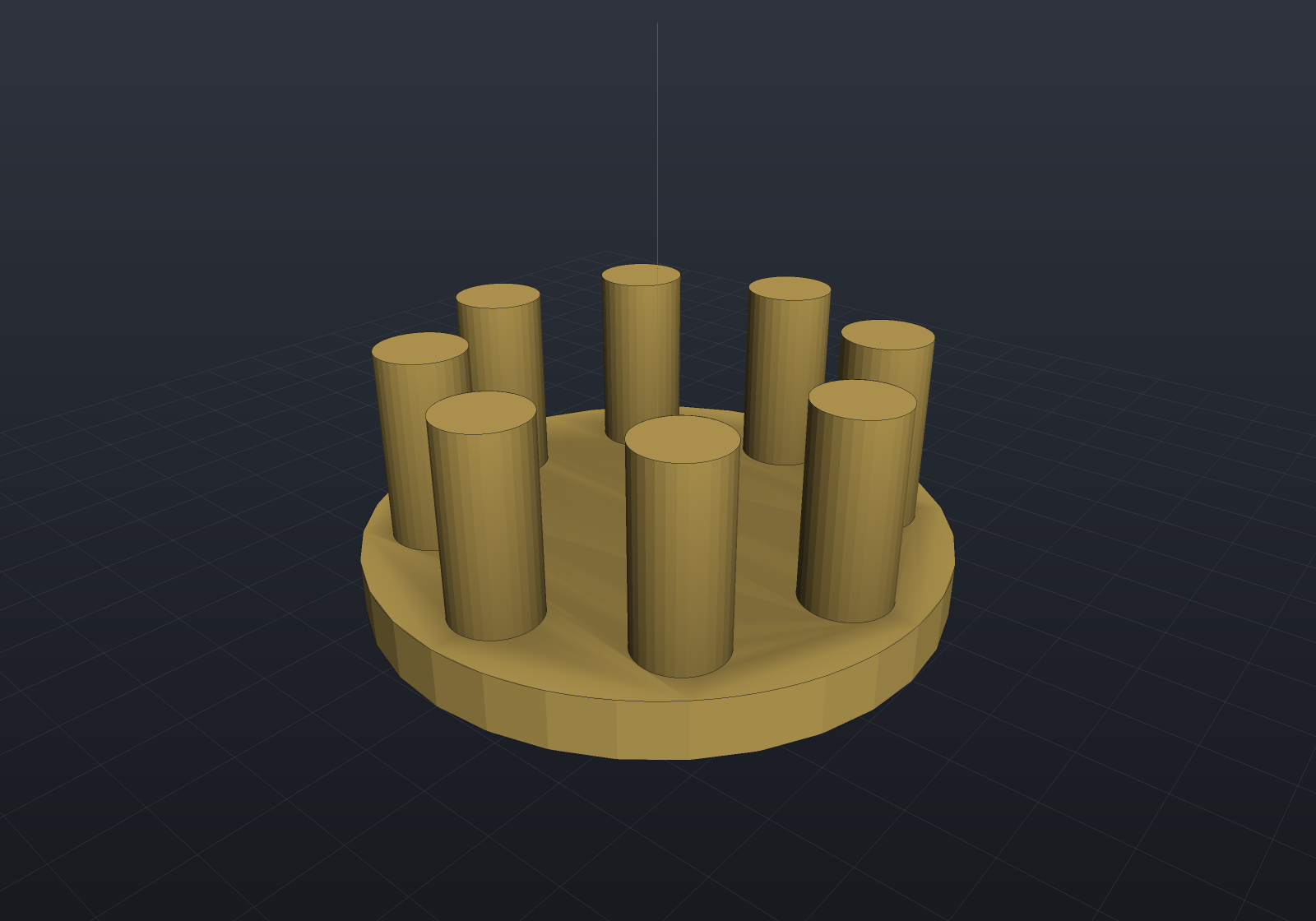
For arrays of holes, keep passing point lists to Drill — one boolean
with many tools is cheaper than patterning a drilled body.
Location sets: one layout, every consumer
“Place this feature at these N poses” is a value, not an operation:
LocationSet.Grid / Polar / PolarArc / Hex / Linear / At(points) build one,
Translate / Rotate / + compose it, and the same value feeds Shape.Drill,
Shape.Pattern and ComponentAssembly.Place — build123d’s
GridLocations/PolarLocations/HexLocations and CadQuery’s
pushPoints/rarray/polarArray as one idea instead of three:
// One layout value: a bolt circle plus two dowel positions.var bolts = LocationSet.Polar(6, 18);var dowels = LocationSet.At(new Vector2d(32, 0), new Vector2d(-32, 0));
// The same LocationSet vocabulary drives holes and patterns alike.var top = SketchPlane.At((0, 0, 8), Vector3d.UnitX, Vector3d.UnitY);var plate = Shape.Extrude(Sketch.Circle(40), 8)    .Drill(StandardHoles.Clearance(5), bolts, 20, top)    .Drill(HoleSpec.Simple(4), dowels, 20, top);
// Pattern stamps a copy per location: the rib is modeled at the plane origin and// each polar location moves AND rotates it (rotate: false would keep copies upright).var rib = Shape.Box(10, 3, 4).Translate(31, 0, 8);var ribbed = plate | rib.Pattern(LocationSet.Polar(6, 0, Math.PI / 6));
var scene = new Scene();scene.Add(new Part("ribbed plate", ribbed, Palette.Steel));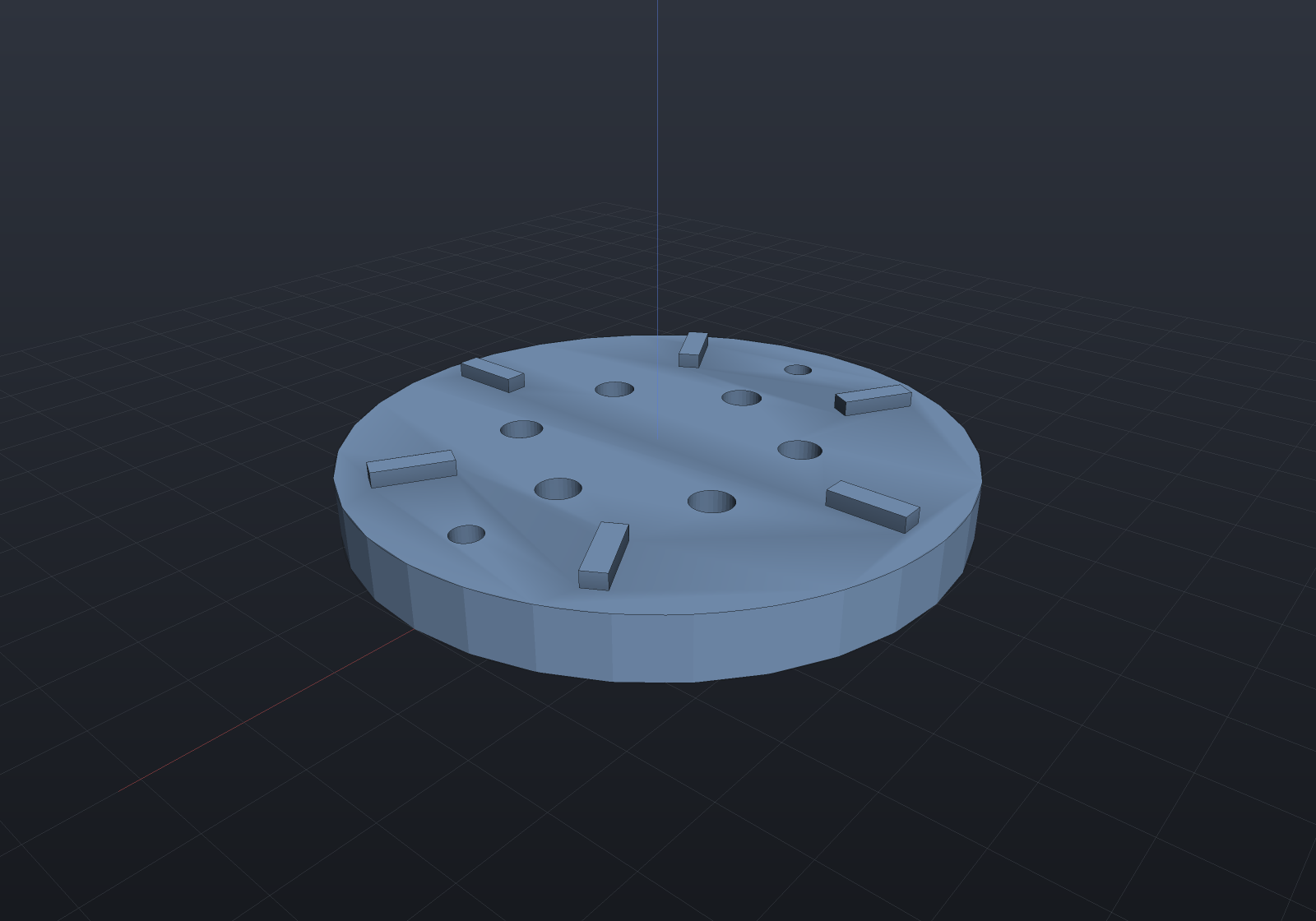
Points run deterministically (grids x-fastest and centred, polar counter-clockwise
without repeating the seam; hex fields are the closest packing at the given pitch),
and each location carries an in-plane rotation that Pattern honors — a polar
location turns its copy with its position, exactly matching PatternCircular of the
pre-translated shape. Everything is serializable the way
geometry references are: Descriptor is a canonical parseable
string (grid(3,2,10,8), translate([5,0],hex(3,3,6))) that LocationSet.Parse
reconstructs bit for bit, so a [Param] location set is an honest regeneration cache
key and survives feature JSON.
var layout = (LocationSet.Grid(3, 2, 10, 8) + LocationSet.Polar(4, 30)).Rotate(0.2);var parsed = LocationSet.Parse(layout.Descriptor);if (parsed.Descriptor != layout.Descriptor) throw new Exception("descriptor drifted");for (int i = 0; i < layout.Count; i++){ if (parsed[i] != layout[i]) throw new Exception($"location {i} did not round-trip bit for bit");}