The SDF vocabulary
Beyond the shapes the Shape API builds exactly, the implicit engine carries its own
primitive set and a family of domain operations that reshape space itself. Reach
for these through Shape.From(sdf) when you are already in field land — and see
dropping down to the engines
for how they come back into the modelling vocabulary.
Field primitives
Each states whether it is an exact distance or a bound:
| primitive | fidelity |
|---|---|
Sdf.RoundedBox(x, y, z, r) | exact |
Sdf.RoundCone(r0, r1, h) | exact — the hull of two spheres |
Sdf.Link(major, minor, halfLength) | exact |
Sdf.Prism(sides, circumradius, height) | exact — regular n-gon, so 3 and 6 are the triangular and hexagonal prisms |
Sdf.Wedge(x, y, z, topX, topOffsetX) | exact — the field twin of Shape.Wedge |
Sdf.Pyramid(baseSize, height) | exact |
Sdf.Ellipsoid(a, b, c) | a bound — see below |
Sdf.ConvexPolyhedron(halfSpaces) | exact — ConvexDistance.HalfSpaceBound asks for the cheap lower bound instead |
var scene = new Scene();scene.Add(new Part("rounded box", Shape.From(Sdf.RoundedBox(20, 20, 20, 5)), Palette.Steel, Matrix4d.CreateTranslation((-40, 0, 12))));scene.Add(new Part("hex prism", Shape.From(Sdf.Prism(6, 11, 24)), Palette.Brass, Matrix4d.CreateTranslation((0, 0, 12))));scene.Add(new Part("round cone", Shape.From(Sdf.RoundCone(9, 3, 18)), Palette.Teal, Matrix4d.CreateTranslation((40, 0, 0))));scene.Add(new Part("link", Shape.From(Sdf.Link(9, 3, 6)), Palette.Coral, Matrix4d.CreateTranslation((0, 40, 12))));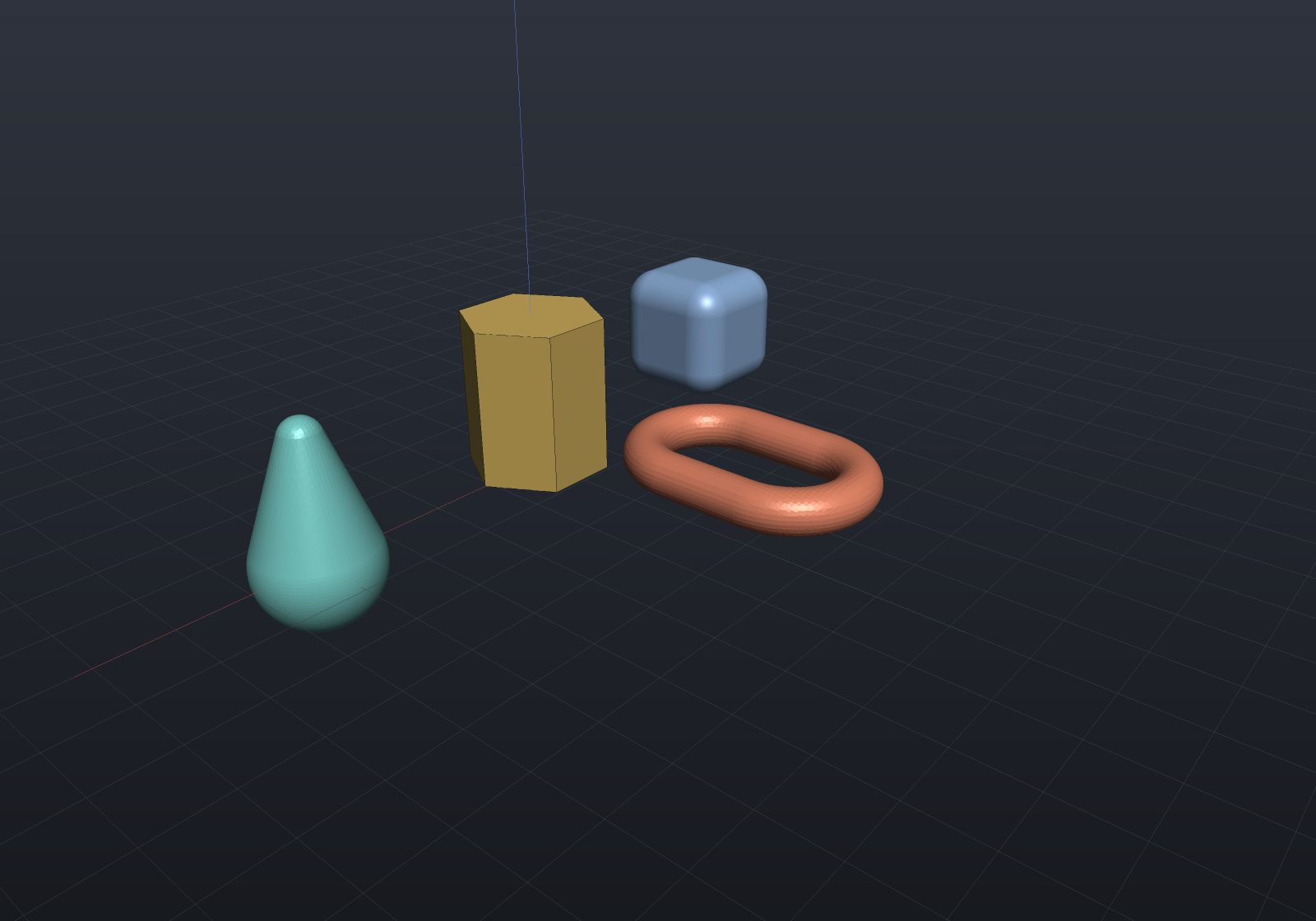
The ellipsoid is the one with no closed form
A point’s distance to an ellipsoid is the root of a degree-6 polynomial, so every
practical ellipsoid field is an approximation. Sdf.Ellipsoid uses the standard
scaled-implicit form, and rather than repeat the folklore that “the error grows with
eccentricity”, here is the measurement — reported distance over true distance, against an
exact Lagrange-multiplier oracle:
| aspect ratio | 1 | 1.25 | 1.67 | 3 | 4 | 10 |
|---|---|---|---|---|---|---|
| outside | 1.000 | 0.983 | 0.916 | 0.675 | 0.544 | 0.238 |
| inside | 1.000 | 1.081 | 1.369 | 2.076 | 2.673 | 6.585 |
Two things follow. Outside the solid it is a genuine lower bound — never nearer than the truth, which is what meshing, culling and offsetting need — and equal semi-axes reduce it to the sphere’s exact distance. Inside, it over-reports depth, so do not read a wall thickness off an eccentric ellipsoid’s field. The sign is exact everywhere.
One more thing is worth knowing before you probe near the middle of a very eccentric
one: the field is genuinely discontinuous at the centre. Approaching the origin down
the long axis the value tends to −rmax and down the short axis to −rmin, so a
10 × 1 × 1 ellipsoid reads −10 and −1 a nanometre either side of its own centre. That is
maximally far from the surface, so nothing that meshes or culls it is affected, and
Sdf.LipschitzBound states the regime it covers rather than pretending otherwise.
The convex polyhedron
Sdf.ConvexPolyhedron(halfSpaces) is the escape hatch for a plane-bounded solid with no
factory — and unlike an Sdf.Intersection over the same half-spaces it reports finite
bounds, by enumerating the vertices where three planes meet and every other is
satisfied, so a polygonizer can size its own region.
It is exact. Inside, the maximum over the face half-spaces already is the distance
(for a convex body the nearest boundary point lies on the nearest face plane); outside,
that maximum understates wherever the nearest feature is an edge or a corner, so the
field takes the minimum over the solid’s own boundary triangles instead — built from the
vertices it had already enumerated. ConvexDistance.HalfSpaceBound asks for the cheap
form, which is a correct-sign lower bound at one dot product per plane rather than a
Voronoi-region test per triangle; reach for it when the polyhedron has many faces and the
outside magnitude does not matter.
Domain operations
These reshape space itself rather than combining two solids, which is what makes them cheap: the field is evaluated at a moved query point, so a lattice of ten thousand instances costs one primitive.
var bar = Sdf.Box(11, 11, 40);
// The default view looks down −X, so the parts read left to right in decreasing x.var scene = new Scene(new MeshQuality { SdfResolution = 140 });scene.Add(new Part("twist", Shape.From(bar.Twist(radiansPerUnit: 0.055)), Palette.Teal,    Matrix4d.CreateTranslation((54, 0, 22))));scene.Add(new Part("taper", Shape.From(bar.Taper(bottomScale: 1.0, topScale: 0.3)), Palette.Brass,    Matrix4d.CreateTranslation((18, 0, 22))));scene.Add(new Part("bend", Shape.From(Sdf.Box(40, 11, 7).Bend(curvature: 0.028)), Palette.Coral,    Matrix4d.CreateTranslation((-18, 0, 22))));scene.Add(new Part("elongate", Shape.From(Sdf.Sphere(7).Elongate((0, 0, 13))), Palette.Slate,    Matrix4d.CreateTranslation((-54, 0, 22))));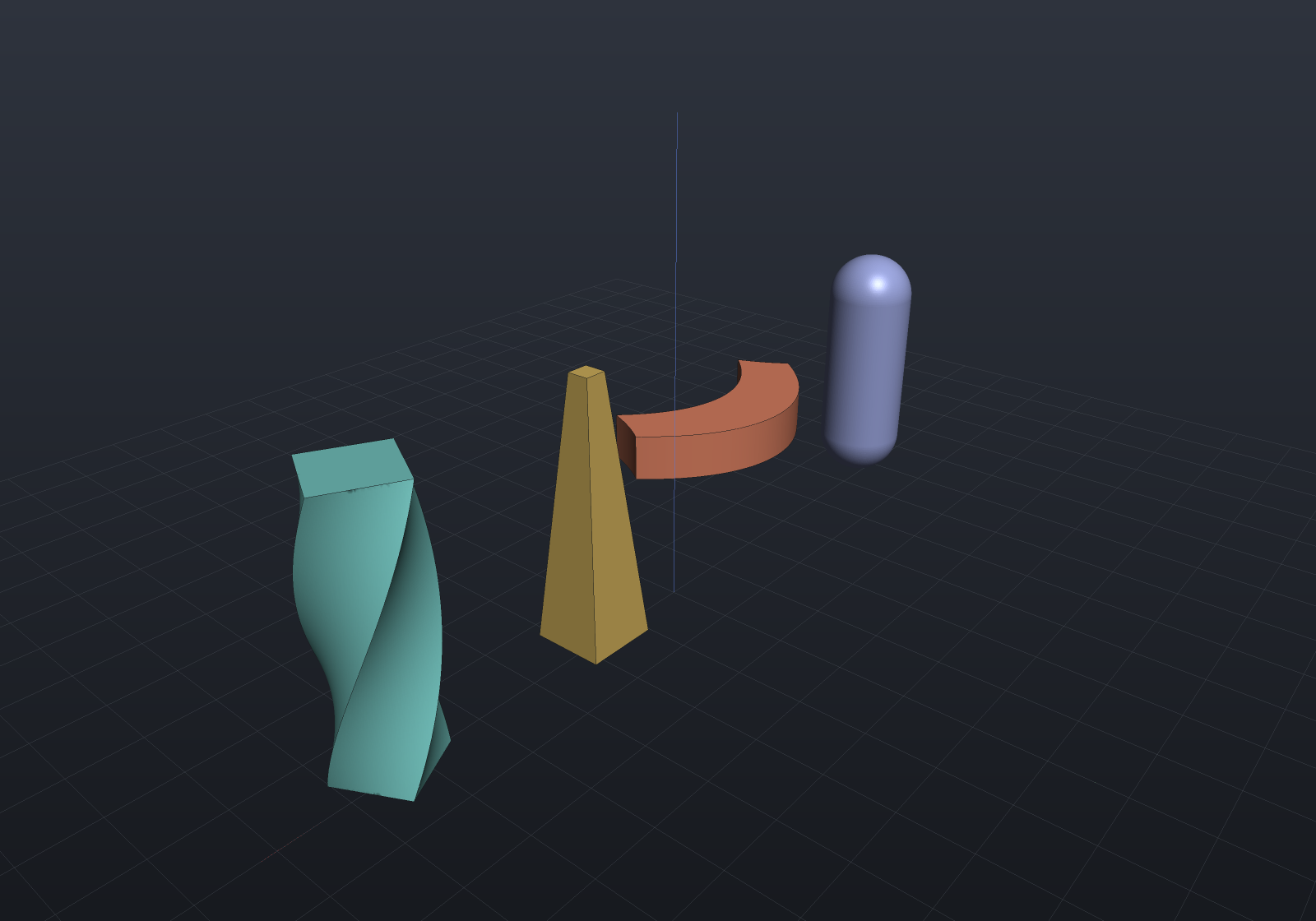
Displace(amplitude, frequency) adds a sinusoidal ripple — knurling, texture, a
grip surface:
var knurled = Sdf.Cylinder(14, 30).Displace(amplitude: 0.9, frequency: (1.4, 1.4, 1.4));
var scene = new Scene(new MeshQuality { SdfResolution = 190 });scene.Add(new Part("knurled boss", Shape.From(knurled), Palette.Brass,    Matrix4d.CreateTranslation((0, 0, 16))));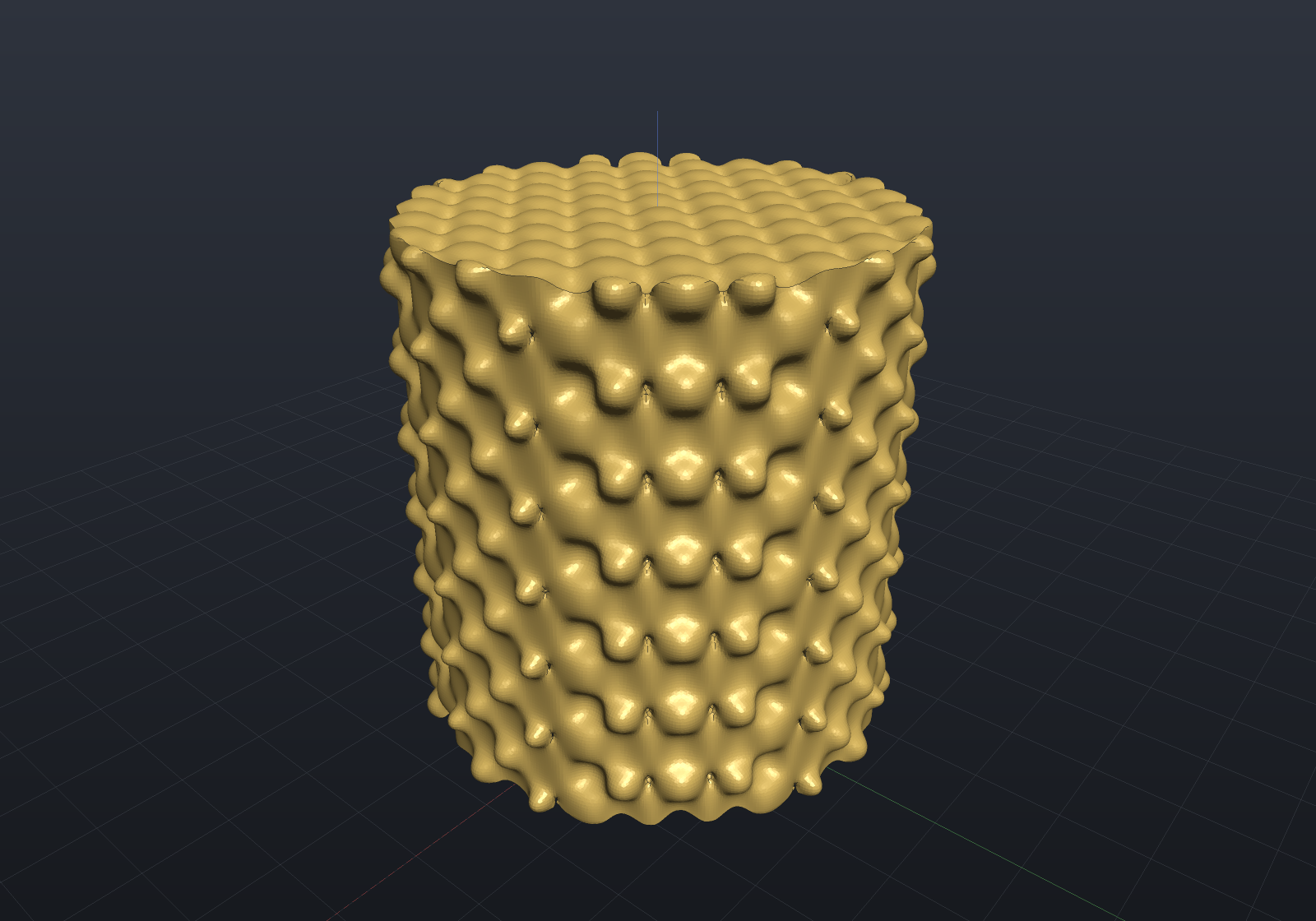
The ripple is a product of three sines, so a zero frequency component makes it
identically zero rather than two-dimensional. And it is the one operation here that adds
a value rather than moving a point, which is why its bounds carry a precondition:
material appears wherever the child reads below the amplitude, so the reported bounds are
right as long as the child never reports less than the escape from its own bounds. Every
primitive and every boolean satisfies that — including a difference near its subtracted
tool, which is the case you would expect to break it — but a Twist, Bend or Taper
underneath does not, so state the region yourself there:
var bumpy = tapered.Displace(0.8, (4, 4, 4), bounds: tapered.Bounds.Expanded(2.4));Repetition
Repeat(spacing) tiles a solid over an infinite lattice, and Repeat(spacing, counts)
gives it a finite count. Both cost one child evaluation per neighbouring cell rather than
one per instance, so the count is free:
var pins = Sdf.Cylinder(2.5, 18).Repeat((10, 10, 0), new Vector3i(6, 4, 1));var plate = Sdf.Box(70, 46, 5).Translate((25, 15, -11));
var scene = new Scene(new MeshQuality { SdfResolution = 200 });scene.Add(new Part("pin field", Shape.From(pins | plate), Palette.Steel,    Matrix4d.CreateTranslation((-25, -15, 14))));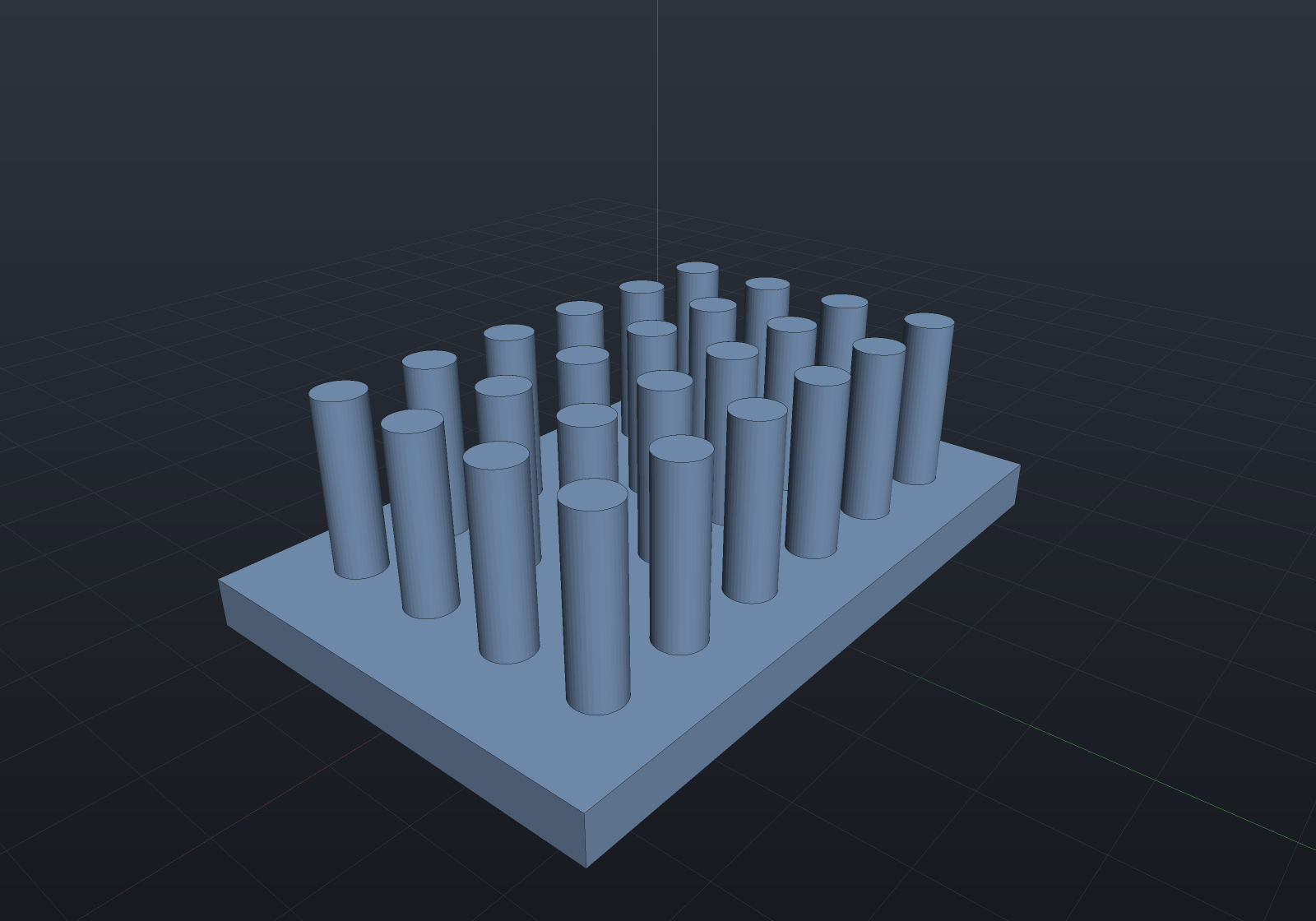
The child must fit inside one cell, and that is enforced rather than assumed: outside
that condition a query point can lie inside an instance the evaluation never visits, and
the sign would be wrong. The refusal names the span it measured. (That precondition is
also why Repeat cannot build a strut lattice
— a strut spans its whole cell, so its capsule overhangs by the radius.)
What these cost you: the distance stops being a distance
A translate, a rotate, a mirror and a repetition are isometries — they move points without changing lengths — so the field stays an exact distance. A twist, a bend and a taper are not: they shear or stretch space, so the value changes faster than the query point moves. Three consequences, all handled for you but worth knowing:
- the sign stays exact everywhere (the solid is exactly the pre-image of the child), so booleans, meshing and inside/outside classification are unaffected;
- the magnitude becomes an over-estimate of the true distance, by at most a factor the
node computes and reports (
Sdf.LipschitzBound), so do not read a wall thickness or a clearance off a twisted field; - the polygonizer, the narrow-band grid and the remesher’s projection each widen by exactly that factor, which is why a twisted lattice meshes correctly instead of losing slivers of geometry. That factor is 1 for every exact field, so nothing else pays for it.
Compiling a field
Sdf.Compile() flattens a whole AST into one delegate, removing the virtual call per node
per query. It is bit-for-bit identical to the un-compiled field, and it composes like
any other node:
var probe = body.Compile(); // an Sdf, with the same Bounds and the same fielddouble d = probe.Evaluate(point);Measured (win-x64, Mpts/s):
| case | scalar walk | compiled | batch (SIMD) |
|---|---|---|---|
| single sphere | 434.0 | 444.5 | 519.2 |
| bracket CSG tree | 10.8 | 13.3 | 45.2 |
| deep union chain (24 nodes) | 4.8 | 12.8 | 28.0 |
So it buys 1.02×–2.67× over per-point evaluation — the win tracks how much of the cost is
dispatch rather than arithmetic — and it loses to the batch path in every case. Since
Evaluate(points, distances) is what meshing, grid bakes and section contours already use,
reach for Compile() only when you are genuinely stuck with one point at a time: a
marching solver, an interactive probe, a scattered query loop.
A compiler emitting vector kernels would beat both, and the honest headroom is small enough to be worth stating: on a union chain the marginal cost of one more node in the batch path is flat at about 1.36 ns/point from depth 4 to 48, while a lone sphere — which carries the whole AoS→SoA transpose by itself — costs 1.85 ns. So the per-node plumbing a vector compiler would remove has already been amortized to below the arithmetic.
Related
- Smooth blends, Offset, Shell — the field
operations the
ShapeAPI exposes directly - Lattices — the periodic fields
- Polygonization — turning any of these into a mesh