The three representations
EngrCAD is a hybrid kernel: it carries three different mathematical descriptions of a solid, because no single one serves precision modeling, organic geometry, and manufacturing output at once.
| What it stores | Where it wins | Its honest weakness | |
|---|---|---|---|
| B-Rep | Parametric surfaces (planes, cylinders, cones, spheres, tori, NURBS, helical) stitched into topology: Solid → Shell → Face → Loop → Edge → Vertex | Exactness — a bore is a cylinder of radius 4, an edge is a circle; STEP export, drawings, face/edge selection, feature history | Every operation must produce a surface the catalog can spell; a smooth blend has no exact form, so it refuses rather than approximates |
| Implicit | A signed distance field — one function f(x, y, z) → distance, negative inside, composed as an AST of primitives and operators | Robustness and organic shapes — booleans are min/max, so smooth blends, offsets, shells and lattices are one-liners with no topology to corrupt | There are no faces or edges to name, measure or export; a surface only appears when the field is polygonized at a chosen resolution |
| Mesh | Discrete triangles in a half-edge structure — every edge knows its twin, so adjacency is O(1) | The lingua franca: rendering, 3D printing (STL/3MF), FEA tet meshing, imported scans; booleans, remeshing, decimation and repair on arbitrary triangle sets | It is a sample — a mesh of a sphere is a polyhedron that is not a sphere, and the chord error is baked in at tessellation time |
You rarely choose up front. Model with the one Shape vocabulary and decide the
representation at the end — that is the whole design of the API.
B-Rep: exact boundaries
A B-Rep face is a region of an analytic surface, trimmed by loops of edges that are themselves exact curves. Nothing is sampled, so the model answers questions with identities rather than approximations:
var body = Shape.Box(40, 30, 10) - Shape.Cylinder(4, 40).Translate(8, 5, 0);BrepSolid solid = body.ToBrep();
// Six box faces plus one bore wall; the top and bottom carry the hole as a loop,// not as extra faces.if (solid.Faces.Count() != 7)    throw new Exception($"expected 7 faces, found {solid.Faces.Count()}");
// The bore wall IS a cylinder — its radius is the number the model was built from,// not a fit to samples.var bore = solid.Faces.Single(f => f.IsCylindrical(out _, out _, out _));bore.IsCylindrical(out _, out var axis, out double radius);if (Math.Abs(radius - 4.0) > 1e-12)    throw new Exception($"the bore carries its radius exactly; read {radius}");if (Math.Abs(Math.Abs(axis.Z) - 1.0) > 1e-12)    throw new Exception("the bore axis is exactly vertical");
That exactness is what drawings, dimensions, STEP interchange and the selection vocabulary stand on — “the cylindrical face of radius 4” is a query with a well-defined answer. It is also what makes feature edges crisp in the viewer: the overlay samples the exact edge curves, so a bore rim stays a smooth circle however coarse the display mesh is.
The cost of exactness is a refusal culture: an operation the surface catalog cannot spell (a smooth blend, a field offset, a lattice) is Impossible in B-Rep and says so, rather than shipping an approximation wearing an exact label.
// Classic B-Rep territory: a machined plate. Every face is an exact plane,// cylinder or torus band, and the fillet is topology surgery, not a mesh trick.var plate = Shape.Extrude(Sketch.RoundedRectangle(60, 40, 8), 10)    .Fillet(2, FaceSetRef.PlanarWithNormal(Vector3d.UnitZ))    .Drill(StandardHoles.Counterbored(5), [new(-20, 0), new(20, 0)], depth: 14,           SketchPlane.At((0, 0, 10), Vector3d.UnitX, Vector3d.UnitY));
var scene = new Scene();scene.Add(new Part("plate", plate, Palette.Steel));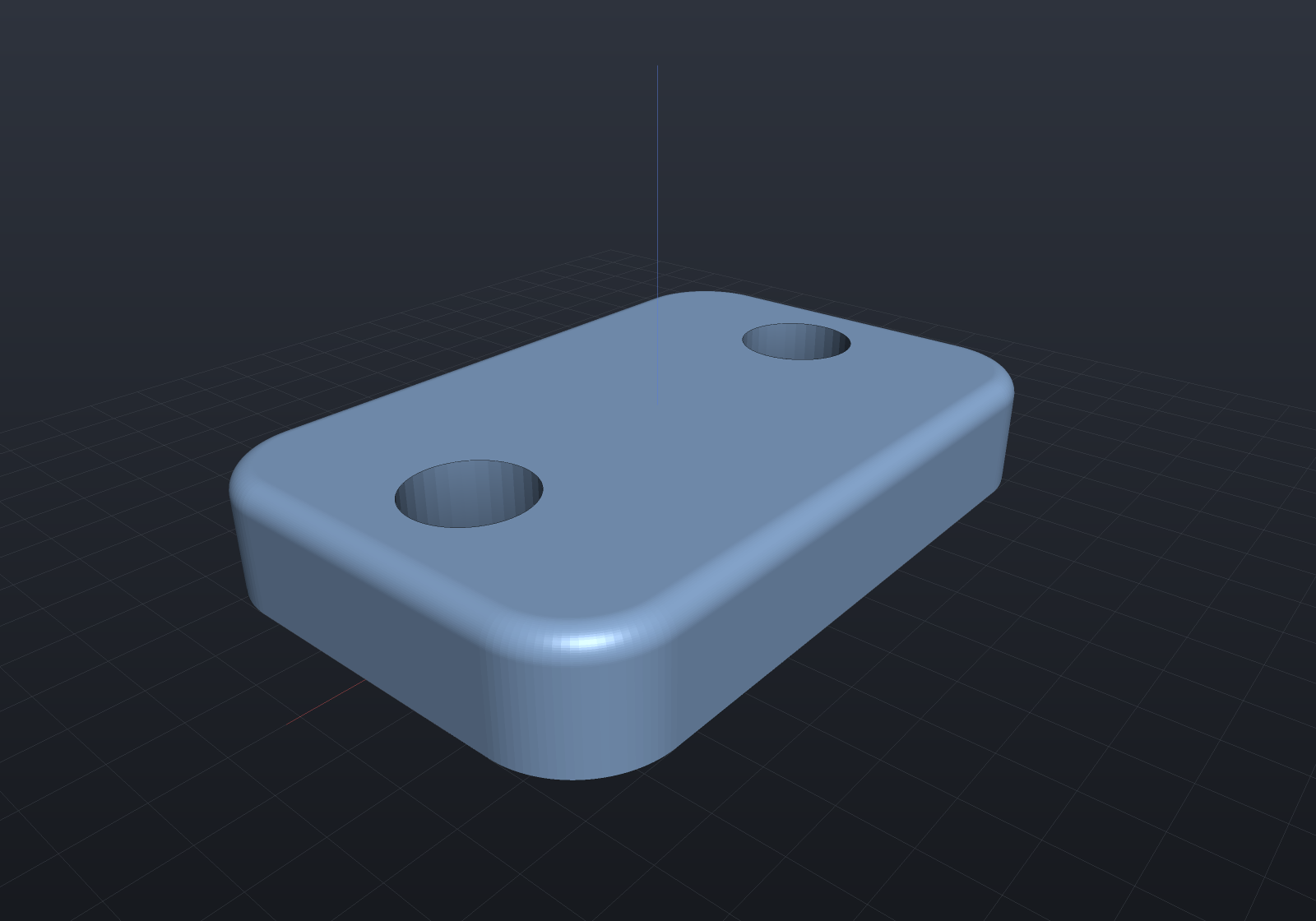
Implicit: signed distance fields
An implicit solid is not a boundary at all — it is a rule for all of space. Evaluate the field anywhere and the sign says inside or outside; the magnitude says how far the surface is:
Sdf field = Shape.Sphere(10).ToImplicit();
if (Math.Abs(field.Evaluate(new Vector3d(0, 0, 0)) - (-10.0)) > 1e-12)    throw new Exception("the centre is 10 inside");if (Math.Abs(field.Evaluate(new Vector3d(10, 0, 0))) > 1e-12)    throw new Exception("a surface point reads zero");if (Math.Abs(field.Evaluate(new Vector3d(13, 0, 0)) - 3.0) > 1e-12)    throw new Exception("a point 3 outside reads +3");
// Operations become arithmetic ON the field. An offset is one subtraction:Sdf grown = Shape.Sphere(10).Offset(2).ToImplicit();if (Math.Abs(grown.Evaluate(new Vector3d(0, 0, 0)) - (-12.0)) > 1e-12)    throw new Exception("offsetting by 2 shifts the field by exactly 2");
Because a boolean is just min (union) or max (intersection) of two fields, there
is no intersection curve to trace, no seam to weld and no topology to corrupt —
which is why the operations B-Rep refuses are native here.
Smooth blends, offsets, shells and lattices all fall out of field
arithmetic:
// Organic territory: a blended body and a gyroid-latticed sphere. Neither has any// exact boundary representation — both are one-liners as fields.var blend = Shape.Cylinder(5, 26)    .SmoothUnion(Shape.Sphere(10).Translate(0, 0, 16), blend: 6);
var lattice = Shape.Sphere(12).Lattice(Sdf.Gyroid(cellSize: 6, thickness: 1.2));
var scene = new Scene(new MeshQuality { SdfResolution = 180 });scene.Add(new Part("smooth blend", blend, Palette.Teal,    Matrix4d.CreateTranslation((-22, 0, 13))));scene.Add(new Part("gyroid lattice", lattice, Palette.Coral,    Matrix4d.CreateTranslation((22, 0, 13))));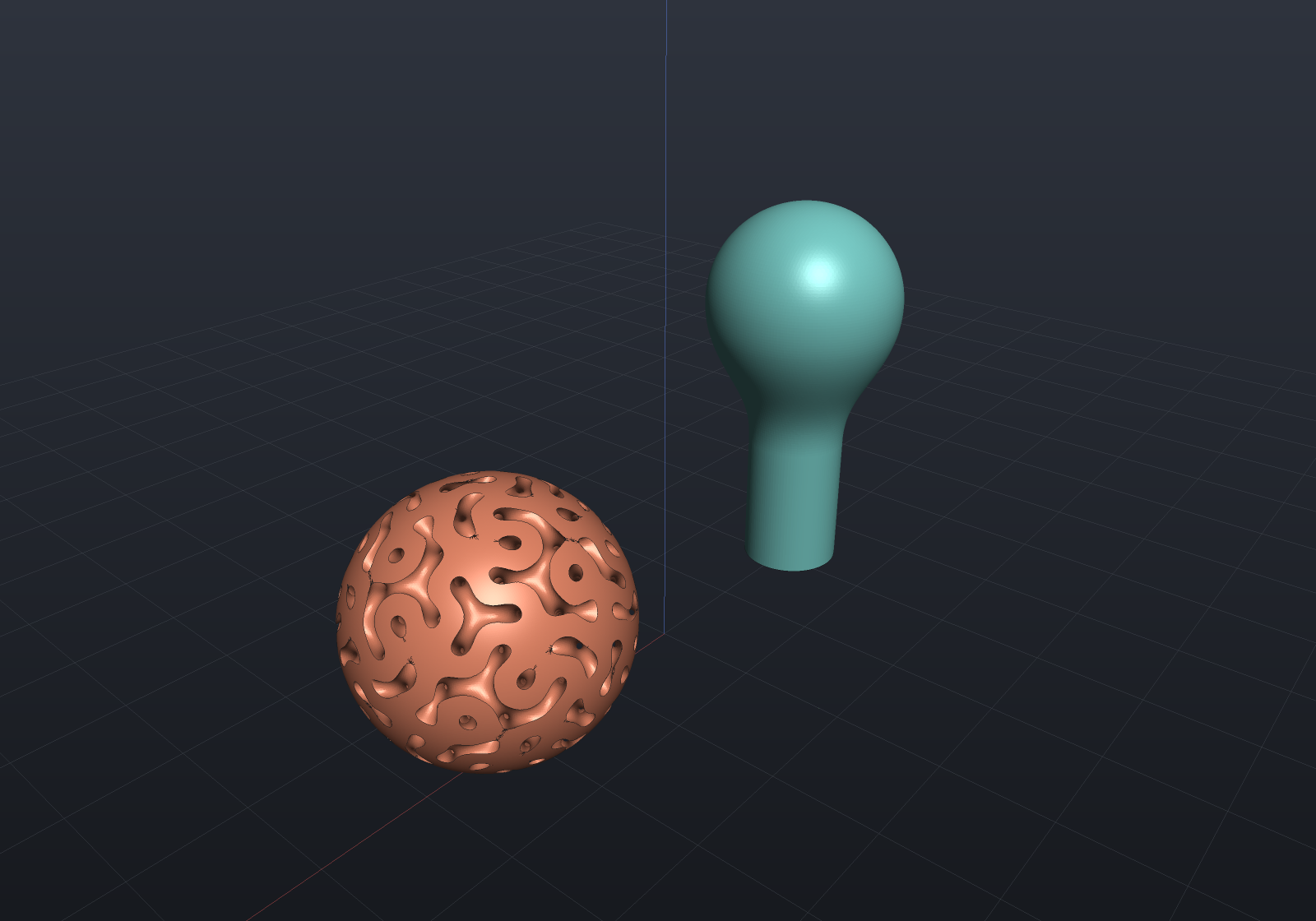
The trade: the field has no named faces, so you cannot select “the top face”, export it to STEP, or dimension an edge — and a surface only exists once Surface Nets polygonizes the field at a resolution you choose. The section-plane isolines in the viewer are the field made visible: iso-distance contours on the cut, which is wall thickness at a glance.
Mesh: discrete triangles
A mesh is the representation everything can become — the viewer draws one, a 3D printer consumes one, the FEA mesher fills one with tetrahedra, and an imported scan arrives as one. EngrCAD stores meshes in a half-edge structure (every edge knows its twin and its face), which is what makes booleans, remeshing, decimation and repair walkable in O(1) steps.
Its honest nature is that it is a sample. A tessellated cylinder is a prism over an inscribed n-gon — a different (slightly smaller) solid than the cylinder, with a volume you can write down in closed form:
double exact = Math.PI * 8 * 8 * 20;                     // the cylinder: pi r^2 h
var coarse = Shape.Cylinder(8, 20).ToMesh(new MeshQuality { SegmentsPerCircle = 16 });var fine = Shape.Cylinder(8, 20).ToMesh(new MeshQuality { SegmentsPerCircle = 128 });
// The mesh's volume is EXACTLY its inscribed n-gon prism's — an identity, not an// approximation with unknowable error:double ngon16 = 16 / 2.0 * 8 * 8 * Math.Sin(2 * Math.PI / 16) * 20;if (Math.Abs(coarse.Volume() - ngon16) > 1e-9)    throw new Exception("a mesh is the polyhedron it actually is");
// Refining converges on the true solid from inside:if (!(coarse.Volume() < fine.Volume() && fine.Volume() < exact))    throw new Exception("inscribed volumes approach pi r^2 h from below");if ((exact - fine.Volume()) / exact > 5e-4)    throw new Exception("128 segments is within 0.05% of the true volume");
So a mesh is never wrong — it is exactly right about a slightly different solid, and the difference is controlled by tessellation quality. The same wireframe seen at two densities makes the point visually:
// The same cylinder tessellated at 12 and 64 segments per circle. Shape.From(mesh)// re-enters the vocabulary, so both discrete solids sit in one scene.var coarse = Shape.From(Shape.Cylinder(8, 20).ToMesh(new MeshQuality { SegmentsPerCircle = 12 }));var fine = Shape.From(Shape.Cylinder(8, 20).ToMesh(new MeshQuality { SegmentsPerCircle = 64 }));
var scene = new Scene();scene.Add(new Part("12 segments", coarse, Palette.Steel,    Matrix4d.CreateTranslation((-14, 0, 10))) { DisplayMode = DisplayMode.Wireframe });scene.Add(new Part("64 segments", fine, Palette.Steel,    Matrix4d.CreateTranslation((14, 0, 10))) { DisplayMode = DisplayMode.Wireframe });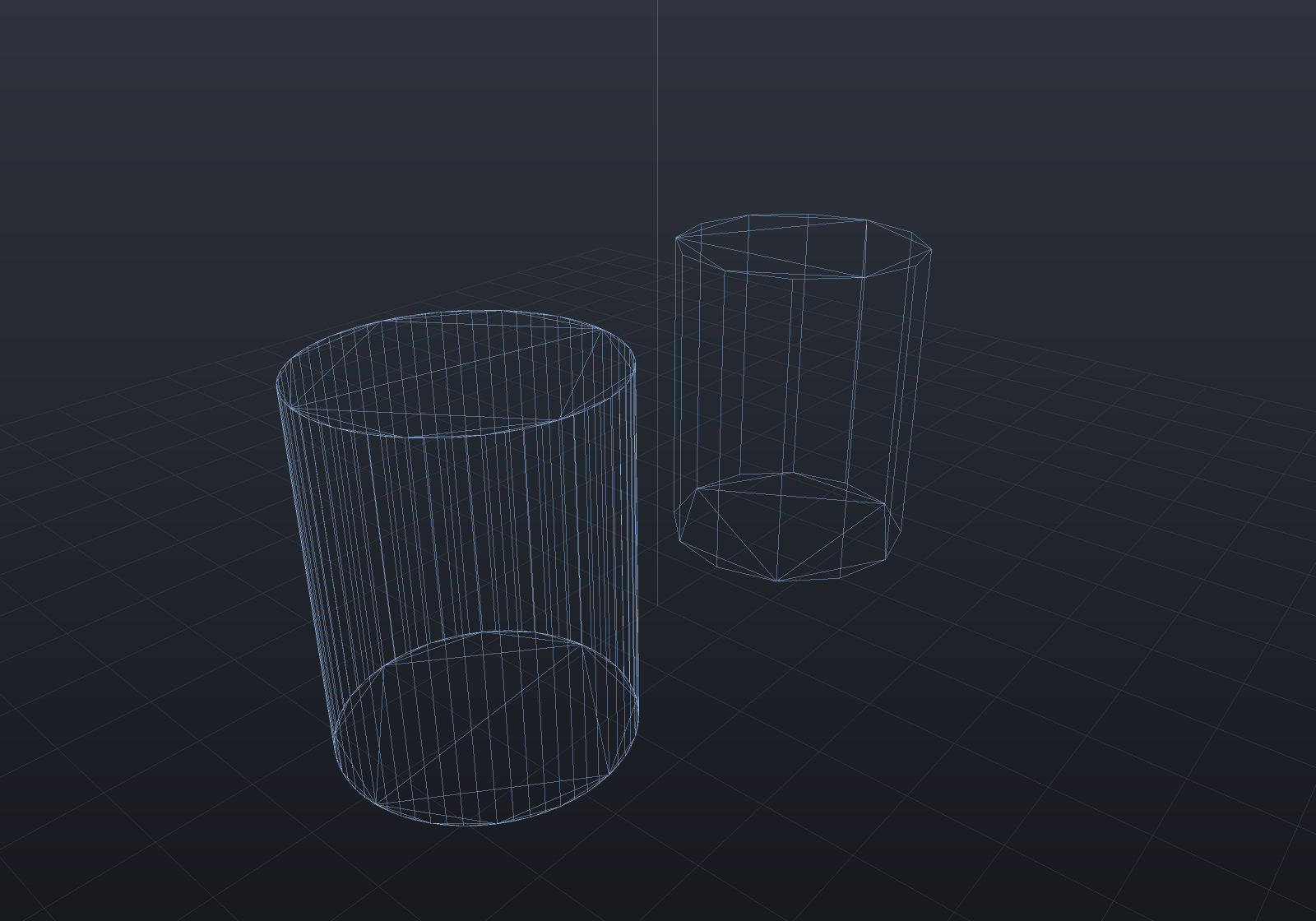
Model once, choose at the end
A Shape is an immutable operation graph, not geometry. Lowering it chooses the
engine: ToBrep() (exact solids), ToImplicit() (signed distance fields),
ToMesh() (triangles). Each lowering uses native operations where the target has
them and bridges through another representation where it doesn’t:
var model = Shape.Box(30, 21, 12)    .SmoothUnion(Shape.Sphere(7.5).Translate(0, 0, 8), blend: 4)    - Shape.Cylinder(4.5, 40).Translate(8, 0, 0);
// The smooth blend has no B-Rep form, so the B-Rep column drops it:var brepModel = Shape.Box(30, 21, 12) - Shape.Cylinder(4.5, 40).Translate(8, 0, 0);
var scene = new Scene();scene.Add(new Part("to B-Rep", Shape.From(brepModel.ToBrep()), Palette.Steel,    Matrix4d.CreateTranslation((-38, 0, 6))));scene.Add(new Part("to implicit", Shape.From(model.ToImplicit()), Palette.Teal,    Matrix4d.CreateTranslation((0, 0, 6))));scene.Add(new Part("to mesh", Shape.From(model.ToMesh()), Palette.Coral,    Matrix4d.CreateTranslation((38, 0, 6))));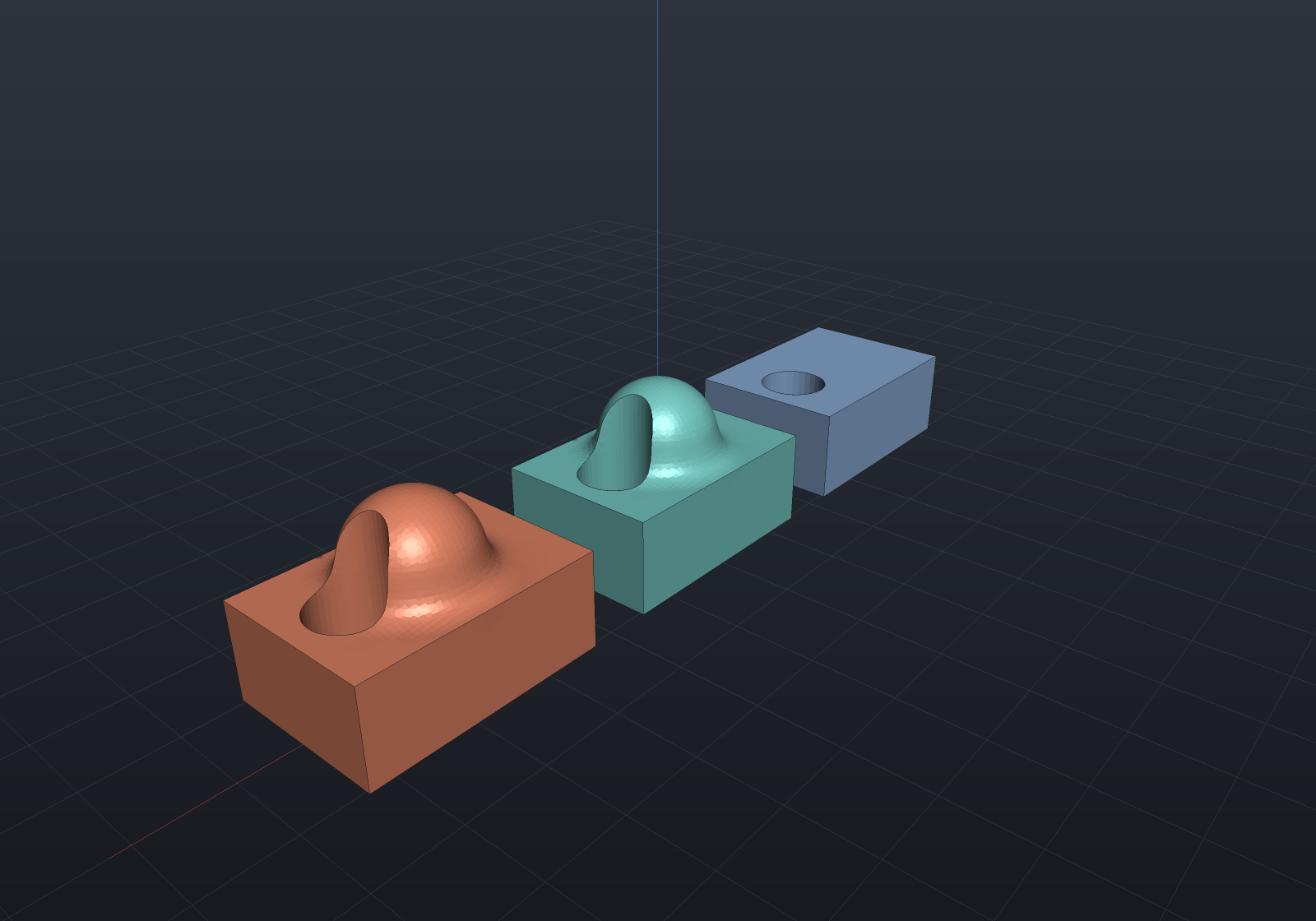
Everything is convertible to mesh — what has no B-Rep form is polygonized from
the SDF path instead, so ToMesh() and Scene.Add never reject a shape. The
bridges are the conversion triangle in EngrCAD.Interop: implicit→mesh is Surface
Nets polygonization, B-Rep→mesh is exact tessellation, and mesh→implicit is
MeshSdf (a distance field over the triangles), which is how a scanned mesh joins
field arithmetic.
Which one, when
| You want | Lower to | Why |
|---|---|---|
| STEP export, a drawing, dimensions | B-Rep | interchange and dimensioning need exact faces and edges |
| Face/edge selection, fillets, feature history | B-Rep | selectors and rim surgery are queries over exact topology |
| Smooth blends, uniform offset, shell, lattice | Implicit | field arithmetic; B-Rep refuses these by design |
| 3D printing | Mesh (via either route) | STL/3MF are triangle formats; print threads and blends via the implicit route with a clearance |
| FEA, rendering, scans | Mesh | tet meshing, the GPU and imported geometry all speak triangles |
| Mass properties | B-Rep when it lowers | tessellate-then-Richardson reaches ~1e-7 relative; mesh volumes are exact for the mesh itself |
Explain: the honest support report
Explain(target) reports the per-node plan — Native, Bridged (through
another representation; approximate but robust), or Impossible — without doing
any work. CanConvertTo is the boolean version, and impossible conversions throw
ShapeConversionException carrying the same report:
var model = Shape.Box(30, 21, 12)    .SmoothUnion(Shape.Sphere(7.5).Translate(0, 0, 8), blend: 4);
var report = model.Explain(TargetRep.Brep);Console.WriteLine(report);            // names the SmoothUnion node as Impossible
if (model.CanConvertTo(TargetRep.Brep))    throw new Exception("a smooth blend must not be B-Rep convertible");if (!model.CanConvertTo(TargetRep.Implicit) || !model.CanConvertTo(TargetRep.Mesh))    throw new Exception("the blend is native in the implicit engine and meshable");
try{    model.ToBrep();    throw new Exception("expected ShapeConversionException");}catch (ShapeConversionException ex){    Console.WriteLine($"rejected as expected: {ex.Report.Entries.Count} nodes classified");}
Transforms are never applied to finished geometry when the target can do better: the
lowering bakes the accumulated matrix into construction inputs (profiles,
directions, axes), so a rotated-then-drilled B-Rep stays exact. See
src/EngrCAD.Modeling/README.md for the full operation-by-target support matrix.
Dropping down to the engine APIs
Shape is a convenience layer, not a cage. Exit to an engine for something the
vocabulary doesn’t surface, then re-enter with Shape.From(...):
// Exit to the SDF AST for a custom field, re-enter, and keep modeling:var ripple = Sdf.Blend(Sdf.Torus(12, 4), Sdf.Sphere(9), blendDistance: 6);
var body = Shape.From(ripple)    .Union(Shape.Cylinder(2.5, 26).Translate(0, 0, 0))    .ToMesh();  // lower once at the end
var scene = new Scene();scene.Add(new Part("hybrid", Shape.From(body), Palette.Plum,    Matrix4d.CreateTranslation((0, 0, 13))));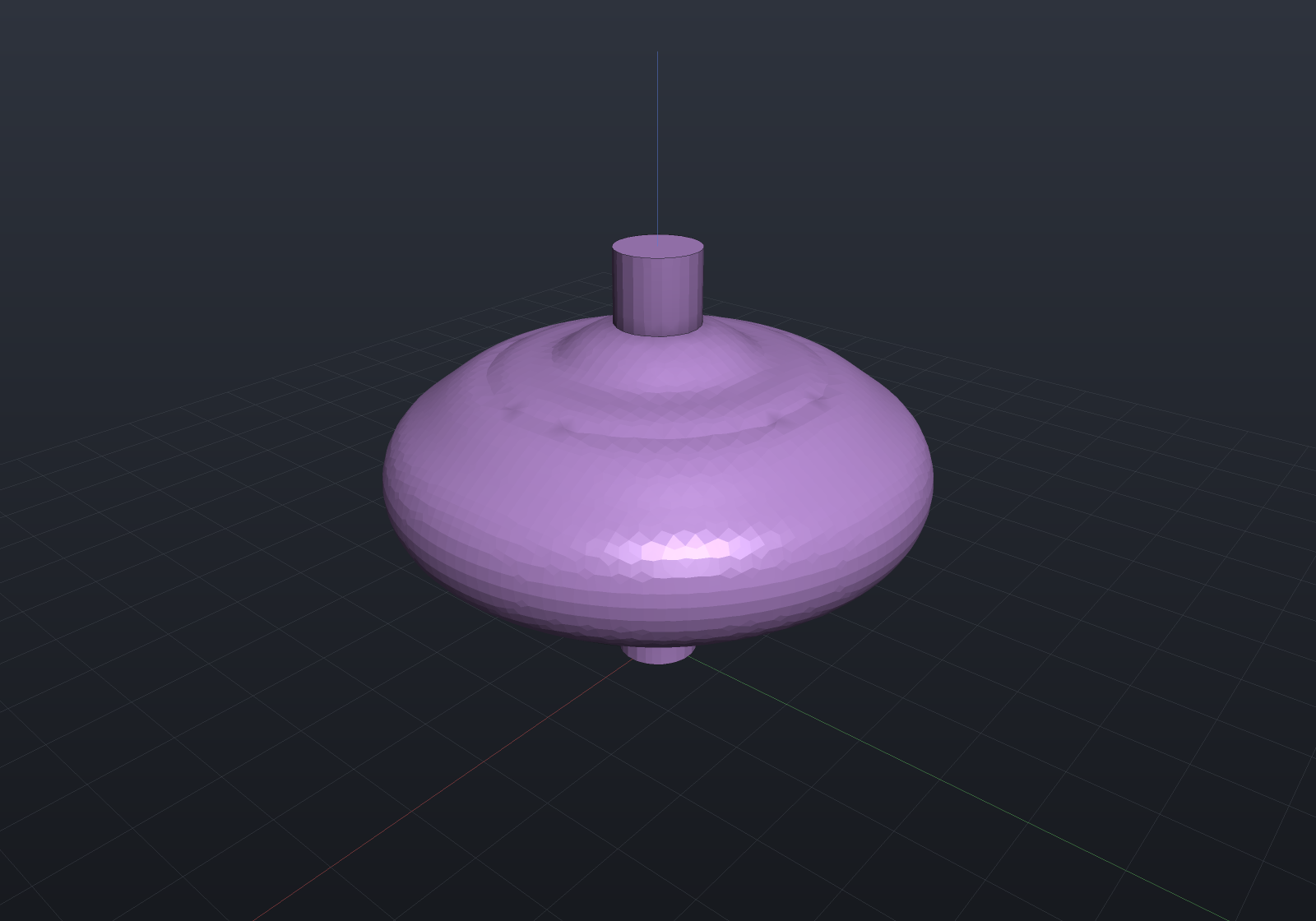
The same works in the other directions: Shape.From(brepSolid) re-enters an exact
solid after B-Rep surgery (e.g. Filleting.FilletEdge), and Shape.From(mesh) wraps
scanned or generated meshes (exact mesh SDF in implicit lowerings, direct
participation in mesh booleans).