Polygonization (implicit → mesh)
Every implicit shape becomes a mesh through Surface Nets — a dual contouring scheme
that samples the field on a grid and puts one vertex in each cell the surface passes
through. MeshQuality.SdfResolution sets the grid; MeshQuality.SurfaceNets sets how the
vertices are placed and how coarse the output may be.
Sharp features are on by default
A cell’s surface crossings all lie ON the surface, so their mean lies strictly inside every convex corner and every edge. That is what plain Surface Nets computes, so a polygonized box came back chamfered at every resolution — not as an error that refinement reduces, but as the answer the averaging rule gives.
The fix is the field’s own gradient. Sampling the normal at each crossing gives a tangent plane, and the vertex goes at the minimiser of the summed squared distance to those planes (the quadratic error function of dual contouring with Hermite data). At a box corner the three crossings report three perpendicular normals, that minimiser is unique, and it is the corner:
var body = Shape.From(Sdf.Box(20, 20, 20) - Sdf.Sphere(12.5));
var plain = new MeshQuality{    SdfResolution = 40,    SurfaceNets = new SurfaceNetsOptions { SharpFeatures = false },};
var scene = new Scene();scene.Add(new Part("averaged", Shape.From(body.ToMesh(plain)), Palette.Slate,    Matrix4d.CreateTranslation((-16, 0, 11))));scene.Add(new Part("sharp", body, Palette.Teal,    Matrix4d.CreateTranslation((16, 0, 11))));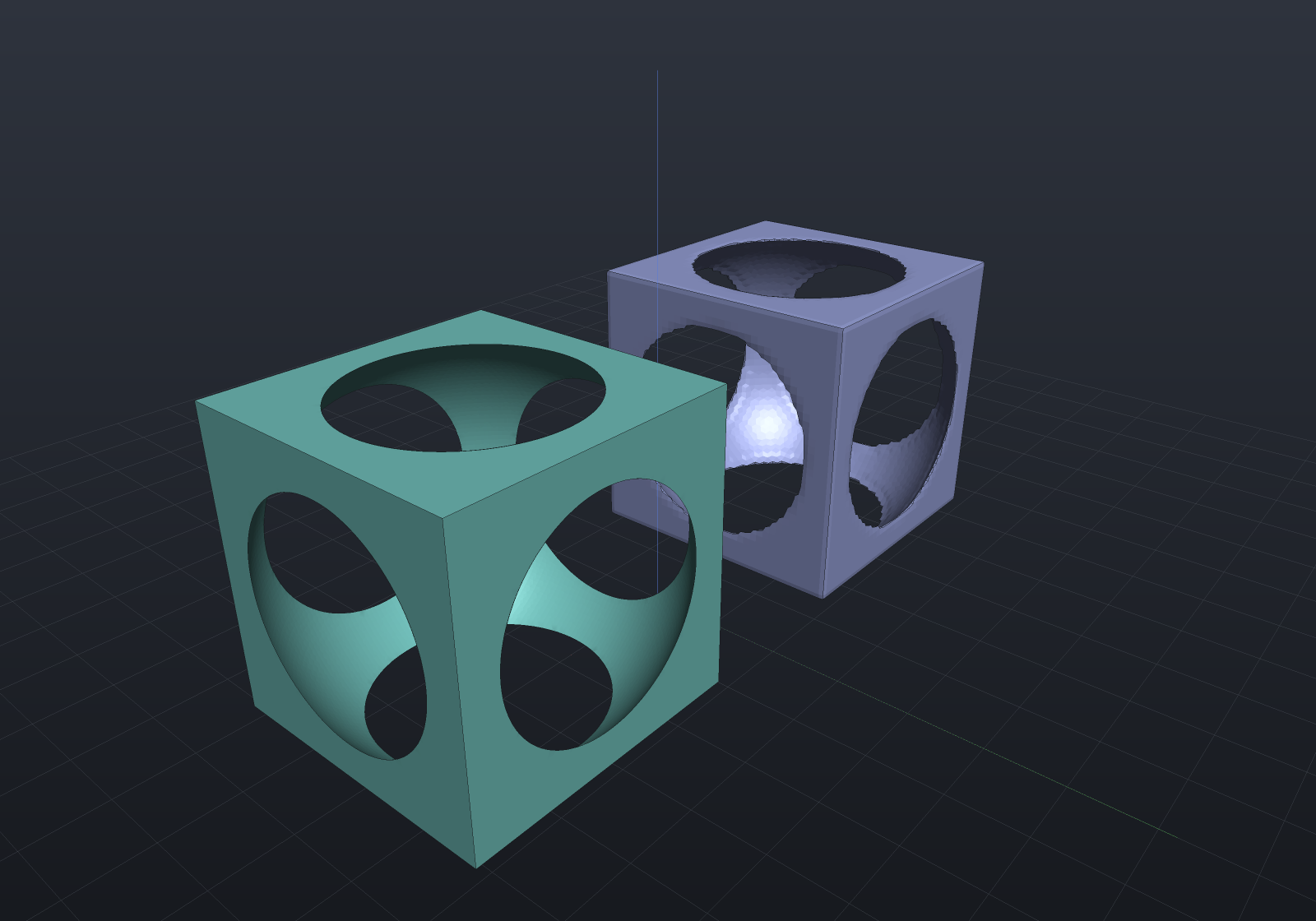
The teal solid is the default; the slate one behind it is the same field with
SharpFeatures = false. Its box edges are chamfered and its cavity rims are stepped, and
no resolution removes either.
The claim is an identity rather than a tolerance, and it is asserted as one: every vertex
of a polygonized Sdf.Box reads exactly zero from the box’s own field, and the mesh’s
volume is exactly the box’s, at every resolution and at any placement or rotation.
Smooth fields improve too, which is the other half of why this is the default rather than a mode for mechanical parts: on a curved surface the quadric is rank 1, so the vertex is projected onto the field’s own tangent plane instead of sitting inside by the chord sagitta. Measured volume error against the analytic value, averaged against sharp:
| field | resolution | averaged | sharp |
|---|---|---|---|
| sphere | 16 | −2.66% | +0.57% |
| sphere | 64 | −0.119% | +0.025% |
| torus | 32 | −2.18% | +0.46% |
| torus | 128 | −0.113% | +0.024% |
SharpFeatures = false reproduces the previous output bit for bit. The cost is about
1.6–2.1× the plain walk, falling with resolution (the extra work is per crossing, and
crossings are a surface quantity).
The feature angle
FeatureAngleDegrees (default 10) is the smallest deviation from flat that counts as a
feature. It is stated as an angle rather than as a matrix threshold because that is the
quantity a model has; below it the vertex keeps the averaged position in that direction,
which is the safe direction — declining to resolve a crease returns the incumbent answer,
where resolving one the samples barely constrain sends the vertex a long way off.
Where a vertex may go
ClampCells (default 1) bounds how far outside its own cell a vertex may be placed, and
both textbook answers are wrong. Clamping to the strict cell chamfers a rotated box’s
edges by a quarter of a cell, because a cell that sees both faces of an edge need not
contain the edge; not clamping at all lets an under-resolved lattice throw a vertex four
cells out, past its neighbours’ neighbours. One cell is the neighbourhood a cell’s own
crossings can speak about, and it is exact on every box placement while still bounding the
lattice.
Adaptive output
The grid is uniform, so a large flat face costs one quad per cell whatever the surface is
doing. SimplifyTolerance merges the cells whose merged quadric still describes the same
surface, stated as a length: the root-mean-square distance a merged vertex is allowed
to sit from the tangent planes its cluster swallowed.
var body = Shape.From(Sdf.Box(20, 20, 20) - Sdf.Cylinder(6, 30));
Part At(string name, double? tolerance, Vector3d at, PartColor colour) =>    new(name, Shape.From(body.ToMesh(new MeshQuality    {        SdfResolution = 48,        SurfaceNets = new SurfaceNetsOptions { SimplifyTolerance = tolerance },    })), colour, Matrix4d.CreateTranslation(at));
var scene = new Scene();scene.Add(At("uniform", null, (-16, 0, 11), Palette.Slate));scene.Add(At("adaptive", 0.05, (16, 0, 11), Palette.Coral));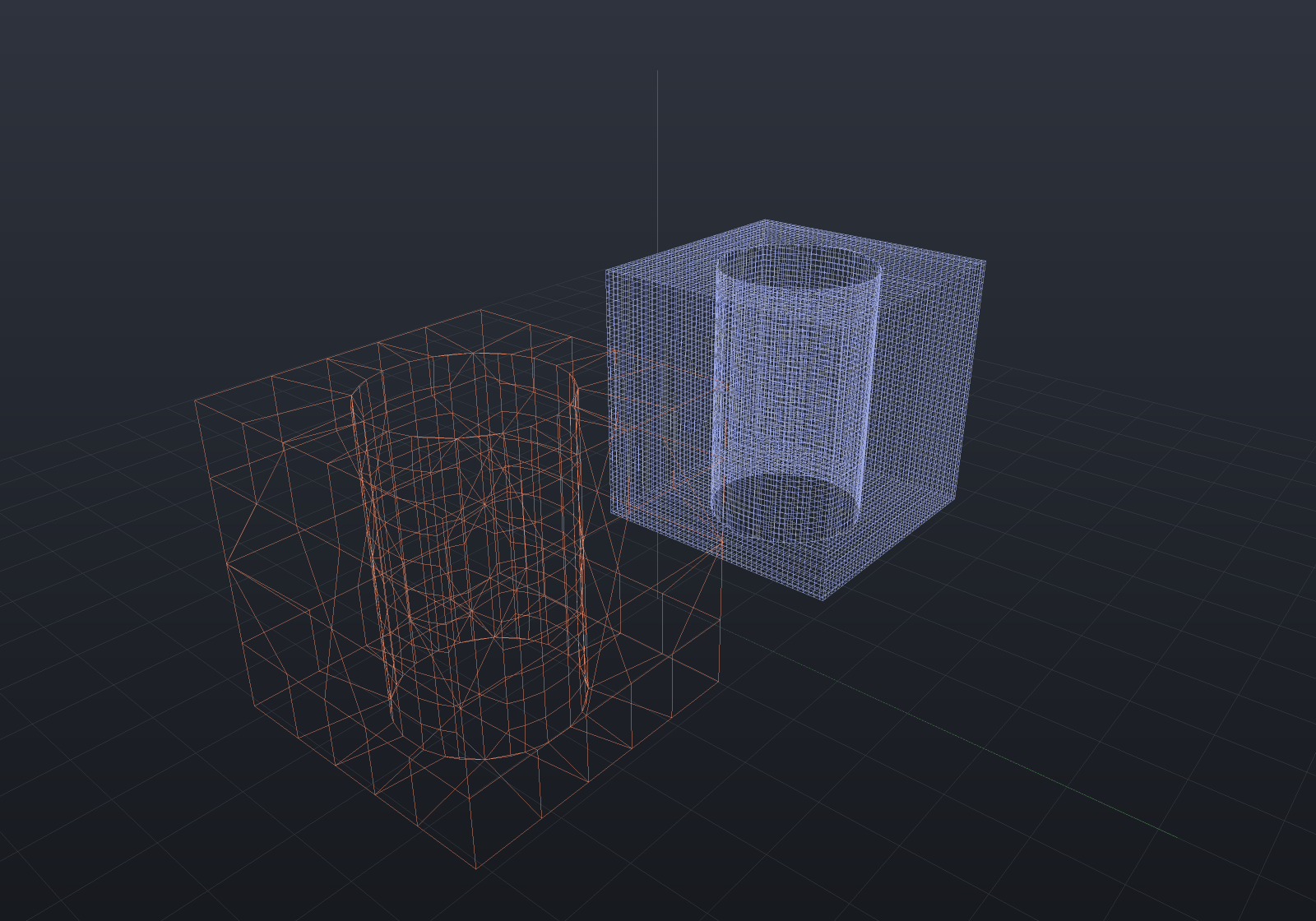
Drawn as wireframe so the difference is the thing you can see: the same solid at the same resolution, one quad per cell in slate and one quad per flat region in coral — dense only where the bore actually curves.
A box collapses to six quads with its volume still exactly 1000 — a flat region is one plane at any size, so collapsing it is provably lossless and spends none of the tolerance. A drilled box at resolution 64 goes 12 008 faces → 1 160 (10.4×) for 0.03% of volume, with the bore still round. Measured on the smooth-blend CSG fixture, the face count falls by 3.3× at resolution 48 and by 14.7× at 256 — the saving grows with the grid because the surface it is describing does not.
Two properties are structural rather than checked:
- Cracks are impossible. The connectivity is the uniform walk’s face buffer re-indexed, never re-derived, so there is no T-junction to make. A face whose corners all land in one cluster vanishes; a face straddling two becomes a triangle; every other face keeps the quad it always was.
- It is bottom-up. A top-down octree that stops subdividing where the field looks flat would save the sampling as well — and it cannot certify that no feature hides between the samples it took, which is exactly the argument the surface cull is built on. Collapsing cells the walk has already visited inherits that argument unchanged. The cost is stated: this saves faces and everything downstream of them, and saves no evaluation time.
Manifoldness is checked rather than argued: contracting a connected set of dual vertices is a manifold quotient only when its induced subcomplex is a disk, so each octant’s members are split into connected components first and any cluster implicated in a repeated corner, a duplicate directed edge or a pinched vertex link is reverted.
What it composes with
These are MeshQuality settings, so they reach every route that polygonizes a field —
Shape.ToMesh, a Part’s display mesh, --export, the MCP server and the docs renderer:
var scene = new Scene(new MeshQuality{ SdfResolution = 96, SurfaceNets = new SurfaceNetsOptions { SimplifyTolerance = 0.02 },});For the mesh-side quality knobs that apply after polygonization see remeshing; for the B-Rep side see tessellation quality.