Selecting faces and edges
Feature operations need a way to say which geometry they mean — the top face, the
largest bore, the second step of a stepped block. CadQuery answers with string
selectors (">Z"); build123d with ShapeList.sort_by/group_by/filter_by. EngrCAD
deliberately takes the second road, as plain LINQ: BrepQueries classifies
(IsPlanar, IsCylindrical, IsCircular…) and BrepSelection orders and groups —
type-safe, composable with Where/Select, and with nothing stringly to mistype.
| Query | Meaning |
|---|---|
faces.SortAlong(axis) / edges.SortAlong(axis) | Sorted ascending along a direction (stable). |
faces.Extreme(axis), .Highest(), .Lowest() | The furthest face/edge along a direction (ties keep the first — deterministic). |
faces.GroupAlong(axis)[n] | Faces grouped by level along a direction, ascending; index from the end for “one down from the top”. |
faces.GroupByCoplanar() | Groups of genuinely coplanar faces (same outward normal and same plane offset). |
faces.FilterBy(SurfaceKind.Cylindrical) | Semantic surface-kind filter: Planar, Cylindrical, Conical, Spherical, Toroidal, Revolved, Extruded, Swept, Nurbs. |
faces.LargestByArea(), .SortByArea(), face.Area() | Area queries — exact for planar faces, quadrature (~1–2%) for curved ones. |
faces.NthByRadius(n) / edges.NthByRadius(n) | The n-th smallest distinct bore/rim radius (-1 = largest). |
Every query is deterministic: ties keep input order, so a selection cannot flicker between regenerations.
Selecting rims to blend
A stepped block, its upper step found by grouping the upward faces along Z rather
than by typing its height — then chamfered by feeding the selection straight into
ChamferEdges:
// A stepped block: an L-shaped side profile (x across, z up) extruded along y.var lProfile = Sketch.Start(0, 0).LineTo(60, 0).LineTo(60, 10)    .LineTo(30, 10).LineTo(30, 22).LineTo(0, 22).Close();var block = Shape.Extrude(lProfile, 40,    SketchPlane.At((-30, 20, 0), Vector3d.UnitX, Vector3d.UnitZ));
// "The top of the upper step": the highest planar face — no coordinates typed.var stepped = block.ChamferEdges(2.5,    solid => solid.Faces.FilterBy(SurfaceKind.Planar).Highest().RimEdges());
var scene = new Scene();scene.Add(new Part("stepped block", stepped, new PartColor(0.75f, 0.62f, 0.35f)));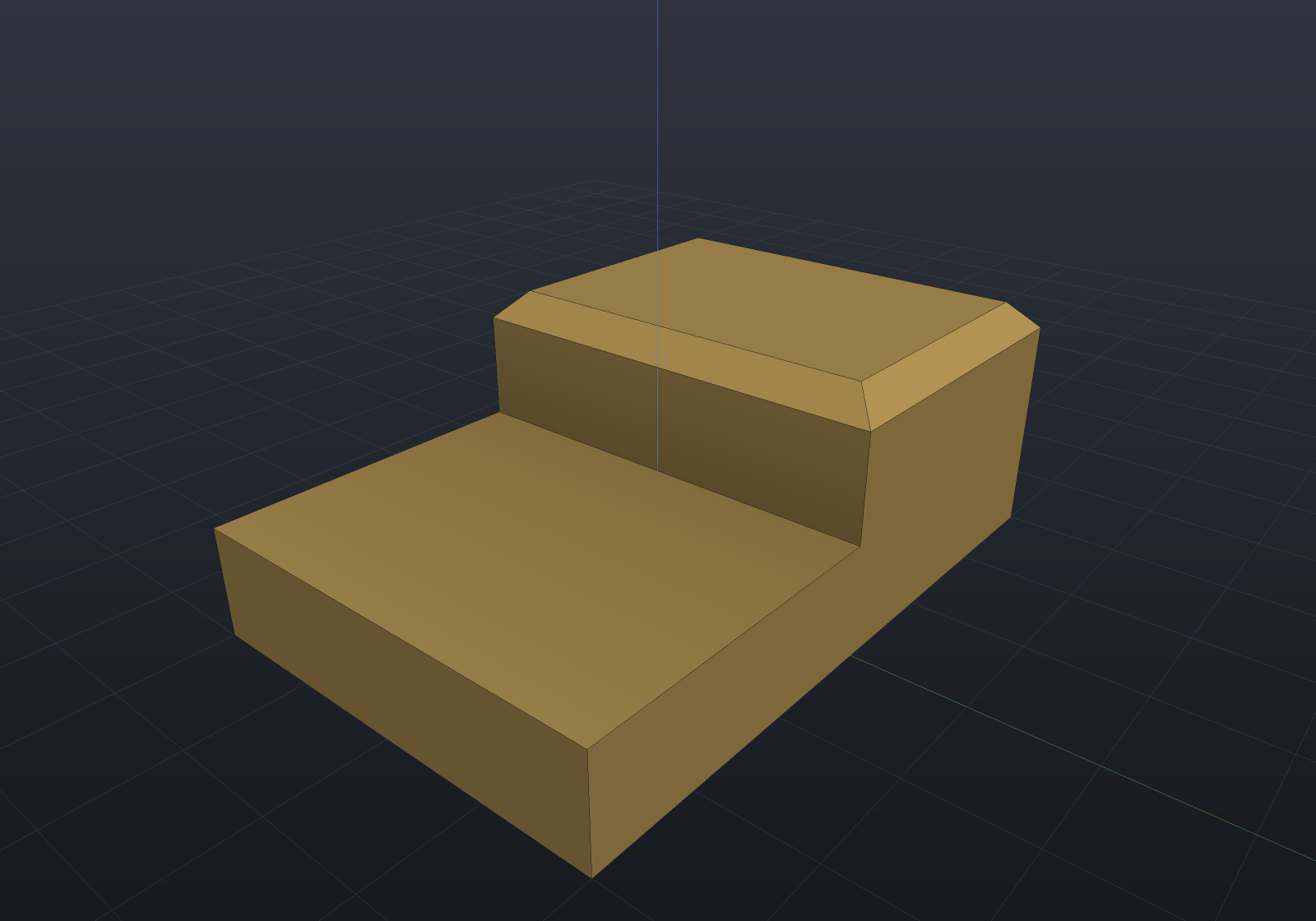
The selector runs against the lowered solid at every regeneration, so if the step grows taller the query still finds it — this is the same topological-naming story the parametric features use.
Ordering, grouping, measuring
var plateTop = SketchPlane.At((0, 0, 8), Vector3d.UnitX, Vector3d.UnitY);var plate = Shape.Extrude(Sketch.Rectangle(40, 30), 8)    .Drill(StandardHoles.Clearance(6), [new Vector2d(-10, 0)], 20, plateTop)    .Drill(StandardHoles.Clearance(3), [new Vector2d(10, 0)], 20, plateTop);var solid = plate.ToBrep();
// Sort and take extremes along any direction.var top = solid.Faces.Highest();                       // the z = 8 capvar levels = solid.Faces.GroupAlong(Vector3d.UnitZ);   // bottom / sides+bores / topif (!ReferenceEquals(levels[^1][0], top)) throw new Exception("grouping disagrees");
// Filter by surface kind, index bores by size without typing radii.var bores = solid.Faces.FilterBy(SurfaceKind.Cylindrical).ToList();if (bores.Count != 2) throw new Exception($"expected 2 bores, got {bores.Count}");var smallBore = solid.Faces.NthByRadius(0);   // the M3 clearance bore (Ø3.4)var largeBore = solid.Faces.NthByRadius(-1);  // the M6 clearance bore (Ø6.6)
// Area: exact for planar faces (arc terms closed-form), quadrature for curved.double topArea = top.Area();double expected = 40 * 30 - Math.PI * (1.7 * 1.7 + 3.3 * 3.3);if (Math.Abs(topArea - expected) > 1e-6) throw new Exception($"top area {topArea}");var main = solid.Faces.LargestByArea();if (!main.IsPlanar(out _, out _)) throw new Exception("largest face should be planar");
Area is honest about its accuracy: planar faces are exact (straight edges and
circular arcs contribute closed-form boundary-integral terms — the drilled top cap
above lands to 1e-6), while curved faces integrate by quadrature over the trimmed
parameter domain, good to a percent or two. That is ordering-grade — right for
LargestByArea — not mass-property grade; use BrepMassProperties when the number
itself matters.
Naming a construction step (Shape.Tag)
Every query above asks what a face is. Shape.Tag lets a design say where a face
came from — the persistent half of topological naming — and it answers the one question
a semantic query structurally cannot: which of two identical bosses is this?
var body = Shape.Box(80, 60, 12)    | Shape.Cylinder(6, 20).Translate(-24, 0, 6).Tag("left")    | Shape.Cylinder(6, 20).Translate(24, 0, 6).Tag("right");var solid = body.ToBrep();
// Same shape, same height, same normals: PlanarWithNormal(Z) sees two identical// candidates, and the tag tells them apart.var leftTop = FaceRef.Extreme(    FaceSetRef.PlanarWithNormal(Vector3d.UnitZ).Within(FaceSetRef.Tagged("left")),    Vector3d.UnitZ).Resolve(solid, "top");
if (Math.Abs(leftTop.Bounds().Center.X + 24) > 1e-6)    throw new Exception("that is not the left boss's top");
Tag changes no geometry in any representation and adds no row to Explain — it is a
label, not an operation. The B-Rep lowering stamps the name onto every face the tagged
sub-shape produced, and the faces carry it forward.
A tag names a SET, never “the” face. A boolean can split one face into several, and a
boss contributes both a cylinder and a plane, so FaceSetRef.Tagged is set-valued by
construction. Within narrows it against the semantic vocabulary (as above), and
FaceRef.One/FaceRef.Extreme make the “exactly one” claim deliberately, failing loudly
if it breaks. The descriptor round-trips like every other term
(within(planar([0,0,1]),tagged(left))), so a tagged selector persists with the rest of a
feature’s parameters.
Exactly where the guarantee stops
A tag is inherited wherever a face is derived from another. That covers the whole boolean pipeline (untouched faces pass through by reference and every split fragment takes its parent’s tags) and the operations that rebuild a solid face by face, each of which hands every new face its positional parent.
| Operation | Tag survives? |
|---|---|
Union / intersection / difference, Drill | Yes — including the subtracted tool’s own walls |
| Transforms, patterns, mirroring | Yes |
Shape.From(brepSolid) (which clones) | Yes |
Rim Fillet/Chamfer | Yes, on the rewritten face and its re-trimmed neighbours. The new blend bands carry nothing |
RoundEdges (whole-solid) | Yes, on each shrunk original face. The edge bands and corner patches carry nothing |
Draft | Yes — every tapered wall and both caps |
Shell(t, openings) | Yes — and a wall’s cavity twin inherits too, so one tagged face answers with two |
ShapeHealing.Heal | Yes |
| STEP export / import | No — there is no AP214 entity for provenance |
ToImplicit() / ToMesh() | Not applicable — a distance field and a triangle soup have no faces |
What carries no tag is what is genuinely new rather than derived, and that is a statement about the geometry rather than a gap: a fillet band, a corner patch and a partial run’s termination face descend from no single face, so they are left untagged instead of being attributed to one of the two surfaces they join.
The failure is deliberately one-sided: a missing tag yields fewer faces, never a face
from somewhere else. So an over-narrow selection breaks its cardinality contract loudly
instead of quietly blending the wrong edge — which is the whole reason to prefer a
conservative scheme over a clever one. Shelling is the one case that answers with more
than the design named, and it is honest rather than surprising: the cavity wall exists only
because the outer wall does, and Within narrows to whichever you meant.
Tags live inside the geometry-reference descriptor grammar, so they are restricted to ASCII
letters, digits and underscores. A tag the grammar cannot spell is refused with a
suggestion rather than sanitized: silently turning "boss top" into a descriptor that
resolves to nothing is precisely the failure mode a naming scheme must not have.
The serializable spellings
Every query has a GeometryRef spelling, so parametric features and mates can declare a selection that survives JSON round trips and re-resolves per regeneration:
var plateTop = SketchPlane.At((0, 0, 8), Vector3d.UnitX, Vector3d.UnitY);var plate = Shape.Extrude(Sketch.Rectangle(40, 30), 8)    .Drill(StandardHoles.Clearance(6), [new Vector2d(-10, 0)], 20, plateTop)    .Drill(StandardHoles.Clearance(3), [new Vector2d(10, 0)], 20, plateTop);var solid = plate.ToBrep();
var bore = FaceSetRef.NthByRadius(-1);                  // "the largest bore"var mainFace = FaceRef.Largest;                          // "the largest face"var planar = FaceSetRef.OfKind(SurfaceKind.Planar);      // "the planar faces"var step = FaceSetRef.GroupAlong(planar, Vector3d.UnitZ, -1); // "the top level"
// Descriptors are the cache key AND the serialized form — parse round-trips exactly.foreach (GeometryRef reference in new GeometryRef[] { bore, mainFace, planar, step }){    var parsed = GeometryRef.Parse(reference.Descriptor, reference.GetType());    if (parsed.Descriptor != reference.Descriptor)        throw new Exception($"descriptor did not round-trip: {reference.Descriptor}");}
var faces = bore.Resolve(solid, "Bore");if (faces.Count != 1) throw new Exception("expected the one M6 bore");
A failed query names the input and what it found — "Bore: NthByRadius: index 5 is out of range — 2 distinct radius group(s) exist (1.7, 3.3)." — rather than silently
selecting nothing.