Geometry inputs for features
A feature usually needs more than numbers: it needs somewhere to build. A
GeometryRef says which geometry, declaratively — “the top face”, “the one
planar face facing +Y”, “the bore of radius 3” — and re-resolves that query
against whatever the model looks like on this regeneration. No indices are
persisted, so an upstream parameter edit re-seats the feature instead of
breaking it.
Five reference types cover the vocabulary:
| Type | Resolves to | Cardinality |
|---|---|---|
PlaneRef | SketchPlane | exactly one |
FaceRef | BrepFace | exactly one |
FaceSetRef | IReadOnlyList<BrepFace> | at least one (.Optional() allows none) |
EdgeSetRef | IReadOnlyList<BrepEdge> | at least one |
AxisRef | Ray3d (origin + unit direction) | exactly one |
Declare one as a property and the history resolves it before Apply runs.
sealed class BasePlate : Feature{    [Param(Min = 20, Units = "mm")] public double Width { get; init; } = 60;    [Param(Min = 20, Units = "mm")] public double Depth { get; init; } = 40;    [Param(Min = 4, Units = "mm")] public double Thickness { get; init; } = 10;
    public override Shape Apply(FeatureContext c) =>        Shape.Extrude(Sketch.RoundedRectangle(Width, Depth, 5), Thickness);}
var history = new FeatureHistory();history.Add(new BasePlate());
// Default: the body's top plane, re-resolved every regeneration. Change the// plate's Thickness and these holes move up with the face they sit on.history.Add(new HoleFeature(StandardHoles.Clearance(5), [(-20, 0), (20, 0)]){    Name = "TopHoles",    Depth = 20,});
// A named face instead: the single planar face whose outward normal is +Y.// Points are then measured in THAT face's own 2D coordinates, so (0, 0) is the// middle of the side wall however wide the plate becomes.history.Add(new HoleFeature(StandardHoles.Clearance(4), [(0, 0)]){    Name = "SideHole",    Depth = 8,    Plane = PlaneRef.On(FaceRef.One(FaceSetRef.PlanarWithNormal(Vector3d.UnitY))),});
// Rim features take a face SET; the default is the +Z faces.history.Add(new ChamferRimFeature { Setback = 1.5, Name = "TopEdge" });history.Add(new ChamferRimFeature{    Name = "BottomEdge",    Setback = 1.5,    Faces = FaceSetRef.PlanarWithNormal(-Vector3d.UnitZ),});
var scene = new Scene();scene.Add(history.ToPart("bracket", Palette.Steel));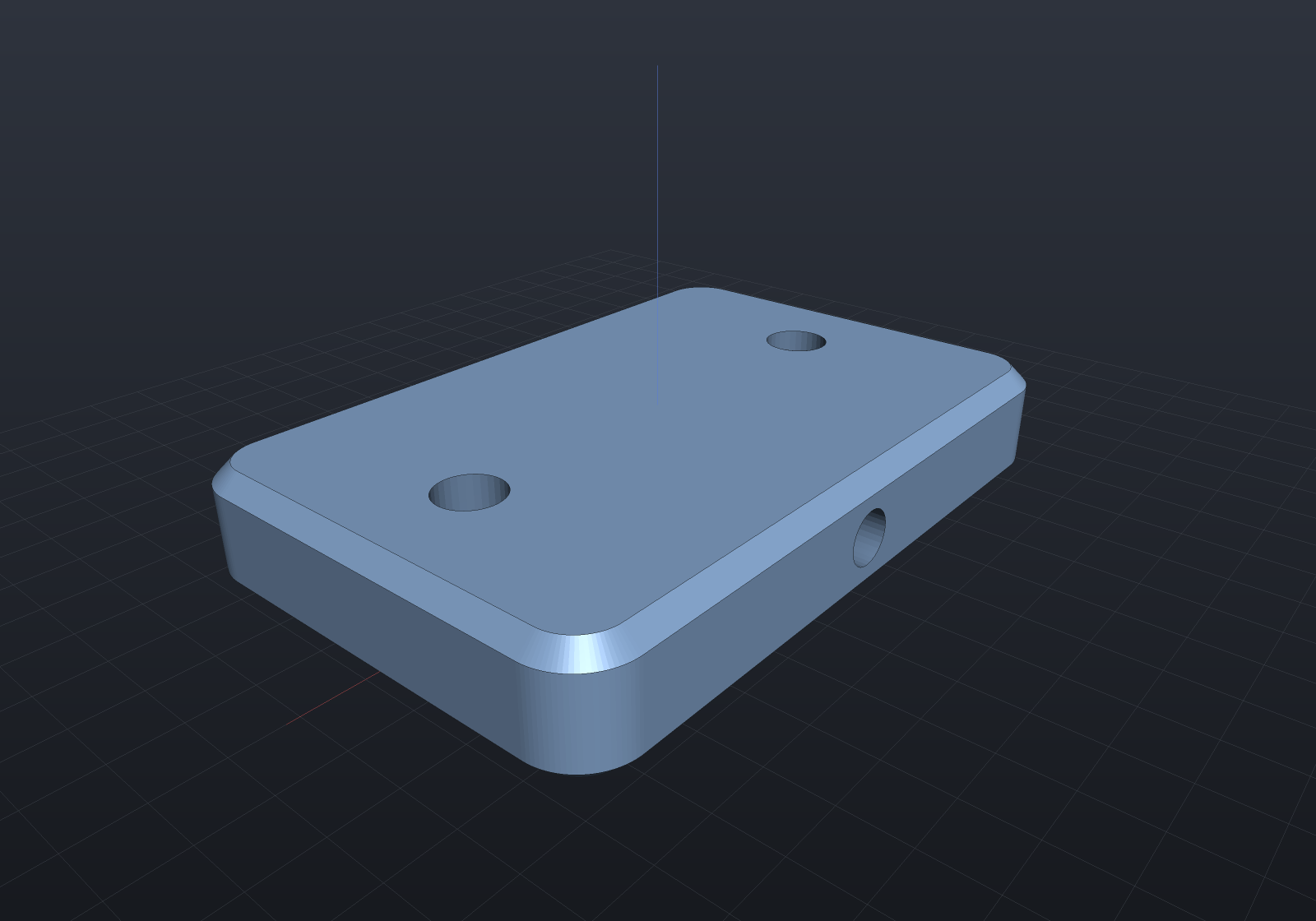
Naming geometry
Every reference is built from a small set of named queries, and they nest:
FaceSetRef.PlanarWithNormal(Vector3d.UnitZ) // upward planar facesFaceSetRef.Cylindrical(radius: 3.3) // bores of that radiusFaceSetRef.All.Optional() // an empty match is legalFaceRef.Top // the highest upward planar faceFaceRef.One(FaceSetRef.Cylindrical()) // fails if the query is ambiguousFaceRef.Extreme(faces, Vector3d.UnitX) // furthest along a directionPlaneRef.TopPlane // world-aligned, at the top face's heightPlaneRef.OnTopFace // the same face, in the face's own framePlaneRef.On(faceRef) // sketch on any planar facePlaneRef.At(SketchPlane.XY) // explicit; needs no bodyEdgeSetRef.RimOf(faces) // those faces' outer-loop edgesEdgeSetRef.Convex // the edges a chamfer removes material fromEdgeSetRef.Circular(radius: 2) // bore rimsEdgeSetRef.CircularBetween(0, 5) // every rim under radius 5EdgeSetRef.ShorterThan(2) // every edge under 2 longFaceSetRef.RimFacesOf(edges) // the complete rims covering an edge setAxisRef.OfCylindrical(FaceSetRef.Cylindrical(3)) // "pattern about that bore"AxisRef.Of(origin, direction) // explicit; needs no bodyPlaneRef.TopPlane and PlaneRef.OnTopFace pick the same face and differ
only in where 2D coordinates are measured from: TopPlane gives a
world-axis-aligned plane at (0, 0, z) (so drill coordinates stay world
coordinates), OnTopFace gives the face’s own frame, centred on the face.
A SketchPlane converts implicitly wherever a PlaneRef is wanted, and so does
a SketchPlane? whose null means “the top plane” — so existing code keeps
working unchanged.
When no named query fits, drop to a lambda:
FaceSetRef.From("wide bores", s => s.Faces.Where(f => f.IsCylindrical(out _, out _, out var r) && r > 5))FaceSetRef.Where("upward", f => f.IsPlanar(out _, out var n) && n.Z > 0.99)EdgeSetRef.From("long edges", s => s.Edges.Where(e => e.Length() > 30))Lambda-backed references work everywhere a named one does, but they cannot be
written to (or read from) a parameter file — they print as opaque(label).
Derived planes, ranking, points and neighbours
A construction plane is usually stated relative to something the model already has, so
a PlaneRef can be moved:
var solid = (Shape.Box(40, 30, 10).Translate(0, 0, 5)    - Shape.Cylinder(3, 20).Translate(-12, 0, 5)    - Shape.Cylinder(7, 20).Translate(12, 0, 5)).ToBrep();
// "30 above the top face", and "the top face tipped 30 degrees about its own x axis".var raised = PlaneRef.TopPlane.Offset(30);var tilted = PlaneRef.TopPlane.Rotated(30, (1, 0));
if (Math.Abs(raised.Resolve(solid, "plane").Origin.Z - 40) > 1e-9)    throw new Exception("offset should sit 30 above the top face at z = 10");
// It re-finds its base every time, which is the point: change the plate and the// derived plane follows.var thicker = Shape.Box(40, 30, 16).Translate(0, 0, 8).ToBrep();if (Math.Abs(raised.Resolve(thicker, "plane").Origin.Z - 46) > 1e-9)    throw new Exception("a derived plane follows its base");
// Ranking, a point, the neighbours, and a radius RANGE.var bigFlats = FaceSetRef.LargestByArea(FaceSetRef.OfKind(SurfaceKind.Planar), 2);var underTheCursor = FaceSetRef.Touching((0, 12, 10));var wallsRoundTheTop = FaceSetRef.AdjacentTo(FaceSetRef.PlanarWithNormal(Vector3d.UnitZ));var smallBores = FaceSetRef.CylindricalBetween(0, 5);
if (bigFlats.Resolve(solid, "faces").Count != 2) throw new Exception("two big flats");if (underTheCursor.Resolve(solid, "faces").Count != 1) throw new Exception("one face at that point");if (smallBores.Resolve(solid, "faces").Count != 1) throw new Exception("one bore under radius 5");if (wallsRoundTheTop.Resolve(solid, "faces").Count != 6) throw new Exception("four walls and two bores");
// Edges take ranges too: by RADIUS (the twin of CylindricalBetween) and by LENGTH.var smallRims = EdgeSetRef.CircularBetween(0, 5);var shortEdges = EdgeSetRef.ShorterThan(12);var longEdges = EdgeSetRef.LongerThan(41);
if (smallRims.Resolve(solid, "edges").Count != 2) throw new Exception("both rims of the small bore");if (shortEdges.Resolve(solid, "edges").Count != 4) throw new Exception("the four 10 mm verticals");if (longEdges.Resolve(solid, "edges").Count != 2) throw new Exception("the big bore's two rims");
// A range nests like any other term, so the composed query is still one parseable// string — still a cache key, still a serialized form.if (FaceSetRef.RimFacesOf(shortEdges.Optional()).Descriptor    != "rimFacesOf(optional(lengthBetween(0,12)))")    throw new Exception("descriptors compose");
An offset carries its base’s in-plane axes unchanged, so a sketch coordinate means
the same thing on the derived plane as on the base; a rotation’s axis is given in the
base plane’s own coordinates, so it survives the base being re-resolved somewhere else.
Touching decides membership by projecting onto the face’s carrier and then applying
the face’s own trim loops — so a point directly over a bore belongs to no face, which
a bounding-box test could never tell you. And a radius RANGE is the filter an exact
radius deliberately is not: Cylindrical(3) compares at the weld tier, which is right
for exactly-constructed geometry and useless for “every bore under 5”.
Edges carry the same two range shapes. EdgeSetRef.CircularBetween(min, max) is the
radius one; LongerThan / ShorterThan / Between filter on
BrepQueries.Length, which is exact for lines and circular arcs and a 64-chord
polyline otherwise — so it is honestly a filter on a measured length, which is why
there is deliberately no exact-length query beside it to be mistaken for the same
thing. An open-ended range gets its own descriptor term (lengthAtLeast(2)) rather
than an infinite bound, because the grammar’s numbers are a digit/sign/exponent scan
and widening them to read Infinity would change every reference type’s parser to
spell one range.
The same vocabulary outside a feature history
Shape’s rim operations take these references directly, so a plain design gets the
same readable failures a Feature does:
var box = Shape.Box(30, 20, 6);
double typed = box.Fillet(2, FaceSetRef.PlanarWithNormal(Vector3d.UnitZ)).ToMesh().Volume();double lambda = box.Fillet(2, s => s.PlanarFacesWithNormal(Vector3d.UnitZ)).ToMesh().Volume();if (Math.Abs(typed - lambda) > 1e-9) throw new Exception("the two spellings are the same call");
try{    Shape.Box(10, 10, 10).Fillet(1, FaceSetRef.Cylindrical(99)).ToBrep();    throw new Exception("a box has no radius-99 bore");}catch (GeometryInputException e) when (e.Message.Contains("faces:")){    // "faces: expected at least one cylindrical face of radius 99, found 0."}
Validation names the input
Declared references resolve before Apply, all-or-nothing. A query that
matches nothing is a Failed status naming the property, not an exception from
somewhere inside the operation — and, as always, the last good body survives and
later features are skipped:
sealed class Plate : Feature{    public override Shape Apply(FeatureContext c) => Shape.Extrude(Sketch.Rectangle(40, 30), 8);}
sealed class Counterbore : Feature{    [Param(Description = "Face to counterbore")]    public FaceRef Face { get; init; } = FaceRef.One(FaceSetRef.Cylindrical());
    public override Shape Apply(FeatureContext c) => c.Body!;   // never reached here}
var history = new FeatureHistory();history.Add(new Plate());history.Add(new Counterbore());
var result = history.Regenerate();Console.WriteLine(result.Statuses[1].Error);// Face: expected exactly one cylindrical face, found 0.
if (result.Succeeded) throw new Exception("the broken reference should have failed");if (result.Body is null) throw new Exception("the last good body should survive");
The same applies to ambiguity: FaceRef contracts to exactly one, so a query
matching six faces fails with found 6 rather than silently taking the first.
References in parameter files
A named reference is a value, so it round-trips through
SaveParameters/LoadParameters alongside the numbers — a design can be
re-targeted without recompiling:
sealed class Plate : Feature{    [Param(Min = 1)] public double Thickness { get; init; } = 8;
    public override Shape Apply(FeatureContext c) =>        Shape.Extrude(Sketch.Rectangle(40, 30), Thickness);}
var history = new FeatureHistory();history.Add(new Plate());history.Add(new HoleFeature(StandardHoles.Clearance(4), [(0, 0)]) { Depth = 20 });if (!history.Regenerate().Succeeded) throw new Exception("initial regeneration failed");
Console.WriteLine(history.SaveParameters());// { "Plate": { "Thickness": 8 }, "HoleFeature": { "Depth": 20, "Plane": "topPlane" } }
var warnings = history.LoadParameters("""    { "HoleFeature": { "Plane": "plane([0,0,8],[1,0,0],[0,1,0])" } }    """);if (warnings.Count != 0) throw new Exception(string.Join("; ", warnings));if (!history.Regenerate().Succeeded) throw new Exception("regeneration after retarget failed");
The descriptor string is not only the serialized form — it is also what the
regeneration cache keys on, so changing a reference invalidates exactly the
features downstream of it. A lambda-backed reference prints its opaque(...)
marker instead and declines to load with a warning, never a crash.
Deferred inputs
FilletRimFeature and ChamferRimFeature mark their Faces input
[DeferredInput]. The Shape graph resolves rim selections at lowering time
against its own solid, so resolving them during validation would force an extra
B-Rep lowering per regeneration and learn nothing new. The deferred resolution
still names the input when it fails:
history.Add(new FilletRimFeature { Radius = 1, Faces = FaceSetRef.Cylindrical() });history.Regenerate(); // succeeds - nothing has been lowered yethistory.Result!.ToBrep(); // GeometryInputException: // "Faces: expected at least one cylindrical face, found none."